

TL;DR:
- Candidates often fail technical interviews not due to knowledge gaps but because they present answers in the wrong style. Custom AI answer styles allow candidates to tailor responses’ tone, depth, and format, improving clarity and interview outcomes. Properly using these styles enhances communication, builds confidence, and aligns answers with interviewers’ expectations while maintaining ethical integrity.
Most candidates who fail technical interviews aren’t failing because they don’t know the material. They fail because they present the right answer in the wrong way. A hiring manager who expects a clean three-point summary doesn’t want a five-minute deep dive, and an interviewer probing for system design thinking won’t be impressed by a single bullet. Communication style is doing more work than most candidates realize, and custom AI answer styles are changing how serious job seekers close that gap.
Table of Contents
- What are custom AI answer styles?
- Why does answer style affect interview outcomes?
- Types of custom AI answer styles for technical interviews
- Choosing and creating your best-fit AI answer style
- Risks, privacy, and ethical considerations with custom AI interview answers
- The real advantage: Customization isn’t just for show
- Take your next technical interview to new heights with MeetAssist
- Frequently asked questions
Key Takeaways
| Point | Details |
|---|---|
| Custom style clarity | Tailoring your answer style to an interviewer unlocks stronger clarity and confidence. |
| Multiple answer formats | Custom AI tools let you switch between concise, deep-dive, and code-centric responses for every question. |
| Ethical and authentic use | It’s essential to use custom answer tools as assistive guides—never as substitutes for real expertise. |
| Privacy matters | Always choose platforms that offer strong data security and transparent privacy controls for your information. |
| Strategic interview prep | Leverage different AI answer styles during practice to boost adaptability and interview performance. |
What are custom AI answer styles?
A standard AI response gives you an answer. A custom AI answer style gives you the right kind of answer for a specific context. That distinction matters enormously when you’re in a technical interview and the interviewer’s patience is measured in seconds.
Custom answer styles let you control how AI-generated responses are structured, toned, and formatted. Instead of receiving a generic wall of text, you configure the output to match the situation. Want a concise bullet summary for a fast-paced screening call? You get that. Need a detailed walkthrough with code examples for a whiteboard challenge? That too. Researching customizable answer approaches shows that these formats are increasingly being used to sharpen how candidates communicate technical knowledge in product and engineering environments.
Here’s what the core elements of customization look like in practice:
- Tone: Formal vs. conversational, confident vs. exploratory
- Depth: High-level summary vs. technical deep-dive
- Language: Layman explanations vs. domain-specific terminology
- Format: Bullet points, numbered steps, narrative stories, or code-only responses
- Length: Two sentences or two paragraphs, depending on the question type
The difference between a generic AI response and a customized one is similar to the difference between a GPS giving you a route and a local giving you directions. Both get you there, but one fits the context.
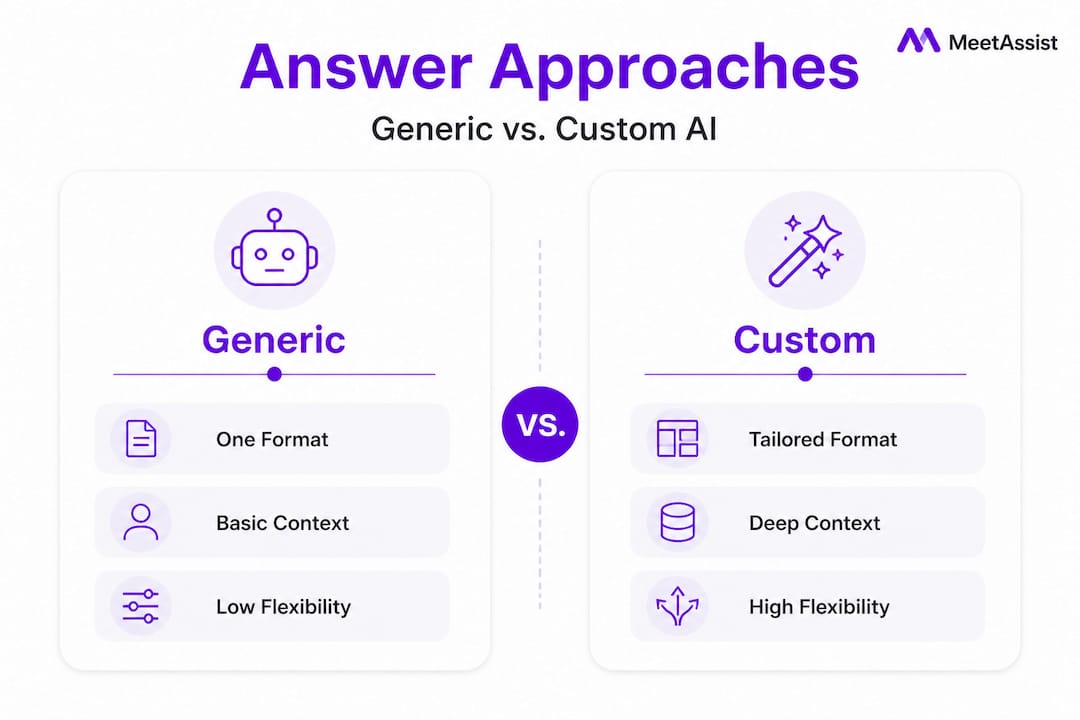
| Feature | Generic AI response | Custom AI answer style |
|---|---|---|
| Format | Paragraph prose | Bullets, STAR, code, narrative |
| Tone | Neutral | Matched to interviewer preference |
| Depth | Fixed | Adjustable on demand |
| Personalization | None | Resume-integrated, role-specific |
| Use case fit | General | Question-type specific |
If you want to go deeper on how AI answer suggestions work for job seekers beyond basic chatbot use, there’s a practical case for treating these tools as communication coaches rather than answer machines. The way AI formats in technology products are built increasingly mirrors what technical interviewers themselves expect from candidates.
Why does answer style affect interview outcomes?
Here’s the uncomfortable truth: most interviewers form an impression within the first 90 seconds of your answer. If your communication style doesn’t match what they’re mentally expecting, you lose credibility before you’ve finished your point.
“Tailored AI responses consistently show higher engagement and satisfaction in technology-driven environments, because they meet users where they are — not where the system finds it convenient.” Source: MeetAssist on personalizing interview answers
The evidence on this is clear. When you match your answer format to what the interviewer is looking for, you reduce cognitive friction. They don’t have to extract the key point from a paragraph. The structure does the work for them, and that earns you points for clarity even before they evaluate technical accuracy.
Here’s how the impact compounds step by step:
- Confidence increases. When you know your answer is formatted correctly, your delivery is steadier.
- Miscommunication drops. Structured answers reduce the chance of interviewers misunderstanding your intent.
- Follow-up questions improve. A well-organized answer invites deeper technical discussion rather than clarification questions.
- Interview ratings rise. Interviewers tend to score candidates higher when responses are easy to evaluate against the rubric.
The common failure mode is what we call the “one-size-fits-all” trap. Candidates rehearse one style of answer, usually the detailed, thorough explanation, and apply it universally. That approach tanks performance in fast-paced screenings where brevity is prized. Strong AI engagement strategies address this by building adaptability into the response layer itself.

Understanding customization for remote interviews adds another layer here. On video calls, visual cues are diminished, so the clarity of your verbal structure carries even more weight than it would in person.
Pro Tip: Before your next mock interview, identify what style the company likely favors by looking at their engineering blog, job description language, and any interview prep resources they share publicly. Fast-moving startups typically want crisp, opinionated answers. Large enterprise teams often want thorough, documented thinking.
Types of custom AI answer styles for technical interviews
Not every question deserves the same treatment. One of the biggest advantages of working with AI interview assistance is having access to multiple response modes that you can switch between based on what’s being asked.
Here’s a breakdown of the main styles and where they work best:
| Answer style | Best for | Avoid when |
|---|---|---|
| Succinct/summary | Initial screening, quick-fire rounds | Deep system design questions |
| In-depth explanation | Architecture discussions, whiteboard challenges | Behavioral or culture-fit questions |
| STAR method (scenario-based) | Behavioral questions, conflict examples | Pure technical or coding problems |
| Code-only | LeetCode-style challenges, syntax reviews | Communication-heavy discussions |
| Hybrid (narrative + code) | Full-stack problem walkthroughs | Time-limited rapid-fire questions |
Each style comes with real trade-offs:
- Succinct style is low-risk for pacing but may seem shallow if the question needs substance
- In-depth style shows expertise but can overwhelm interviewers who just want the headline
- STAR method works brilliantly for behavioral questions but can feel forced in technical contexts
- Code-only is precise but strips out the communication that many interviewers are explicitly assessing
- Hybrid is the most flexible but hardest to execute under pressure without practice
A practical use case: imagine a whiteboard challenge where you’re asked to design a rate-limiting system. A code-only response might solve the problem but miss the architectural reasoning the interviewer wants to evaluate. A hybrid response that explains your thinking, then shows pseudocode, earns marks in both categories.
Confident interview preparation always involves drilling these styles until switching between them feels natural. The best candidates don’t just know the answer. They know how to package it.
There are solid AI tools for technical interviews already helping candidates test their responses across different style profiles. The key is practicing output variation so you’re never locked into a single mode when the interview pressure hits.
Choosing and creating your best-fit AI answer style
Knowing the styles exists is step one. Knowing which one to use, and when, is where real interview performance is built. Here’s a step-by-step approach to picking your best fit:
-
Research the company and interviewer. Review their engineering blog, LinkedIn profiles, and job description carefully. Fast-growing startups often value brevity and strong opinions. Large companies may reward structured, comprehensive answers that show process-oriented thinking.
-
Identify the question category before answering. Behavioral? Technical? System design? This takes about two seconds but changes everything about format selection.
-
Pick a primary style, then adapt in real time. Start with your chosen style but listen for cues. If the interviewer interrupts with “can you give me more detail?” you shift deeper. If they say “got it, move on,” you tighten up.
-
Run mock interviews with each style. Don’t just read about them. Practice generating in-depth vs. concise responses to the same question. You’ll feel where each one breaks down under time pressure.
-
Iterate based on feedback. After every mock session, note which styles landed and which felt clunky. Adjust your default templates.
The latest work in AI-driven answer generation shows that candidates who actively configure their AI tools around personal communication strengths outperform those who treat AI as a static answer bank. The tool learns to match your voice, not replace it.
Pro Tip: Keep three ready-to-go templates saved for each interview type: one crisp, one thorough, one story-driven. When you’re nervous, you’ll thank yourself for having pre-tested formats to fall back on rather than improvising under pressure.
A critical mistake to avoid is over-customization. When you spend so much energy on formatting that the technical accuracy of your answer suffers, you’ve reversed the priority. The style serves the content, never the other way around.
Risks, privacy, and ethical considerations with custom AI interview answers
Using AI tools in interviews is powerful. It also comes with responsibilities that too many candidates ignore until something goes wrong.
The most important principle is authenticity. Custom AI answer styles should sharpen how you communicate what you actually know, not fabricate knowledge you don’t have. If your AI-assisted response claims deep experience with Kubernetes and you’ve never touched it, that lie surfaces the moment an interviewer probes further. The damage to your credibility is far worse than a knowledge gap would have been.
Here are the key ethical and privacy checkpoints to keep in mind:
- Use AI as a communication layer, not a knowledge layer. The content should reflect your real expertise, shaped into clearer form.
- Always do a human review. Read every AI-generated suggestion before using it. Catch factual errors, awkward phrasing, and anything that doesn’t sound like you.
- Check what data the tool collects. Some AI platforms store conversation data or audio. Always read the privacy policy before using any tool during a live interview.
- Don’t outsource your integrity. If an interviewer is assessing whether you can solve a problem, submitting a solution you didn’t understand is a breach of professional trust.
Detailed AI interview privacy insights highlight how custom response formats can create user data vulnerabilities in technical environments if the platform isn’t designed with security in mind. This is not a minor footnote. Audio data from interviews can include sensitive company information, personal background details, and proprietary technical discussions.
For a balanced view of AI interview ethics tips that covers both the practical and principled sides of using these tools, it’s worth reviewing what responsible use actually looks like at each stage of the interview process.
When evaluating any AI interview tool, look for: end-to-end encryption, a clear no-recording policy, local or on-device processing where possible, and transparent data retention terms.
The real advantage: Customization isn’t just for show
Here’s what most articles about AI interview tools miss entirely. Customization isn’t about impressing interviewers with a slick response format. It’s about understanding the human dynamics at the center of every interview and meeting them deliberately.
Every interviewer brings a mental model of what a great answer looks like. That model is shaped by their background, their team’s communication norms, the urgency of the role they’re filling, and how many interviews they’ve already sat through that week. When you customize your answer style, you’re not gaming the system. You’re doing the communicative work that strong professionals do naturally in every meeting, negotiation, and presentation.
The candidates who treat strategic answer customization as a superficial tool use it to generate polished-sounding answers they don’t fully understand. That approach collapses quickly under follow-up questions. The candidates who use it well treat it as a rehearsal system. They practice explaining the same technical concept in three different ways until the ideas feel like second nature regardless of the format.
The real competitive advantage isn’t having access to AI suggestions. It’s developing the habit of thinking in multiple communication registers and knowing which one the room needs. AI tools accelerate that development when used correctly. They slow it down when used as a shortcut.
If you’re preparing for technical interviews seriously in 2026, the question isn’t whether to use AI assistance. It’s whether you’re using it in a way that makes you genuinely better or just temporarily smoother.
Take your next technical interview to new heights with MeetAssist
If this article has you thinking about how to put custom answer styles into practice, MeetAssist is built exactly for that purpose.
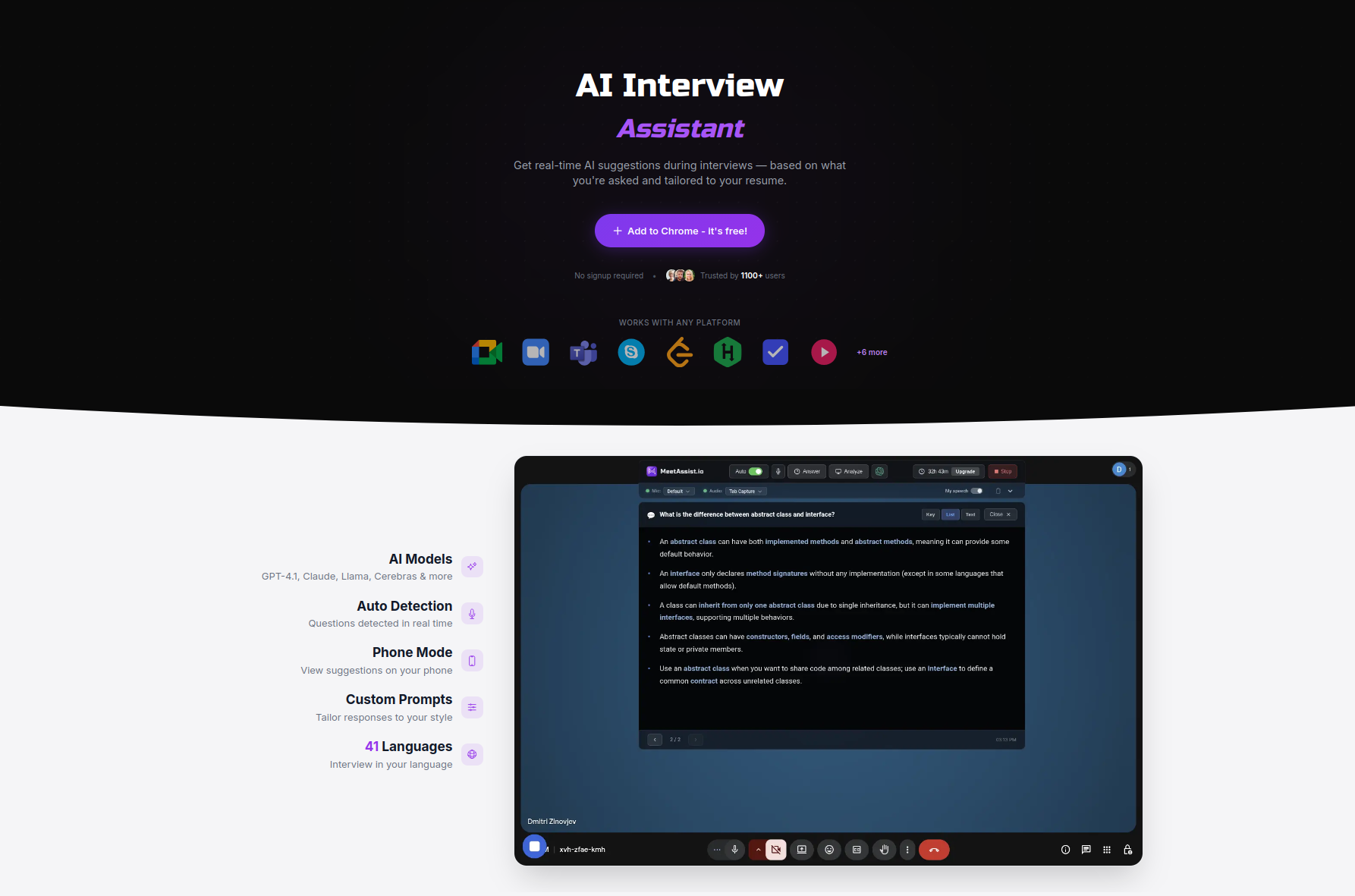
MeetAssist is a Chrome extension that listens to your interview in real time and generates AI-powered response suggestions tailored to the moment. You can switch between concise, detailed, STAR method, and bullet-point styles on the fly, across Google Meet, Zoom, Microsoft Teams, and any web-based platform. Upload your resume and the suggestions become personalized to your actual experience. In Phone Mode, everything moves to your device so nothing appears on screen. If you want to explore MeetAssist or compare top AI interview tools before committing, both options are available with no subscription required.
Frequently asked questions
How do I know which AI answer style fits the job I’m applying for?
Analyze the company culture, review interviewer profiles on LinkedIn, and test multiple answer styles during mock sessions to identify which one connects best with each role type.
Can using custom AI answers feel inauthentic to interviewers?
When you use answer templates as guides and layer in your own experience and voice, interviewers perceive you as both well-prepared and genuine rather than scripted.
Are there risks in using AI-powered tools for technical interview questions?
AI tools may create user privacy vulnerabilities or produce over-polished answers that don’t survive follow-up probing, so always review suggestions carefully and verify they reflect your actual knowledge.
What features should I look for in an AI AI interview assistant?
Prioritize tools that offer multiple configurable answer styles, strong privacy controls including no audio recording, resume personalization, and the ability to review all suggestions before use.
Can custom AI answer styles help with remote or asynchronous interviews?
Absolutely. For remote interview customization, matching your tone and structure to video, chat, or recorded formats noticeably improves how clearly your answers land when visual and body language cues are reduced.
Recommended
- Confident Interview Preparation Steps for Technical Success – MeetAssist | MeetAssist
- Customizable Interview Responses for Tech Success – MeetAssist | MeetAssist
- AI Interview Assistant Alternatives — Compare Top Tools (2026) | MeetAssist
- How to personalize interview answers for greater success | MeetAssist
- ApplyGenius Features – Build AI-Optimized Resumes