

TL;DR:
- AI is now embedded in 99% of Fortune 500 hiring workflows by 2026.
- AI-driven interviews significantly improve hiring quality and reduce human screening time.
- Bias in AI hiring tools presents risks, requiring regulation compliance and active fairness management.
By 2026, 99% of Fortune 500 companies use AI to filter applicants, and 40% rely on it for screening interviews. The efficiency gains are undeniable. But this rapid adoption has also triggered bias litigation against platforms like Workday and Eightfold AI, forcing HR leaders to reckon with both the promise and the peril of algorithmic hiring. If you manage recruiting at a tech company, you are standing at a crossroads where the wrong tool choice or the wrong process design can expose your organization to serious legal and reputational risk. This guide cuts through the noise and gives you the practical knowledge you need.
Table of Contents
- The rise of AI-driven hiring in tech
- AI interview platforms: Benefits and measurable impact
- Bias, fairness, and regulation: Navigating complex AI risks
- Practical strategies for ethical, effective AI hiring in 2026
- What most articles miss about AI in hiring
- See how MeetAssist can help optimize your AI hiring
- Frequently asked questions
Key Takeaways
| Point | Details |
|---|---|
| Efficiency gains | AI systems have reduced hiring cycles by up to 50%, saving recruiters significant time. |
| Bias risks | Despite benefits, AI hiring tools can introduce or amplify positional and gender bias if not managed carefully. |
| Regulatory challenges | New laws and audits require transparency and fairness in AI-driven recruitment. |
| Measurable impact | Structured AI interviews lift pass rates and increase candidate job-finding success. |
| Ethical strategies | Regular audits and human oversight are critical for ensuring fair, effective AI hiring. |
The rise of AI-driven hiring in tech
Having previewed the stakes, let’s break down how AI adoption has reshaped hiring in tech.
The speed of adoption is striking. Just a few years ago, AI in hiring meant a basic keyword filter on a resume. Today, AI systems conduct full screening interviews, analyze candidate responses, score technical assessments in real time, and generate ranked shortlists before a human recruiter even logs in. The technology has moved from a nice-to-have to the operational backbone of high-volume tech recruiting.
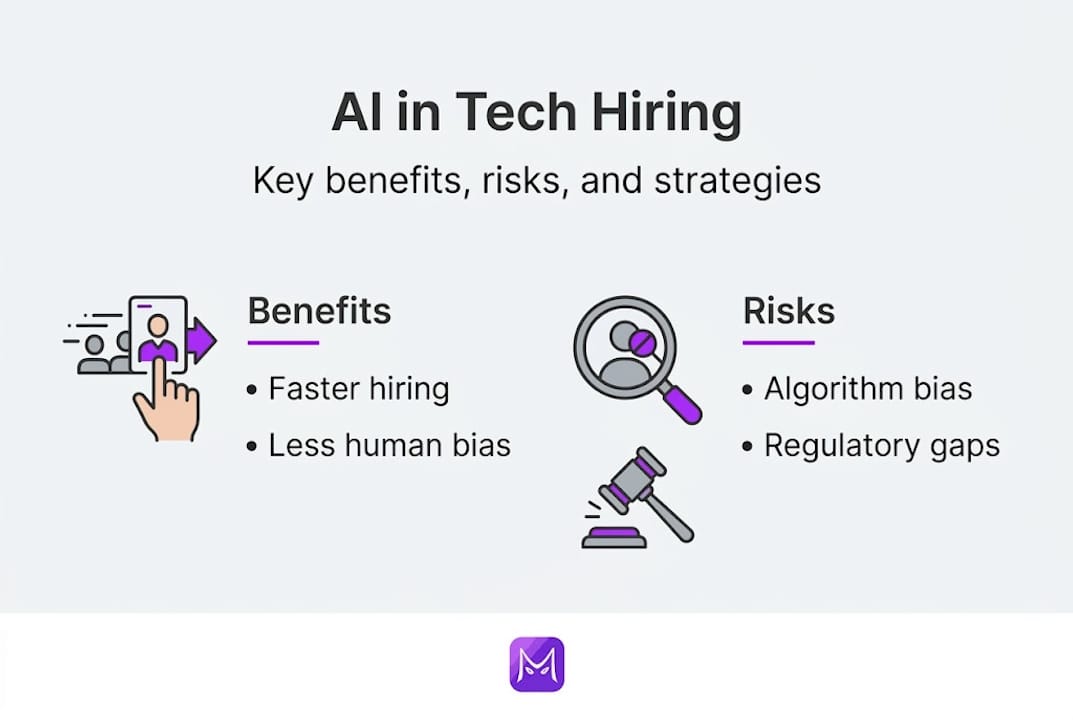
The data backs this up. AI recruiting tools cut hiring cycles by up to 50% in competitive industries, with 92% of firms reporting measurable benefits and recruiters saving a full workday per week. In a sector where top engineering talent can receive three competing offers within a week, speed is not just a convenience — it is a competitive advantage.
Here is what AI systems now routinely handle across the hiring funnel:
- Applicant filtering: Parsing thousands of resumes in seconds and ranking candidates by skill match
- Initial screening interviews: Conducting asynchronous or real-time AI-led conversations at scale
- Skills assessments: Automatically scoring coding challenges, technical quizzes, and simulation exercises
- Bias flagging (in theory): Some platforms claim to surface potentially inconsistent scoring patterns for human review
- Candidate communication: Automating interview scheduling, status updates, and rejection notices
Key stat: AI-based hiring tools are now embedded in 99% of Fortune 500 hiring workflows, making them the default infrastructure for large-scale tech recruitment in 2026.
Understanding these AI hiring trends in 2026 is essential before you choose a platform or design a workflow. Adoption without understanding is where legal exposure begins. The same AI tools that reduce time-to-hire also inherit the biases baked into their training data, and regulators are starting to take notice. Learning about AI tools and ethics early in your adoption process is not optional — it is damage prevention.
The tech industry’s particular reliance on AI hiring is driven by several factors. High applicant volumes for engineering roles, the precision needed to assess technical skills, and the speed required to compete for talent all push tech HR teams toward automation faster than any other sector. But moving fast without governance frameworks is exactly how companies end up in front of the EEOC.
AI interview platforms: Benefits and measurable impact
Now, let’s examine how AI interview platforms deliver real-world results across hiring stages.
The most compelling evidence for AI’s hiring impact comes from a large-scale controlled experiment. In a randomized field test with 37,000 applicants, AI-led structured video interviews improved the final human interview pass rate from 34% to 54% — a 20-percentage-point lift. Human interviews were reduced by 44%, and AI-selected candidates showed a 17-percentage-point higher job-finding rate after five months. These are not marginal improvements. They represent a fundamental shift in how well hiring decisions predict actual job success.

Here is a summary of those outcomes:
| Metric | Before AI | After AI | Change |
|---|---|---|---|
| Human interview pass rate | 34% | 54% | +20pp |
| Human interviews required | Baseline | Reduced | -44% |
| Candidate job-finding rate (5 months) | Baseline | Higher | +17pp |
These numbers matter because they challenge a common assumption: that AI screening simply filters faster without improving quality. The data shows it can genuinely improve the signal quality of your pipeline.
The practical benefits for your team break down across a few key areas:
- Time savings: Recruiters spend less time on phone screens and more on high-value final stages
- Consistency: Every candidate answers the same structured questions, making comparison far more reliable
- Volume capacity: A single AI platform can interview 500 candidates simultaneously, something no human team can match
- Data-driven shortlisting: Instead of gut feeling, you get scored transcripts and behavioral pattern analysis
Pro Tip: To maximize the efficiency gains from AI interviews, use structured question sets tied directly to role-specific competencies. Unstructured AI interviews still introduce inconsistency. The video interview success strategies that work for candidates also inform how you should design your evaluation criteria as a hiring manager.
The reduction in human interview burden is especially significant for scaling tech teams. When your engineering managers spend two days per week interviewing candidates who were poorly filtered, that is development capacity you are burning. AI pre-screening that cuts human interview volume by 44% returns meaningful engineering time back to the roadmap. And when you pair that with better prediction of job success, as the research shows, you get a stronger hire for less organizational cost. Exploring the broader AI interview automation impact helps you set realistic expectations before rollout.
Bias, fairness, and regulation: Navigating complex AI risks
But the efficiency comes with tradeoffs: let’s explore the crucial issue of bias and fairness.
Here is what surprises most HR leaders when they look carefully at the data. The bias picture is genuinely complicated — and not in the direction most people expect.
A field experiment involving more than 3,000 applicants found that asynchronous AI interviews caused a drop of over 50% in application continuation rates, with the largest dropoff among women. That is a serious pipeline problem. But the same study found that AI actually scored women and underrepresented minorities (URMs) higher than human evaluators did, and that AI scoring better predicted employment success. In other words, the barrier was not the AI’s judgment — it was the format itself deterring qualified candidates from completing the process.
Meanwhile, research on large language models (LLMs) reveals a different set of problems. LLMs favor first-listed candidates 63.5% of the time due to positional bias, and they show gender bias favoring female-named CVs across 70 professions. Adding a gender field or pronouns to a profile amplifies these preferences further.
Compare the two main bias profiles you need to plan for:
| Bias type | Source | Who is affected | Risk level |
|---|---|---|---|
| Positional bias | LLM resume ranking | Any candidate listed later | High |
| Gender bias (format) | Async interview format | Women, highly qualified candidates | High |
| Algorithmic scoring bias | Training data | URMs (varies by tool) | Medium-High |
| Human evaluator bias | Cognitive shortcuts | All underrepresented groups | High |
“AI scores women and underrepresented minorities higher than humans do and predicts their employment success better — yet asynchronous AI interview formats still cause over 50% of women to drop out before completion.” This gap between scoring quality and format experience is the central tension in AI hiring fairness today.
From a regulatory standpoint, the AI hiring ethics landscape is hardening fast. The EEOC has issued guidance making clear that employers are liable for discriminatory outcomes from AI tools, even if those tools are third-party products. New York City’s Automated Employment Decision Tool (AEDT) law requires bias audits. The NIST AI Risk Management Framework is becoming the reference standard for responsible deployment. These are not future concerns — they are current compliance requirements.
Here is the numbered list of regulatory frameworks you need to know right now:
- EEOC guidance: Employer liability applies to AI tool outcomes, not just intent
- NYC AEDT law: Annual bias audits required for automated hiring tools
- NIST AI RMF: Transparency and documentation standards for AI deployment
- EU AI Act: High-risk classification for employment-related AI, with audit trails required
The evolution of AI in hiring has moved faster than regulation, but the regulatory gap is closing. Companies that are not auditing their AI tools today are building liability they will pay for tomorrow.
Practical strategies for ethical, effective AI hiring in 2026
To address these risks and optimize outcomes, here are proven strategies for harnessing AI.
The research is clear: LLM positional and gender biases, asynchronous interview dropout effects, and inherited training data problems require active management, not passive trust. Regulations from EEOC, NYC AEDT, and NIST demand audits and transparency — and that means your HR team needs a structured approach, not just good intentions.
Start with your audit process. Every AI tool you use for hiring should go through a documented bias audit before deployment and at regular intervals after. This is not just a legal requirement in some jurisdictions — it is how you catch problems before they become lawsuits.
Here are the core practices for ethical AI hiring in 2026:
- Randomize candidate presentation order in any LLM-based resume review to neutralize positional bias
- Remove or anonymize gender identifiers in early-stage AI screening to reduce amplified preferences
- Use structured question sets that are validated for job relevance and applied consistently to every candidate
- Offer alternative interview formats so that candidates who find asynchronous AI interviews off-putting can still complete a fair assessment
- Document every AI-assisted decision with enough detail to explain your process to a regulator or in litigation
- Train your recruiting team to understand how algorithmic bias works, not just how to use the tools
Pro Tip: Build an internal AI hiring audit cadence — quarterly reviews of score distributions across gender, race, and age groups. Flag any statistically significant gaps for human review and tool recalibration. Automating interview feedback collection also creates the paper trail regulators increasingly expect.
Here is a practical numbered action plan for compliance and fairness:
- Inventory every AI tool currently used in your hiring process, including third-party applicant tracking systems
- Request bias audit reports from each vendor, covering gender, race, age, and disability status
- Implement structured interviews for all AI-assisted stages, with questions mapped to role competencies
- Anonymize demographic identifiers at the resume screening stage wherever technically possible
- Create a candidate appeal pathway so applicants can request human review of AI-generated decisions
- Train hiring managers on how to interpret AI scores without over-weighting them
One often overlooked risk is resume inflation. AI tools have been shown to uncover resume misrepresentation in about 21% of cases — which is valuable. But over-relying on those flags without human judgment creates its own fairness problems. Learning how to use AI in interviews for job success applies to your process design just as much as it applies to candidates preparing for your interviews.
The bottom line is that ethical AI hiring requires treating fairness as an engineering problem: measurable, testable, and continuously improved.
What most articles miss about AI in hiring
Most expert analysis of AI in hiring frames it as a binary choice: adopt AI for efficiency or resist it for fairness. That framing is too simple, and it misses the real tension that shapes outcomes on the ground.
The optimistic versus cautious divide in AI hiring is real — faster cycles, better predictions, and reduced human bias on one side; litigation risks, trust erosion, and an emerging AI arms race on the other. What experts rarely say is that both sides can be true simultaneously for the same tool.
Here is the uncomfortable reality: AI does not remove subjectivity from hiring — it just moves it upstream into the training data and tool design. When you outsource your screening to an AI vendor, you are inheriting the value judgments of whoever built that system. That is not inherently bad, but it is something you need to audit and own.
There is also a trust dynamic that efficiency metrics do not capture. Candidates who feel evaluated by a faceless algorithm, especially for the first human-facing role interaction, often disengage. The 50% dropout rate in async AI interviews is not just a bias statistic — it is a signal that your employer brand takes a hit every time a qualified person decides your process is not worth completing.
The practical wisdom here: use AI to do what humans genuinely cannot do well at scale — consistent scoring, fast processing, and pattern recognition across thousands of data points. Reserve human judgment for the signals that algorithms still miss — motivation, adaptability, and cultural fit. That blend is not a compromise. It is the only approach that holds up in 2026.
See how MeetAssist can help optimize your AI hiring
If you are rethinking your AI hiring stack and want tools that give candidates a fair, consistent, and transparent experience, MeetAssist is worth exploring. MeetAssist provides real-time AI assistance across Google Meet, Microsoft Teams, and Zoom — supporting structured, high-quality interview experiences that generate useful data for your team.
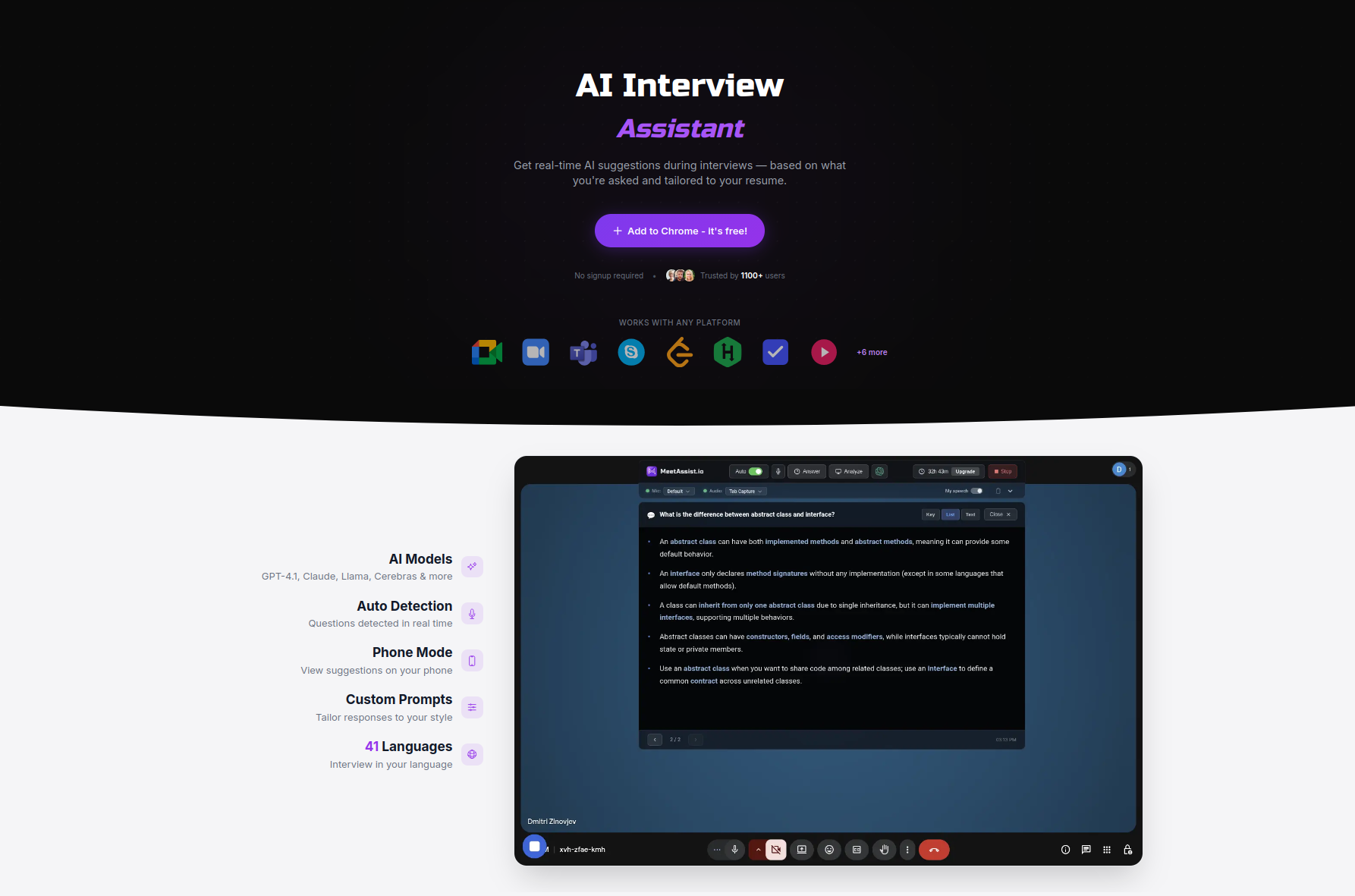
Whether you are building a more equitable screening process or looking to improve the quality of your technical assessments, the MeetAssist platform gives you flexible AI support with privacy built in. No recordings, encrypted data streams, and multiple AI models including GPT-4.1 and Claude. You can also explore AI interview assistant alternatives to compare tools and find the right fit for your hiring workflow. Your next hire deserves a smarter process.
Frequently asked questions
Can AI really reduce hiring time for tech roles?
AI recruiting tools shorten hiring cycles by up to 50% in competitive industries, saving recruiters roughly a full workday each week while handling high-volume screening at scale.
What is the biggest bias risk with AI hiring tools?
LLMs show strong positional bias — favoring the first-listed candidate 63.5% of the time — alongside gender bias toward female-named CVs, while asynchronous AI interview formats cause dropout rates exceeding 50%, especially among women.
How can HR minimize AI bias and stay compliant?
Regular bias audits, anonymized demographic data at screening stages, and structured question sets help — and these practices align with EEOC, AEDT, and NIST requirements that demand documentation and transparency from employers using automated hiring tools.
What measurable improvements has AI delivered in hiring?
In a 37,000-applicant field test, AI-led structured interviews improved human interview pass rates by 20 percentage points and left AI-selected candidates 17 percentage points more likely to find employment within five months.
Recommended
- Why use AI for Microsoft Teams: boost interview success | MeetAssist
- AI-driven assessment explained: Prep smarter for technical interviews | MeetAssist
- How to use AI in interviews for job success in 2026 | MeetAssist
- Technical Interview Automation: Real-Time AI Impact – MeetAssist | MeetAssist
Looking for help with your next interview? MeetAssist provides real-time AI assistance during your video interviews on Google Meet, Zoom, and Teams. Browse our interview preparation guides to get started.