
The landscape of job interviews has transformed dramatically with AI tools becoming commonplace, yet confusion reigns about what’s ethical assistance versus outright cheating. Recent data reveals that cheating adoption doubled from 15% to 35% within just six months, while 59% of hiring managers now suspect candidates use AI during interviews. This guide cuts through the noise to explain AI cheating tools, detection methods, legitimate preparation platforms, inherent biases in AI hiring systems, and practical strategies to succeed ethically in remote technical assessments without risking your reputation or career.
Table of Contents
- Key takeaways
- The rise of AI cheating tools in remote technical interviews
- Legitimate AI tools to ethically boost job interview performance
- Understanding AI biases and detection limits in interview assessments
- Strategies for ethical AI use and success in remote AI-assisted interviews
- Explore MeetAssist for ethical AI interview support
- FAQ
Key Takeaways
| Point | Details |
|---|---|
| AI cheating surge | Cheating tools have surged in popularity in remote interviews with adoption rising from 15 percent to 35 percent in six months and many hiring managers reporting suspicions. |
| Detection advances | Detection now uses behavioral forensics that analyze micro patterns in responses and signals such as eye movement, timing, system activity, and linguistic consistency. |
| Ethical prep tools | Ethical AI preparation platforms offer practice and feedback to build skills without deception, including mock interviews. |
| Hiring bias risk | Known biases in AI hiring tools warrant caution and a focus on fairness when evaluating automated assessments. |
The rise of AI cheating tools in remote technical interviews
AI cheating tools have exploded in popularity as remote interviews became standard practice. These platforms work through sophisticated overlay systems that transcribe interview audio in real time, feed questions to AI models like GPT-4, and display suggested answers on secondary devices or transparent browser overlays. Tools like Cluely and Interview Coder operate by capturing meeting audio, processing it through speech recognition, generating contextual responses, and presenting them invisibly to candidates during live conversations.
The adoption curve tells a striking story. Within a six-month period, cheating adoption doubled from 15% to 35%, with 59% of hiring managers reporting suspicions about AI use during candidate assessments. This rapid proliferation has forced employers to invest heavily in detection systems and rethink their interview formats entirely. The arms race between cheating tools and detection methods intensifies monthly.
Detection methods have evolved to counter these tools through behavioral forensics that analyze micro-patterns in candidate responses. Proctoring systems now track eye movement deviations, unusual response timing patterns, system activity monitoring, and linguistic consistency across answers. Advanced platforms like Polygraf detect Cluely with 98.7% accuracy in under 2 seconds by examining multiple signals simultaneously. Fabric’s detection system similarly employs multi-faceted behavioral analysis to identify unnatural response patterns.
The risks for candidates using these tools extend far beyond immediate detection:
- Permanent reputation damage in professional networks and industry circles
- Automatic disqualification from current and future opportunities with the same employer
- Legal consequences in jurisdictions where interview fraud carries penalties
- Inability to perform actual job duties after fraudulently obtaining positions
- Psychological stress from maintaining deception throughout the hiring process
As one security researcher noted, “The detection systems have become so sophisticated that candidates often don’t realize they’ve been flagged until weeks later when they receive rejection notices without explanation.” For those seeking legitimate remote interview assistance 2026 strategies, understanding these risks is essential. The Cluely AI cheating detection landscape continues evolving as employers refine their monitoring capabilities.
Legitimate AI tools to ethically boost AI interview assistant performance
Ethical AI preparation platforms offer powerful skill development without the detection risks or moral compromises of cheating tools. These systems focus on practice, feedback, and genuine capability building rather than live interview deception. Mock interview platforms like Huru.ai provide personalized feedback on communication style, technical accuracy, and behavioral response quality. The Huru.ai platform has earned a 4.8/5 rating from over 20,000 users who credit it with improving their interview confidence and performance.

Coding copilots represent another category of legitimate AI assistance for technical interview preparation guides. Tools like ShadeCoder help candidates practice algorithmic problems, understand solution patterns, and improve code quality in simulated environments. Research shows that ShadeCoder delivers high correctness in coding interview preparation scenarios when used for practice rather than live cheating. These platforms teach problem-solving approaches rather than providing direct answers during actual assessments.
| Platform | Primary use | Key features | Best for |
|---|---|---|---|
| Huru.ai | Mock behavioral interviews | Real-time feedback, question bank, performance analytics | Communication and STAR method practice |
| ShadeCoder | Coding practice | Algorithm hints, solution patterns, complexity analysis | Technical problem-solving skills |
| Interview Warmup | General prep | Voice recognition, answer analysis, common questions | Building confidence and fluency |
| Pramp | Peer practice | Live coding with peers, feedback exchange, scheduling | Realistic interview simulation |
Pro Tip: Combine AI feedback tools with in-person mock interviews to get both data-driven insights and human perspective on your performance. Record your practice sessions to identify verbal tics and pacing issues that AI might miss.
The sustainable advantage of ethical AI preparation lies in building genuine capabilities that translate to actual job performance. When you master technical concepts through AI-assisted practice, you develop authentic confidence that shows in interviews. Your responses become naturally fluent rather than artificially constructed. You can handle follow-up questions and adaptive scenarios that would expose someone relying on live cheating tools.
These platforms integrate seamlessly with comprehensive using AI in interviews strategies that emphasize skill mastery over shortcuts. For structured preparation timelines, explore AI interview prep 2026 approaches that balance technology with human judgment. The AI interview prep blueprint provides additional frameworks for ethical AI integration into your preparation routine.
Understanding AI biases and detection limits in interview assessments
AI hiring tools carry inherent biases that affect candidate evaluation fairness, even as employers adopt them for efficiency. Research reveals multiple bias categories in AI assessment systems. Positional bias favors candidates whose information appears first in evaluation sequences. Gender bias emerges in language processing models that associate certain communication styles with competence. Racial bias manifests through training data that reflects historical hiring discrimination patterns.
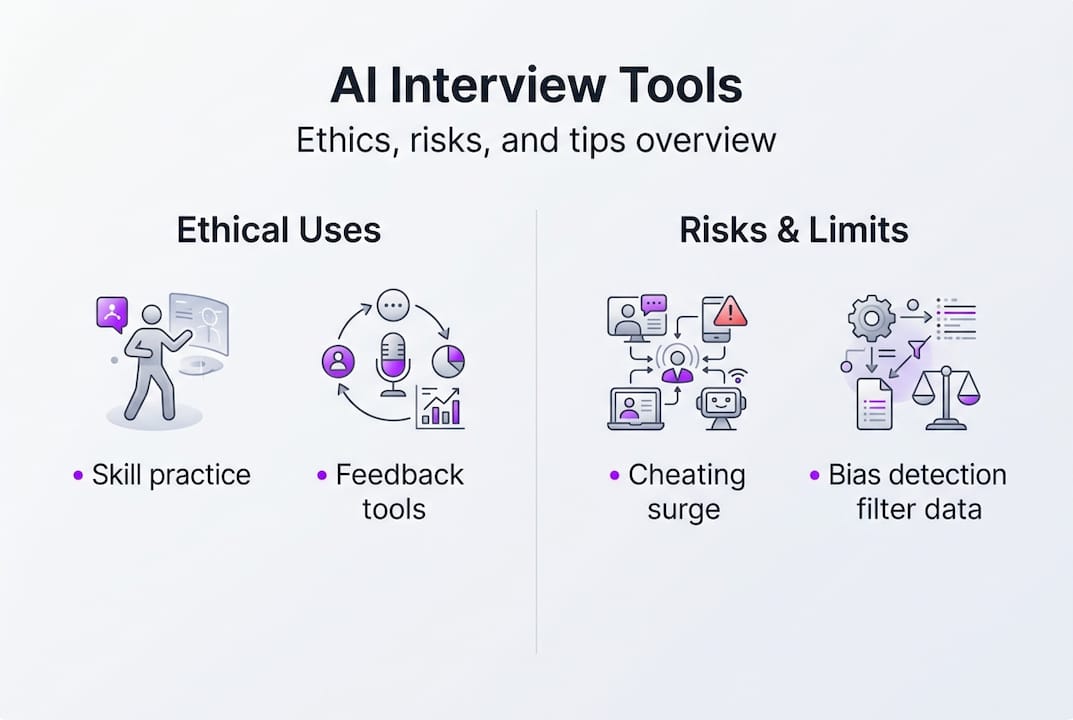
Empirical studies challenge assumptions about AI assistance effectiveness. One comprehensive analysis found that ChatGPT did not improve virtual multiple mini interview outcomes, with candidates using AI assistance performing no better than control groups. The study examined gender and positional biases across AI hiring tools, revealing systematic evaluation inconsistencies. These findings suggest that even when candidates use AI tools, the performance benefits may be minimal or nonexistent in structured interview formats.
Detection systems themselves face reliability challenges that create false positive risks:
- Eye movement tracking can flag candidates with vision differences or neurodivergent traits as suspicious
- Response timing analysis penalizes thoughtful pauses that indicate genuine reflection
- System monitoring generates alerts for legitimate multitasking like referencing notes
- Linguistic analysis may misidentify candidates with strong vocabulary as using AI assistance
- Behavioral baselines fail to account for cultural communication style differences
These detection false positives and proctoring reliability shortcomings create ethical dilemmas for employers and anxiety for honest candidates. A candidate who naturally speaks in polished, structured sentences might trigger cheating alerts despite genuine ability. Someone with ADHD might exhibit eye movement patterns that resemble screen-checking behavior. The technology remains imperfect despite high accuracy claims.
As one AI ethics researcher explained, “The rush to deploy detection systems has outpaced our understanding of their disparate impact on different candidate populations. We’re essentially creating a new form of algorithmic bias while trying to prevent cheating.” Understanding technical interview automation impact helps candidates navigate these complex systems more effectively. The AI hiring bias study from MIT provides deeper analysis of systematic fairness issues in automated recruitment.
Candidates should approach AI hiring tools with realistic expectations about both capabilities and limitations. These systems will continue improving, but current implementations carry significant fairness concerns that responsible employers must address through regular auditing and human oversight.
Strategies for ethical AI use and success in remote AI-assisted interviews
Successful candidates balance AI preparation tools with human skills that technology cannot replicate. Start by incorporating AI ethically into your preparation routine through these strategic steps:
- Use mock interview platforms weekly to build response fluency and identify weak areas in your technical knowledge
- Practice coding problems with AI copilots to understand solution patterns, then solve similar problems independently to verify mastery
- Record yourself answering behavioral questions and compare your responses to AI-generated examples to improve structure
- Create a personal knowledge base of technical concepts explained in your own words rather than memorizing AI-generated answers
- Schedule peer practice sessions to develop conversational adaptability that rigid AI responses lack
Adaptive questioning represents the critical skill that separates prepared candidates from those relying on shortcuts. Interviewers increasingly use follow-up questions that probe deeper than surface-level answers. They ask you to explain your reasoning process, defend alternative approaches, or apply concepts to novel scenarios. These adaptive techniques expose candidates using live AI assistance because the tools cannot anticipate context-specific follow-ups or maintain conversational coherence across multiple exchanges.
Mastering live conversation skills requires practice in ambiguous, unstructured scenarios. Role-play interviews where the interviewer deliberately asks vague questions or interrupts your responses. Practice thinking aloud through problems rather than jumping to polished answers. Develop comfort with saying “I’m not sure, but here’s how I’d approach figuring it out” instead of fabricating knowledge. These authentic communication patterns build interviewer trust more effectively than perfectly crafted responses.
Pro Tip: Record a practice interview where you deliberately pause, self-correct, and think through problems aloud. This natural imperfection often signals genuine expertise more convincingly than flawless, AI-polished responses that raise suspicion.
Tech tools can enhance integrity rather than undermine it when implemented thoughtfully. Full-screen sharing during technical assessments demonstrates transparency while allowing you to showcase your actual problem-solving process. Hybrid proctoring systems that combine automated monitoring with human review reduce false positive rates while maintaining security. Candidates who proactively suggest these measures signal confidence in their authentic abilities.
Research confirms that candidates benefit most by focusing on adaptive conversational skills and ethical AI prep rather than cheating tools. The sustainable career advantage comes from genuine capability development. For comprehensive preparation frameworks, review confident interview preparation steps that integrate AI tools appropriately. Behavioral interview success particularly depends on authentic storytelling, which soft skills interview tips 2026 addresses in detail.
Your interview preparation checklist should include AI tools as skill builders, not crutches. Practice until your knowledge becomes internalized and accessible without technological assistance. This approach eliminates detection anxiety and positions you for actual job success after hiring.
Explore MeetAssist for ethical AI interview support
Navigating the complex landscape of AI interview assistance requires tools designed specifically for ethical skill development. MeetAssist provides real-time AI support during practice sessions and legitimate interview scenarios where transparency is maintained. The platform integrates with Google Meet, Microsoft Teams, and other web-based meeting platforms to deliver contextual assistance without the detection risks associated with cheating tools.
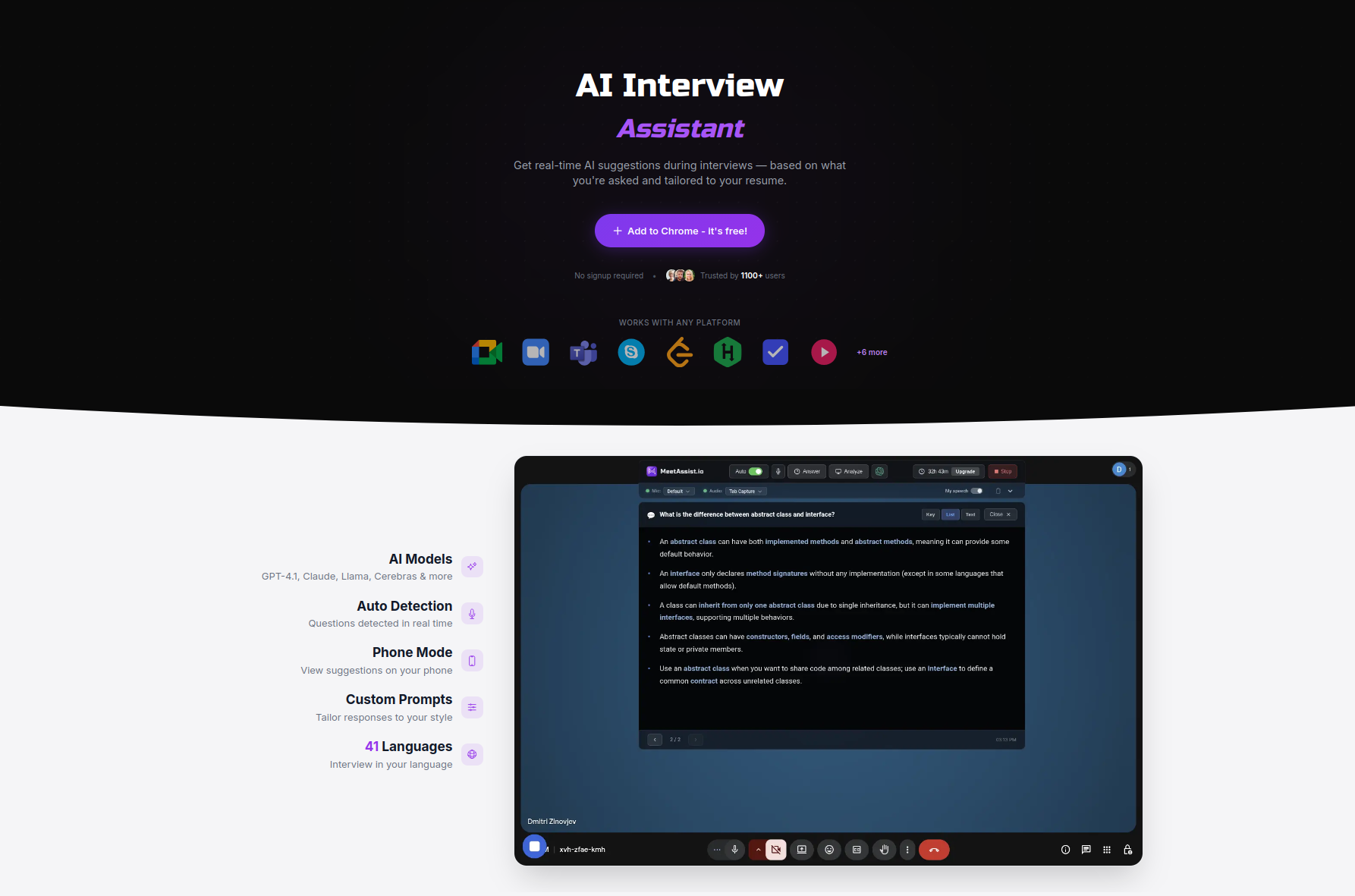
The system supports multiple AI models including GPT-4.1, Claude, Llama and Cerebras, with customizable answer styles that help you learn different response frameworks. You can upload your resume for personalized suggestions that align with your actual experience. Phone Mode removes the extension from your computer screen entirely, syncing all transcripts and AI suggestions to your phone after scanning a QR code. This design prioritizes privacy with encrypted data streams and no audio or video recording.
Comparing AI interview assistant alternatives helps you understand which tools match your preparation needs and ethical boundaries. For Google Meet users specifically, the AI interview assistant in Google Meet guide provides step-by-step setup instructions. MeetAssist’s one-time purchase pricing eliminates subscription concerns while giving you ongoing access to skill-building features that complement your organic interview abilities.
FAQ
What is AI cheating in job interviews?
AI cheating involves using unauthorized tools during live interviews to obtain answers without the interviewer’s knowledge. These systems typically transcribe questions in real time, generate responses through AI models, and display suggestions on hidden screens or overlays. Legitimate AI assistance, by contrast, focuses exclusively on preparation and practice scenarios where no deception occurs.
Can AI cheating tools guarantee better interview results?
Empirical research shows AI cheating tools do not assure higher scores or success rates. Studies found that ChatGPT did not improve virtual multiple mini interview outcomes, with AI-assisted candidates performing no better than control groups. Detection risks and ethical consequences typically outweigh any marginal advantages these tools might provide.
How can I ethically use AI to prepare for technical interviews?
Use AI-powered mock interview platforms to receive structured feedback on your communication and technical responses. Practice coding problems with copilots like ShadeCoder in off-interview scenarios to understand solution patterns and improve your algorithmic thinking. Avoid live cheating tools entirely to maintain professional integrity and build genuine capabilities. For detailed guidance, explore ethical AI interview use strategies.
What detection methods do employers use to spot AI cheating?
Employers deploy multi-signal detection systems that analyze eye movement patterns, response timing consistency, system activity monitoring, and linguistic coherence across answers. Advanced platforms like Polygraf achieve 98.7% accuracy by examining behavioral forensics, proctoring signals, plagiarism detection, and adaptive questioning simultaneously. These comprehensive methods identify AI cheating rapidly, often within seconds of suspicious behavior.
Recommended
- How to use AI in interviews for job success in 2026 | MeetAssist
- AI for Google Meet: boost your interview game in 2026 – MeetAssist | MeetAssist
- AI-powered interview guidance: confidence boost for 2026 – MeetAssist | MeetAssist
- AI interview assistance: boost job success in 2026 – MeetAssist | MeetAssist