

TL;DR:
- Phone-based AI interview tools provide real-time, personalized suggestions while protecting user privacy.
- Many apps process data locally or use encryption, minimizing risks of data leaks during interviews.
- These tools assist with technical questions by offering structured frameworks, but ethical use emphasizes preparation over dependence.
Picture this: you’re three minutes into a technical interview, the interviewer has just asked you to walk through a distributed system design you’ve never implemented, and your mind goes completely blank. This scenario plays out for thousands of candidates every week, and it’s exactly why phone-based AI interview tools have exploded in popularity. These tools let you receive real-time, personalized suggestions without anything appearing on your computer screen. This article covers why they matter, how they protect your privacy, what they can and can’t do for technical questions, and how to use them without crossing ethical lines.
Table of Contents
- Why phone-based AI interview tools matter
- Privacy features: How secure are phone-based tools?
- AI-powered support for technical questions
- Comparing top phone-based interview tools
- Risks, detection, and ethical considerations
- A smarter way to balance interview support and privacy
- Ready to try phone-based AI for interviews?
- Frequently asked questions
Key Takeaways
| Point | Details |
|---|---|
| Real-time tailored support | Phone-based AI tools offer instant interview help tailored to your needs with minimal setup. |
| Privacy-first design | Many apps keep your data secure locally or through encryption and clear privacy policies. |
| Technical and behavioral focus | Advanced tools handle coding, system design, and structured behavioral frameworks like STAR. |
| Risks and ethical use | Understand potential detection, employer reactions, and use AI as a supplement—not a cheat. |
| Smart preparation strategy | Combine AI copilots with personal mastery for best results and true confidence in interviews. |
Why phone-based AI interview tools matter
The modern AI interview assistant is a high-stakes performance under time pressure. You’re expected to recall frameworks, articulate structured answers, and debug logic on the fly, all while projecting calm confidence. That’s a lot to ask. Phone-based AI tools change the equation by sitting quietly in your pocket or on your desk, listening through your phone mic and generating instant suggestions you can glance at without the interviewer ever seeing a second screen.
The benefits of mobile AI interview tools go well beyond simple cheat-sheet access. These tools actively adapt to the conversation. When the interviewer shifts from behavioral questions to a live coding challenge, the AI shifts with them, offering relevant frameworks or sample approaches rather than generic filler. That responsiveness is what separates a modern phone-based copilot from a printed notes page.
Here’s what candidates consistently report as the biggest wins:
- Real-time answer structure. Instead of rambling, you see a clear bullet outline the moment a question lands.
- Reduced cognitive load. Knowing support is available lowers anxiety, which frees up working memory for actual problem-solving.
- Seamless prep-to-live transition. The same tool you practiced with the night before works identically during the real interview.
- Voice-only operation. No keyboard clicks, no mouse movement, nothing that signals tool usage to the interviewer.
Real-time copilots like Interview Pilot and Interview Hammer provide instant, tailored answer suggestions during live interviews by listening to questions via phone mic and processing locally or with encrypted data transfer. That local processing piece is critical and leads directly into the privacy conversation.
“The best interview support is the kind that calms you down enough to let your own knowledge surface. Real-time structure is a confidence tool as much as an information tool.”
Pro Tip: Prioritize tools that offer local or on-device processing. If your answer suggestions never leave your phone, there’s no server log to worry about and no third party holding your interview data.
Privacy features: How secure are phone-based tools?
Privacy is not a secondary concern for technical candidates. You’re often discussing proprietary projects, internal systems you’ve worked on, or confidential employer information during interviews. A tool that ships all of that to a remote server raises legitimate red flags.
The good news is that the better phone-based tools have taken this seriously. Many apps process data locally on the device or use encrypted iCloud sync, with some stating explicit no-data-collection policies, making them suitable for technical candidates who are especially concerned about data leaks. That’s a meaningful distinction. Local processing means the audio captured by your phone mic is transcribed and analyzed entirely on the device, with nothing sent to an external server unless you explicitly choose cloud features.
Even when cloud sync is involved, local processing minimizes cloud risks significantly. The key is that users must verify app policies themselves. Stealth mode, which makes the tool invisible during video or phone calls, is also undetectable when used discreetly. Reading privacy policies sounds tedious, but for a tool that’s actively listening during a sensitive professional conversation, it’s a non-negotiable step.
Here’s a practical privacy checklist before you enable any AI AI interview assistant:
- Check data storage policy. Does the app explicitly state it does not store audio or transcripts?
- Verify encryption. Look for end-to-end or AES-256 encryption on any data that does leave the device.
- Test stealth mode offline. Run a mock interview on video with your camera on and confirm nothing is visible on your computer screen.
- Review permissions. The app should only need microphone access. Camera access or contacts permissions are red flags.
- Look for transparency reports. More established tools publish their data handling practices publicly.
You can learn more about how interview tools handle privacy as well as privacy best practices for interviews specifically in remote settings, where camera angles and screen sharing create additional exposure points.
“Privacy in interview tools isn’t just about legality—it’s about protecting your professional reputation and the confidentiality of your work history.”
Pro Tip: Always run a dry run of your privacy setup 24 hours before the actual interview. Check that stealth mode is working, confirm your phone is charged and positioned correctly, and practice glancing at suggestions without breaking eye contact on your webcam.
AI-powered support for technical questions
Behavioral questions are one thing. System design, live coding, and algorithm challenges are another. This is where phone-based AI tools have to earn their place, and the better ones genuinely do.

Tools provide field-specific responses for coding, system design, and algorithms, with edge case handling and STAR method feedback that directly improves how candidates articulate their problem-solving process. That last part matters enormously. Interviewers are not just grading your solution; they’re evaluating whether you can communicate your thinking clearly under pressure.
The STAR method (Situation, Task, Action, Result) gets a lot of attention for behavioral questions, but it’s equally powerful when explaining technical decisions. When asked why you chose a particular database architecture, structuring your answer as a mini-STAR response, describing the situation’s constraints, the task requirements, the action you took, and the measurable result, makes you sound significantly more prepared than a candidate who just lists technical features.
Understanding AI’s impact on technical interviews helps contextualize how these tools fit into the broader hiring landscape. Separately, preparing for coding interviews requires a structured approach that AI tools can accelerate dramatically.
Here’s a quick reference for how AI tools respond to different technical challenge types:
| Challenge type | What AI assistance provides | Best answer format |
|---|---|---|
| Algorithm design | Time/space complexity hints, pattern recognition | Bullet steps with code outline |
| System design | Component breakdown, scalability notes | Structured diagram description |
| Behavioral question | STAR framework scaffold | Narrative with clear outcome |
| Debugging live code | Edge case flags, common error patterns | Step-by-step walkthrough |
| SQL/data queries | Syntax reminders, join logic | Query structure with explanation |
The role of AI chatbots in technical fields has expanded rapidly, and interview support is now one of the most practical consumer applications of that technology. Knowing smart AI tools for coding interviews and how to apply them strategically is quickly becoming a competitive skill in its own right.
Comparing top phone-based interview tools
Not all tools are created equal. Here’s how the leading options stack up across the dimensions that matter most to technical candidates.
Interview Pilot and Hammer process questions via phone mic with instant feedback, and many highlight privacy and encryption features as core selling points rather than afterthoughts. But the details vary significantly between apps.
| Tool | Privacy model | Technical depth | Stealth mode | Unique strength |
|---|---|---|---|---|
| Interview Pilot | Local processing, encrypted sync | High (coding, system design) | Yes | Resume-personalized answers |
| Interview Hammer | Encrypted cloud | Medium-high | Yes | Speed of response |
| MeetAssist Phone Mode | No audio recorded, encrypted stream | Very high (multi-model AI) | Complete (invisible on screen) | Remote tab capture, QR sync |
| Mock Interview Prep AI | On-device, no data collection | Medium | Partial | Behavioral practice focus |
For a full AI tool comparison for interviews, the criteria above should be your starting framework. Privacy model, technical depth, and stealth reliability matter more than flashy feature lists.
Here’s how to match a tool to your specific situation:
- Identify your weakest interview type. If behavioral questions trip you up, prioritize tools with strong STAR scaffolding. If technical depth is your gap, look for tools trained on coding and design patterns.
- Assess your privacy tolerance. If you’re interviewing at a security-sensitive company or discussing confidential work, local-only processing is non-negotiable.
- Test stealth mode rigorously. Set up a mock video call with a friend and confirm that no AI interface is visible on your shared screen or camera feed.
- Check response speed. A suggestion that arrives five seconds after the question is more useful than one that arrives twenty seconds later after you’ve already started rambling.
- Look at top phone interview app alternatives side by side before committing to any one tool.
Risks, detection, and ethical considerations
Using AI assistance during interviews is not without risk, and pretending otherwise does a disservice to candidates who deserve honest guidance. The conversation around detection and ethics is more nuanced than most articles acknowledge.
Common detection signals include:
- Unnatural pauses. Waiting for AI suggestions before responding looks hesitant or evasive.
- Generic phrasing. AI-generated answers often lack the specific anecdotes and personal details that make responses feel genuine.
- Eye movement patterns. Consistently looking down or to the side while answering can signal reading from another source.
- Inconsistent depth. Strong answers to easy questions but thin answers to follow-ups suggests scripted responses rather than real knowledge.
The AI ethics and interview detection debate is evolving quickly. Some employers now explicitly state in job postings that AI assistance during interviews is prohibited. Others view it the same way they view thorough preparation: an advantage that demonstrates initiative. Knowing where each employer stands is part of your pre-interview research.
The practical guidance here is straightforward. Use AI usage tips for job interviews to supplement your real knowledge, not to replace it. If you can’t explain an answer in your own words without the tool, you’ll struggle in the follow-up questions that always come from experienced interviewers.
“The ethical sweet spot is using AI the way athletes use film study: as a preparation tool that sharpens your own performance, not a performance-enhancing drug you depend on during competition.”
A smarter way to balance interview support and privacy
Here’s a perspective that most guides miss: the candidates who benefit most from phone-based AI tools are not the ones who know the least. They’re the ones who know their material well and use the tool as a confidence anchor rather than a knowledge source.
Think about it from a detection standpoint. When you already know the answer and the AI confirms your instinct, you respond immediately and naturally. When you don’t know the answer and you’re waiting for the AI to tell you what to say, you pause, your phrasing sounds unfamiliar, and experienced interviewers notice. The tool amplifies your strengths. It doesn’t patch over genuine knowledge gaps in real time without detection.
The real advanced interview prep tactic is to use mock interviews with the tool running and then practice giving the same answers without looking at the suggestions. If you can do both equally well, you’ve actually learned the material. The AI was a training wheel that you’ve now outgrown, and during the real interview, you only need to glance at it occasionally for structure, not substance.
Most candidates also significantly overestimate how much technical scrutiny their interviewer is applying to detect AI use. Interviewers are primarily evaluating whether you’d be good at the job. A candidate who gives clear, structured, thoughtful answers looks prepared, not suspicious. The ethical obligation is to yourself: don’t use AI assistance to land a role you’re genuinely not ready for, because the job itself will expose that gap within weeks.
Practice stealth use in at least three full mock interviews before going live. Get comfortable with the glance, the quick read, and the natural pivot back to eye contact. When that motion becomes automatic, detection risk drops to near zero and your confidence in the tool becomes an asset rather than a liability.
Ready to try phone-based AI for interviews?
If you’ve been weighing your options, MeetAssist offers one of the most privacy-focused implementations available. Phone Mode removes the extension from your computer screen entirely after a simple QR code scan, leaving zero visible traces while delivering real-time AI suggestions, live transcripts, and even remote tab capture for coding challenges.
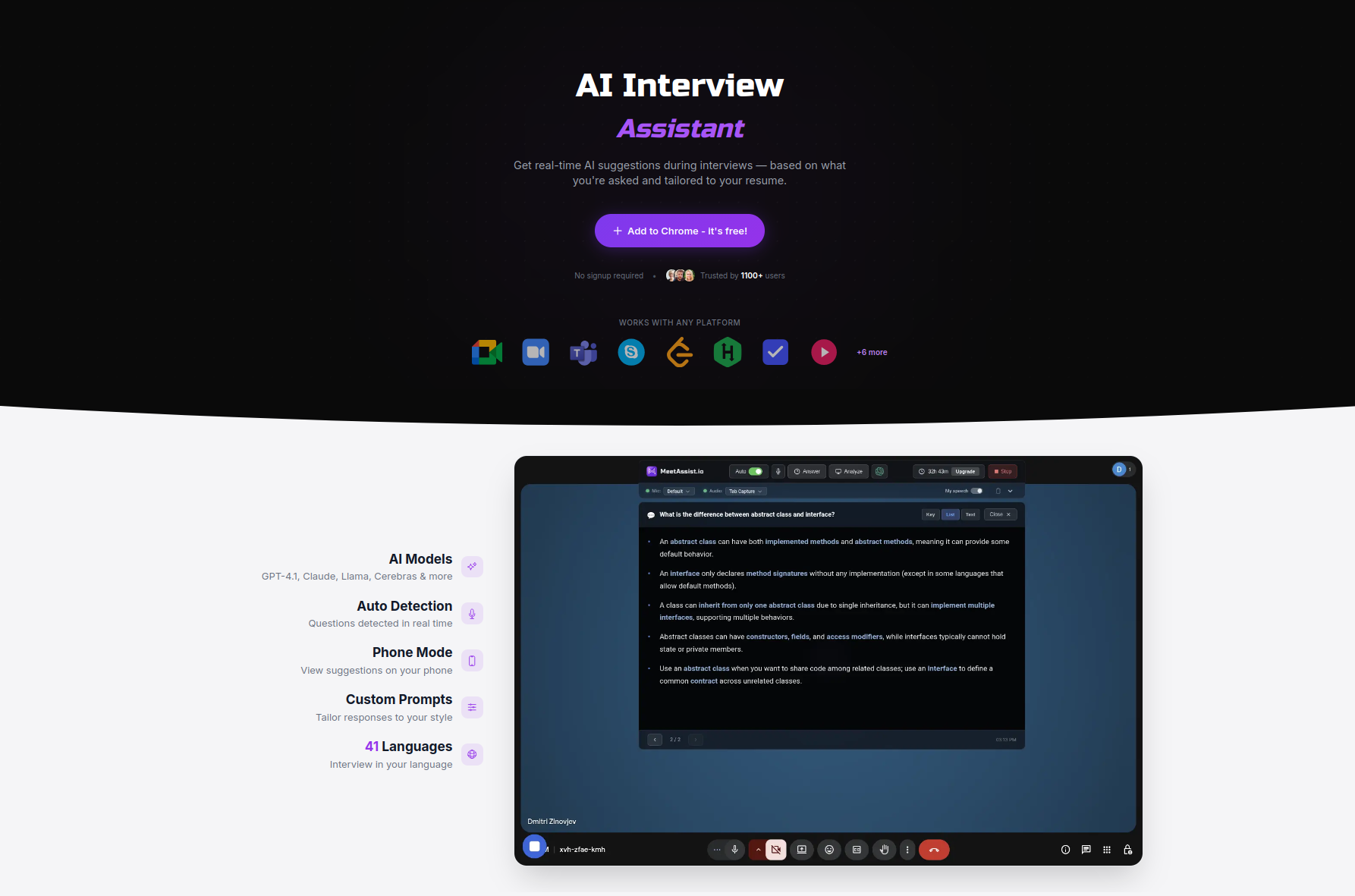
You can compare interview tool alternatives to see exactly how MeetAssist stacks up against other phone-based copilots on privacy, technical depth, and stealth reliability. When you’re ready to go deeper, the guide on how MeetAssist Phone Mode works walks you through setup, QR sync, and how to capture and analyze any active tab from your phone during a live coding assessment. No subscriptions, no audio recordings, and nothing visible on your screen.
Frequently asked questions
How do phone-based interview tools work during live interviews?
These apps listen to interview questions through your phone mic and provide instant, tailored suggestions in real time, with processing done locally or encrypted so responses reach you within seconds.
Are phone-based interview tools safe for privacy-conscious users?
Yes, many process data locally on device and use encrypted sync, but you should always read each app’s privacy policy before enabling microphone access during sensitive interviews.
Can employers detect if I’m using a phone-based AI copilot?
Detection is possible when candidates pause noticeably or give generic responses, so the safest approach is to practice with the tool until your answers sound entirely natural and personal.
What technical topics do these tools handle best?
They excel at coding, system design, and algorithms, along with behavioral questions structured around the STAR method, giving candidates both technical frameworks and narrative scaffolding in real time.