
Many candidates hear the phrase “AI answer suggestions” and immediately picture a robot whispering perfect answers into their ear, giving them an unfair edge over everyone else in the hiring pool. The reality is far more nuanced. These tools function more like a structured thinking partner than a cheat sheet, helping you organize your thoughts under pressure rather than replacing them entirely. This guide breaks down exactly what AI answer suggestions are, how they work in real interviews, where the ethical lines sit, and how you can use them to genuinely improve your performance without compromising your integrity.
Table of Contents
- Defining AI answer suggestions in interviews
- How AI answer suggestions work: Step by step
- Ethical boundaries and guidelines for AI-assisted interviews
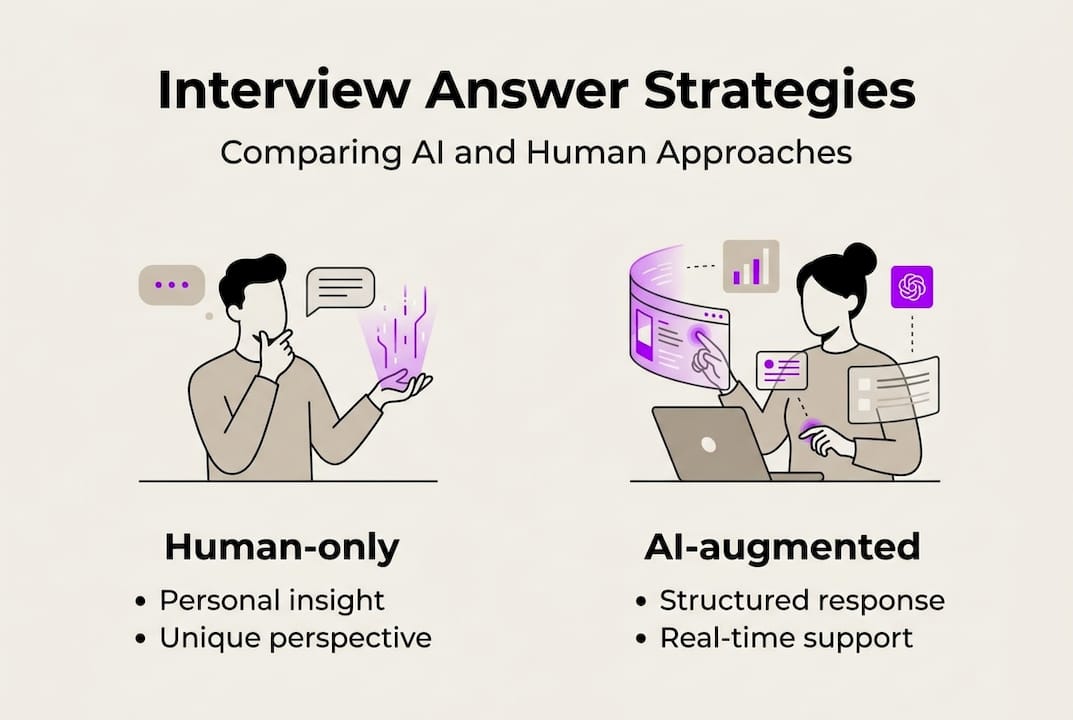
- Comparison: Human-only vs. AI-augmented answer strategies
- Best practices: Using AI answer suggestions to your advantage
- Explore top AI interview assistant tools with MeetAssist
- Frequently asked questions
Key Takeaways
| Point | Details |
|---|---|
| Structured real-time help | AI answer suggestions offer instant frameworks for responding fluently in interviews. |
| Ethics and transparency matter | Always follow official guidelines and clarify your use of AI during interviews. |
| Enhance, don’t replace, reasoning | Use AI suggestions as support but explain and validate your answers for top evaluation results. |
| Preparation is key | Practice building strong AI prompts and adapting answers for every interview context. |
Defining AI answer suggestions in interviews
Let’s clear up the confusion right away. AI answer suggestions are real-time prompts or scaffolds that help candidates structure responses, often using frameworks like STAR or technical step guides. They are not autocomplete tools that type out full answers for you to read verbatim. They are structured support systems that detect what kind of question you are facing and generate a response framework tailored to that context.
Here is what these tools actually do during a live interview:
- Detect question type by analyzing spoken or written input in real time
- Apply relevant frameworks such as STAR for behavioral questions or step-by-step breakdowns for technical problems
- Generate scaffolds that give you a starting structure, not a finished script
- Adapt to your field by recognizing job-specific terminology and context
“AI answer suggestions are real-time prompts or scaffolds that help candidates structure responses, often using frameworks like STAR or technical step guides.” This distinction matters because it shifts the tool from a crutch to a cognitive aid.
Understanding AI in job interviews means recognizing that these tools amplify your thinking rather than replace it. The best candidates use them to stay organized when nerves kick in, not to outsource their reasoning. Exploring AI interview assistance options can help you find the right fit for your specific interview format.
How AI answer suggestions work: Step by step
Now that you know what AI answer suggestions are, let’s look at exactly how these systems operate during live interviews. The process is faster than most people expect.
- Audio or text input is captured from the live conversation or assessment platform
- Natural language processing identifies the question type, intent, and relevant domain
- A framework is selected based on the question category (behavioral, technical, situational)
- A structured scaffold is generated and displayed to the candidate in real time
- The candidate adapts the scaffold using their own experience and knowledge
Real-time AI-powered answer apps claim instant, field-specific answer suggestions by listening to live conversations and generating expert responses. The latency on modern systems is low enough that suggestions appear before you have finished processing the question yourself.
Here is how the workflow differs across question types:
| Question type | Framework applied | Typical latency | Output format |
|---|---|---|---|
| Behavioral | STAR method | Under 3 seconds | Structured bullet scaffold |
| Technical coding | Step-by-step breakdown | Under 5 seconds | Pseudocode outline |
| Situational | Problem-solution-result | Under 3 seconds | Narrative scaffold |
| System design | Component-by-component | Under 5 seconds | Diagram prompt list |
The immediate response scaffolds generated by these tools are especially valuable during remote interview assistance scenarios where you may not have a whiteboard or a colleague to think out loud with.

Pro Tip: Use AI suggestions to structure your answer, not script it. Always replace the placeholder language in the scaffold with your own specific examples and experiences. Interviewers notice when answers sound templated.
Ethical boundaries and guidelines for AI-assisted interviews
While the technology is powerful, using AI answer suggestions requires a clear understanding of evolving guidelines and ethical standards. Not every platform allows them, and the rules are changing fast.
AI interview ethical guidelines from platforms like HackerRank require clear policies on AI tool usage, AI-integrated assessment rules, and monitoring of candidate interaction with AI. Ignoring these policies is not just an ethical issue. It can get your application disqualified entirely.
Here is a practical checklist for staying on the right side of the line:
- Read the assessment policy before your interview, specifically looking for AI tool restrictions
- Disclose your use of AI assistance if the platform or company requests transparency
- Never use AI to generate full answers you read verbatim without understanding them
- Validate every AI output before incorporating it into your response
- Treat AI as a scaffold, not a ghostwriter
Transparency is not just ethical. It is strategic. Candidates who can explain their reasoning process, including how they used AI as a thinking tool, often score higher on modern rubrics that assess process over output.
Understanding AI interview ethics is essential before you sit down for any AI-assisted session. You should also review AI interview privacy policies to understand how your data is handled during these sessions.
Comparison: Human-only vs. AI-augmented answer strategies
To fully understand where AI adds value, let’s see how human and AI-augmented approaches compare in modern interview settings.
Karat AI interview rubrics call for assessing process, not just AI-generated solution quality, and treating AI as a resource, not a shortcut. This shift in evaluation criteria changes everything about how you should prepare.
| Factor | Human-only approach | AI-augmented approach |
|---|---|---|
| Response structure | Varies by nerves and prep | Consistently scaffolded |
| Speed under pressure | Can slow significantly | Maintained with AI support |
| Depth of reasoning | Fully authentic | Requires active validation |
| Risk of errors | Human memory gaps | AI hallucination risk |
| Transparency required | None | Depends on platform policy |
| Rubric performance | Strong if well-prepared | Strong if AI is used as a tool |
The key insight from AI-augmented answer strategies research is that neither approach dominates universally. A well-prepared candidate using AI as a scaffold consistently outperforms both the unprepared candidate using AI as a crutch and the prepared candidate ignoring AI entirely. Reviewing interview preparation steps alongside a technical skill assessment guide gives you the full picture.
Pro Tip: Show your reasoning out loud. When you use an AI scaffold, walk the interviewer through why you are structuring your answer that way. This demonstrates metacognition, which is exactly what modern rubrics reward.
Best practices: Using AI answer suggestions to your advantage
With these comparisons in mind, here is how you can boost your interview performance with proven strategies for using AI answer suggestions effectively.
Building a repertoire of targeted prompts for AI helps candidates clarify edge cases and demonstrate reasoning, not just rely on output. This is the difference between a candidate who scores in the top tier and one who gets flagged for over-reliance.
Do these things:
- Ask AI to surface edge cases and constraints you might have missed
- Use AI scaffolds to organize your answer before you start speaking
- Modify every suggestion with your own specific examples and context
- Validate technical outputs by mentally tracing through the logic yourself
- Practice with AI tools before the interview so the workflow feels natural
Avoid these mistakes:
- Reading AI output verbatim without processing it first
- Using AI on platforms that explicitly prohibit it
- Skipping validation steps because the suggestion looks confident
- Letting AI handle the reasoning while you just narrate
Candidates who blend their own insights with AI frameworks consistently report stronger performance on structured assessments. The edge comes not from the AI itself but from the combination of your domain knowledge and the AI’s organizational structure. Developing high-quality technical responses takes practice, and following a step-by-step interview prep plan alongside Google interview AI tips can sharpen your approach significantly.
Explore top AI AI interview assistant tools with MeetAssist
If you are ready to put these strategies into practice, the next step is finding a tool that fits your interview format, respects your privacy, and gives you real-time support without cluttering your screen.
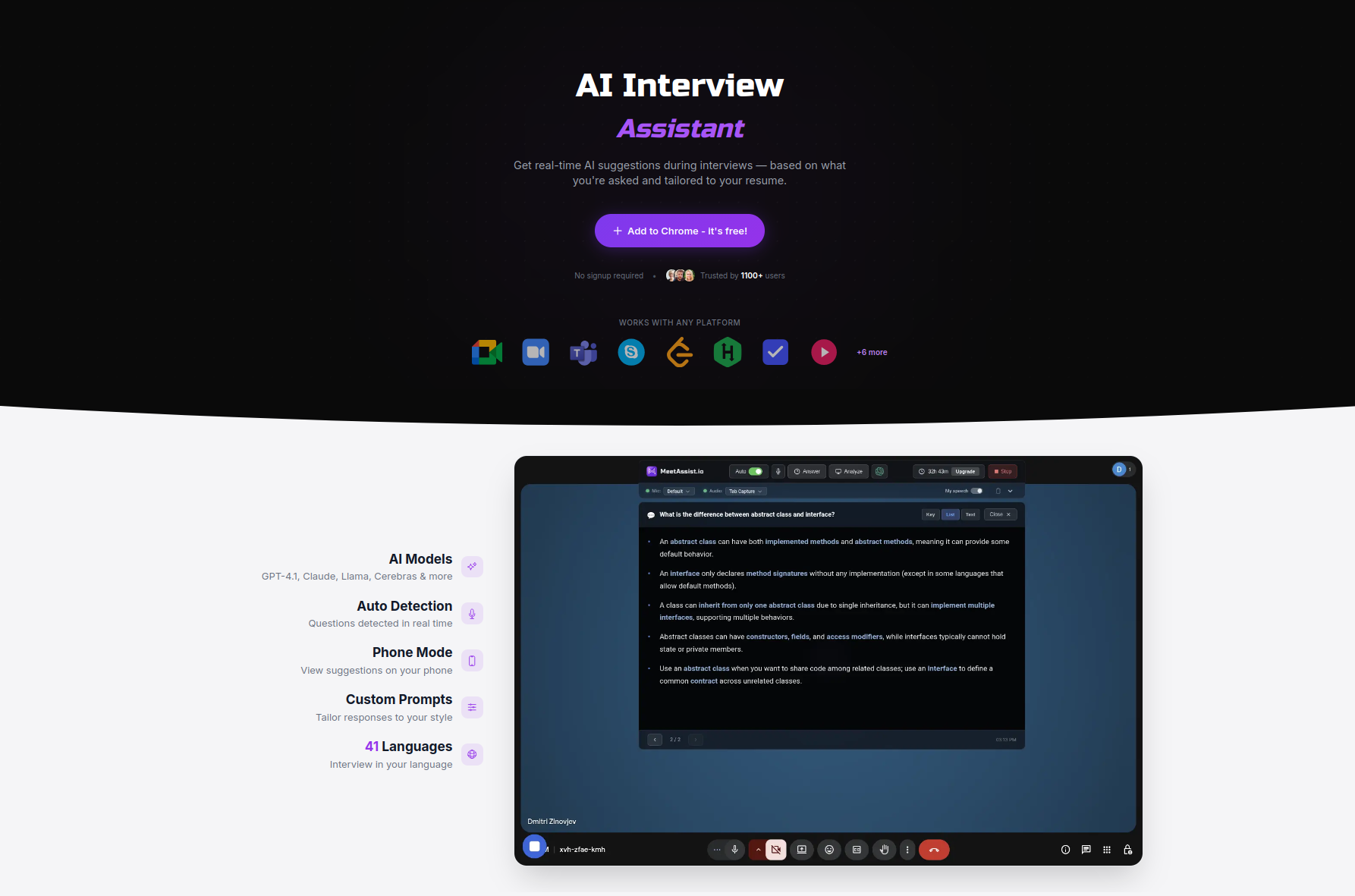
MeetAssist is a Chrome extension that listens to live interviews and generates structured AI answer suggestions in real time, supporting Google Meet, Microsoft Teams, and other web-based platforms. Its Phone Mode is especially useful for high-stakes interviews: after scanning a QR code, all transcripts and AI suggestions move to your phone, leaving your computer screen completely clean. No audio or video is recorded, and all data streams are encrypted. You can also explore top AI interview assistant alternatives to compare options and find the right fit for your specific needs. MeetAssist supports GPT-4.1, Claude, Llama, and Cerebras, with customizable answer styles and resume-based personalization, all available through one-time purchases with no subscriptions.
Frequently asked questions
Are AI answer suggestions allowed in all interviews?
No, rules vary widely across platforms and companies. Always check the assessment’s specific guidelines before using any AI tools, since platforms require clear guidelines on acceptable AI usage.
How do AI answer suggestions detect question types?
AI tools use live conversation analysis to identify question intent and apply the right framework. AI interview tools generate real-time, structured responses by recognizing question type from spoken or written input.
Do candidates need to disclose if they use AI answer suggestions?
Many companies expect transparency about AI tool use during interviews. Policies often require candidates to clarify their use of AI tools, so review the specific process or policy before your session.
What’s the main risk of relying on AI answer suggestions?
Over-reliance can expose you when AI outputs are incorrect or miss critical context. Strong interview rubrics assess candidate judgment and their ability to catch and handle AI mistakes, so always validate before using any suggestion.