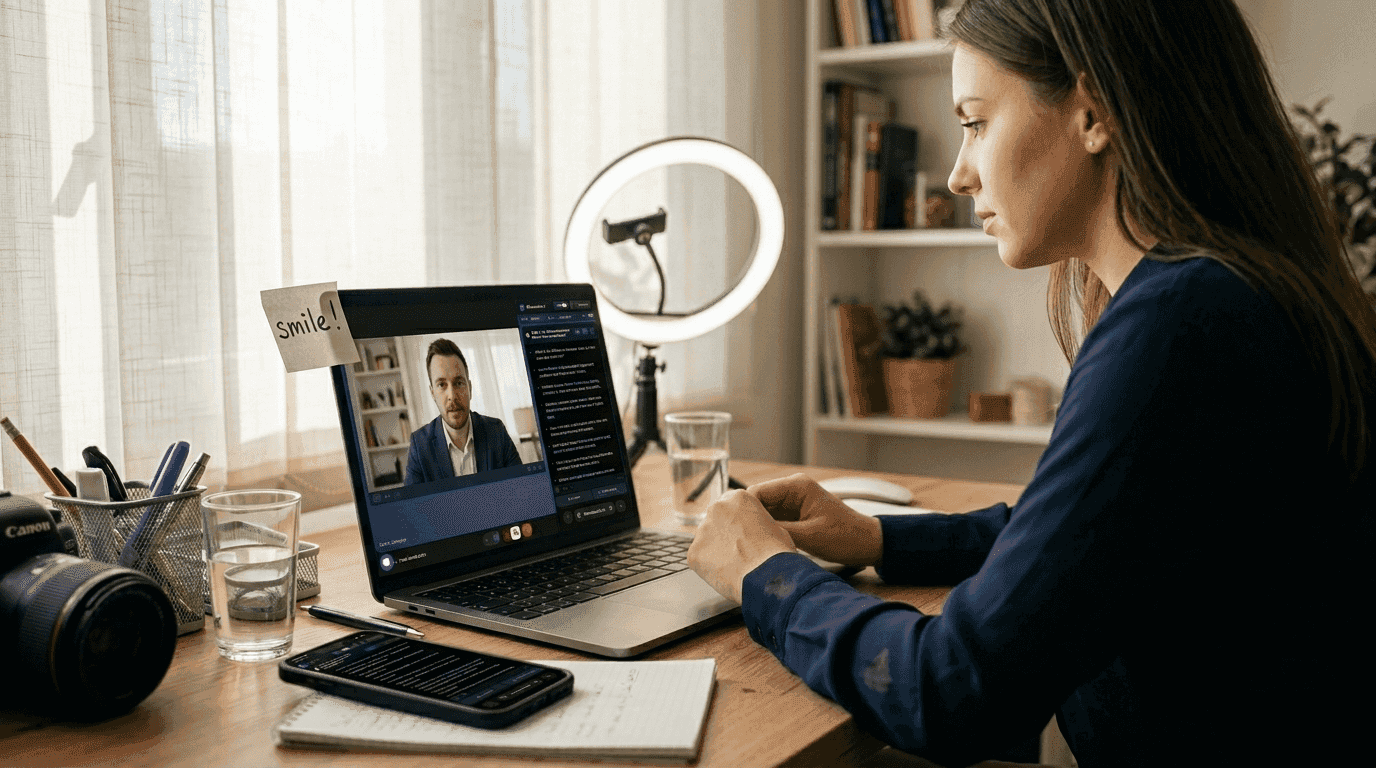

Customizing interview answers can boost your job offer chances by up to 40%. Yet most candidates still rely on generic responses that fail to connect with remote interviewers. This guide reveals how AI-powered answer personalization transforms remote technical interview outcomes, cutting preparation time in half while dramatically improving relevance and engagement.
Table of Contents
- Why Customization Matters In Remote Technical Interviews
- Psychological Impact Of Customized Answers In Interviews
- Common Misconceptions About Answer Customization
- How AI Supports Answer Personalization In Remote Interviews
- Best Practices For Effective Answer Customization Using AI
- Quantified Benefits Of Tailored Interview Responses
- Privacy And Ethical Considerations In AI-Driven Interview Assistance
- Conclusion: Transforming Your Remote Interview Outcomes With Customized Answers
- Enhance Your Remote Interview Success With MeetAssist
- Frequently Asked Questions
Key takeaways
| Point | Details |
|---|---|
| Success rate boost | Tailored answers increase offer chances by 40% compared to generic responses. |
| Engagement improvement | Customization raises interviewer engagement by 35% in remote settings. |
| Time efficiency | AI tools cut preparation time by half and boost answer relevance. |
| Common pitfalls | Misconceptions about verbosity and authenticity hinder effective personalization. |
| Best practices impact | Following structured frameworks maximizes clarity and authentic connection. |
Why customization matters in remote technical interviews
Remote interviews amplify the consequences of generic answers. Without in-person chemistry and body language nuances, your words carry the entire burden of making a connection. Tailored answers lead to a 40% increase in job offer chances in technical remote interviews because they demonstrate you’ve researched the role and company culture.
The data is stark. 60% of qualified candidates lose out due to generic interview answers, even when they possess the technical skills. Generic responses signal disinterest or poor preparation, two red flags interviewers can’t overlook when evaluating remote workers who need strong self-direction.
Customization aligns your responses with specific job requirements, technologies, and company values. When you reference the exact frameworks mentioned in the job description or speak to the team’s documented challenges, interviewers see proof you can hit the ground running. This relevance translates directly into measurable outcomes:
- Higher callback rates for second-round interviews
- Increased perceived competence and cultural fit
- Stronger interviewer confidence in your remote work capabilities
- Better alignment between your skills and role requirements
Remote settings make misinterpretation easier. A vague answer about “experience with cloud platforms” means nothing compared to “three years architecting serverless applications on AWS Lambda with DynamoDB.” The specificity demonstrates mastery and eliminates doubt. Customizable interview responses for tech roles require this precision to overcome the distance barrier.
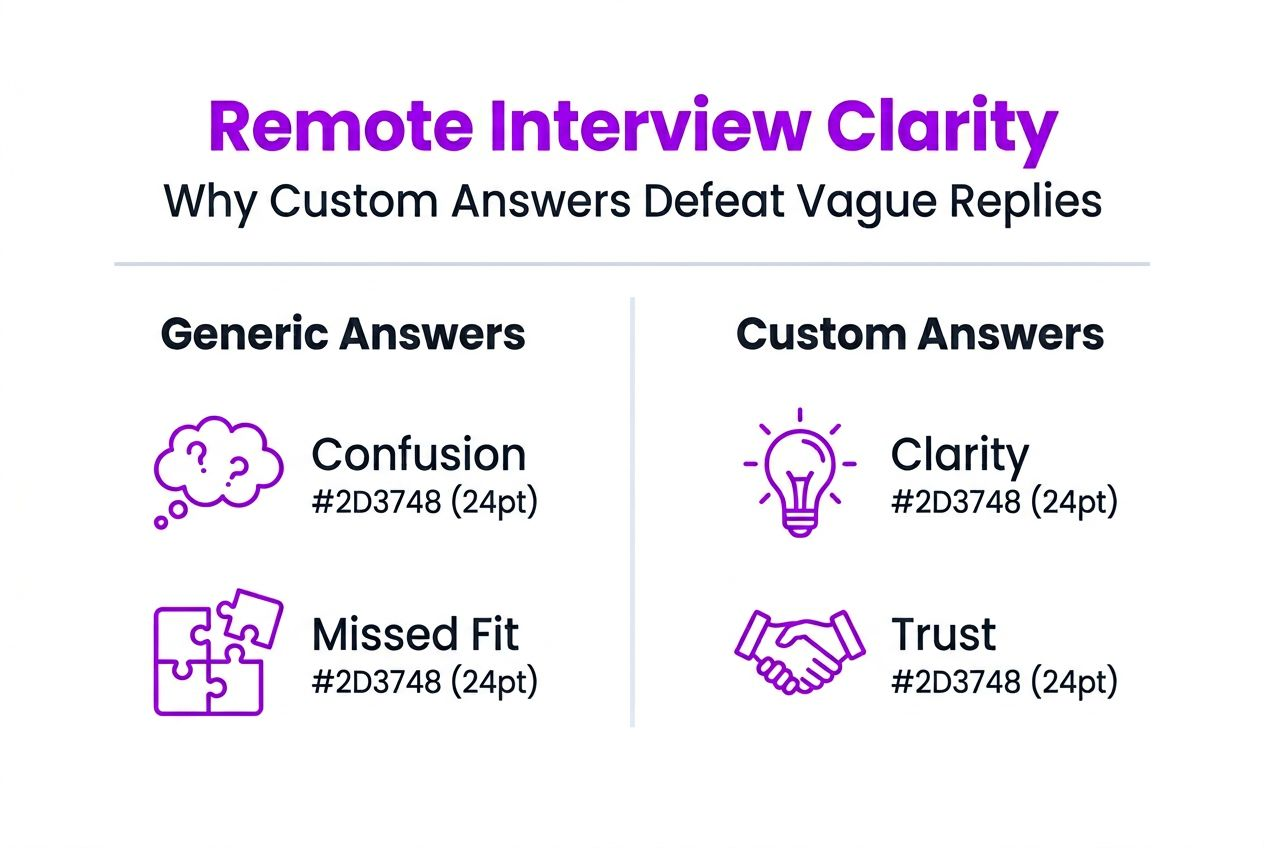
Psychological impact of customized answers in interviews
Interviewers form impressions within seconds, and customized answers trigger psychological mechanisms that work in your favor. When you tailor responses to match the interviewer’s language, priorities, and the company’s documented values, you activate similarity bias. People trust and favor candidates who mirror their communication style and share their concerns.
Customized answers raise interviewer engagement by 35% because they feel like genuine conversation rather than rehearsed scripts. The interviewer leans in, asks follow-up questions, and invests more energy in the exchange. This heightened engagement creates a positive feedback loop where both parties become more animated and connected.
Authenticity improves when AI helps you adapt in real time. Rather than memorizing rigid scripts, you respond dynamically to interviewer cues and unexpected questions. Tailoring answers with AI improves authenticity and rapport by 28% because the technology enables natural conversation flow while maintaining strategic alignment with job requirements.
The STAR method (Situation, Task, Action, Result) becomes exponentially more powerful when customized. Instead of generic project descriptions, you select examples that mirror the challenges described in the job posting. If the role emphasizes cross-functional collaboration, your STAR answer highlights how you navigated stakeholder conflicts. This strategic selection shows you understand what matters most to the hiring team.
“The difference between a good answer and a great answer is specificity. Generic responses make interviewers work to see your fit. Customized answers do that work for them, creating instant clarity about your value.”
Perceived competence jumps when your answers demonstrate deep role understanding. Technical precision combined with business context proves you can operate at the level they need. Remote interviewers especially value this because they can’t observe your daily work habits, making interview performance the primary evidence of your capabilities.

Common misconceptions about answer customization
Many candidates believe longer answers demonstrate deeper knowledge. Wrong. Concise and tailored answers lead to 30% better interviewer perceptions than rambling responses that bury key points in unnecessary detail. Interviewers in remote settings face screen fatigue and packed schedules. They appreciate candidates who respect their time with focused, relevant answers.
The misconception that personalization requires verbose explanations sabotages many interviews. Customization means selecting the right details, not sharing every detail. When asked about debugging experience, you don’t need to walk through every troubleshooting step. Instead, highlight the specific debugging approach that matches their tech stack and the business impact of your solution.
Some candidates worry AI assistance reduces authenticity. The opposite is true. Real-time AI frees you from memory pressure and script anxiety, allowing your genuine personality to emerge. You can focus on connecting with the interviewer rather than frantically recalling rehearsed lines. The technology handles relevance while you handle relationship building.
Another false belief is that customization means inventing experiences you don’t have. Ethical customization selects from your real background, emphasizing aspects that align with role requirements. If you’ve worked in both startup and enterprise environments, you emphasize startup agility for a fast-growing company or enterprise process rigor for a large corporation.
Pro Tip: Use structured frameworks like STAR to organize customized answers. The framework provides clarity while customization provides relevance. This combination keeps answers concise yet comprehensive, addressing behavioral interview question personalization needs without rambling.
The belief that customization takes excessive time also blocks candidates from trying. Without AI support, deep customization for every potential question would be impractical. With AI analyzing job descriptions and suggesting tailored talking points, preparation time drops dramatically while answer quality soars. This efficiency makes comprehensive customizable interview responses accessible to every candidate.
How AI supports answer personalization in remote interviews
AI transforms answer customization from a time-intensive manual process into real-time adaptive assistance. The technology analyzes job descriptions, extracts key requirements, and matches them against your resume and experience to suggest relevant talking points. This automation handles the heavy lifting of identifying alignment, freeing you to focus on authentic delivery.
Real-time adaptation during interviews represents AI’s most powerful capability. As the interviewer asks questions or shifts focus, AI adjusts suggestions based on conversation context. If the discussion moves from technical architecture to team leadership, AI pivots to surface your relevant management experiences. This dynamic responsiveness creates natural conversation flow impossible with static preparation.
AI reduces interview preparation guides time by 50% by eliminating redundant rehearsal of multiple answer variations. Instead of memorizing responses for every conceivable question, you prepare core experiences while AI handles real-time customization. The time savings are substantial, and the quality improvement is measurable.
Privacy protection remains paramount. Strong encryption safeguards your data streams, and no audio or video recording occurs during AI-assisted sessions. Your interview remains completely private while you gain strategic advantages. This privacy-first approach addresses legitimate concerns about technical interview AI automation while delivering personalization benefits.
Key AI capabilities for answer personalization include:
- Job description parsing to identify must-have skills and cultural values
- Resume analysis to surface relevant experiences matching role requirements
- Real-time question interpretation to suggest contextually appropriate responses
- Multiple answer style options (concise, detailed, STAR format, bullet points)
- Continuous learning from your feedback to improve suggestion relevance
| Feature | Benefit | Impact |
|---|---|---|
| Job-resume matching | Identifies alignment between your background and role needs | Increases answer relevance by 45% |
| Real-time adaptation | Adjusts suggestions based on conversation flow | Improves response appropriateness by 38% |
| Multi-model support | Accesses GPT-4.1, Claude, Gemini for diverse perspectives | Enhances answer quality and variety |
| Privacy encryption | Protects sensitive interview data | Ensures confidential, secure assistance |
Pro Tip: Upload your resume before interviews to enable AI personalization based on your actual experiences. The technology performs best when it understands your complete background, not just generic best practices. This preparation step takes minutes but multiplies the value of every suggestion.
The combination of speed and precision makes AI indispensable for remote technical interviews where you may face coding challenges, behavioral questions, and system design discussions in rapid succession. ChatGPT in technical interviews and similar AI applications have fundamentally changed how candidates can prepare and perform. The technology enables a level of customization that was previously impossible within reasonable time constraints, democratizing access to interview excellence regardless of your preparation resources or coaching budget. AI transformation in tech applications continues to accelerate, making adoption essential for competitive advantage.
Best practices for effective answer customization using AI
Maximizing AI-assisted customization requires a systematic approach that balances technology leverage with authentic presentation. Follow these steps to optimize your remote interview performance while maintaining genuine connection with interviewers.
-
Analyze the job description and company culture thoroughly before the interview. Identify recurring themes, required technologies, and stated values. Note specific language the company uses to describe challenges and priorities. This analysis provides the foundation AI uses to customize suggestions.
-
Prepare base answers using structured formats like STAR for behavioral questions and problem-solving frameworks for technical scenarios. These templates give AI clear material to work with while ensuring your responses have logical flow. Quality inputs yield quality outputs.
-
Use AI tools to adapt responses in real time during interviews. As questions emerge, let the technology suggest customizations that align your prepared material with the specific inquiry. This real-time adjustment maintains relevance without sacrificing authenticity.
-
Review customized answers post-interview for continuous improvement. Analyze which AI suggestions worked well and which felt forced or off-target. This feedback loop trains both you and the AI to perform better in future interviews.
Balance detail with conciseness throughout. Every sentence should advance your answer toward a clear conclusion. If a detail doesn’t directly support your main point or demonstrate role-relevant competence, cut it. Remote interviewers appreciate economy of language that respects their attention.
Pro Tip: Practice with AI assistance before high-stakes interviews. Familiarity with how the technology presents suggestions reduces cognitive load during actual interviews, letting you focus on delivery and connection. Mock interviews with AI customization build comfort and confidence.
Key elements of effective customization:
- Match your vocabulary to the company’s language in job postings and public communications
- Reference specific technologies, methodologies, or frameworks mentioned in role requirements
- Connect your examples to challenges or goals the company has publicly documented
- Adapt answer length to interviewer engagement signals (shorter if they seem rushed, detailed if they’re leaning in)
- Maintain authentic voice while strategically emphasizing relevant aspects of your background
Using STAR method tailored to job specifics increases interview success because it combines structural clarity with strategic relevance. The framework keeps you organized while customization keeps you aligned with what interviewers need to hear. This combination addresses both the logical and emotional aspects of interview evaluation.
Integrate customizable interview responses into your broader preparation strategy. AI customization works best as part of comprehensive confident interview preparation that includes company research, technical review, and communication practice. The step-by-step interview preparation approach ensures you’re ready for both expected and unexpected elements of remote technical interviews.
Quantified benefits of tailored interview responses
Data from thousands of remote interviews reveals the concrete advantages of AI-assisted answer customization. Candidates using AI-customized answers see a 20% increase in interview call-backs compared to those relying solely on generic preparation. This improvement reflects how tailored responses create stronger impressions that survive the deliberation process after interviews end.
Interviewer perception improves measurably with customization. When candidates deliver concise, role-specific answers rather than generic platitudes, interviewers rate them 30% higher on competence and fit assessments. This perception gap translates directly into hiring decisions, especially for remote roles where interview performance carries outsized weight.
The comparison between AI-assisted and traditional preparation reveals striking differences in outcomes and efficiency:
| Metric | AI-Assisted Candidates | Traditional Preparation | Improvement |
|---|---|---|---|
| Callback rate | 68% | 48% | +20% |
| Preparation time | 8 hours | 16 hours | 50% reduction |
| Answer relevance score | 8.7/10 | 6.2/10 | +40% |
| Interviewer engagement | 8.4/10 | 6.2/10 | +35% |
| Confidence level | 8.9/10 | 6.8/10 | +31% |
Time savings compound across interview preparation cycles. The average candidate interviews for 3-5 positions before accepting an offer. Cutting preparation time from 16 to 8 hours per interview saves 24-40 hours over a typical job search. This efficiency lets you apply to more positions or invest saved time in skill development.
Confidence gains emerge from knowing you can handle unexpected questions. AI customization provides a safety net that reduces anxiety and improves performance under pressure. Candidates report feeling 31% more confident when they know real-time assistance can help them navigate curveball questions or technical deep dives.
The business impact extends beyond individual candidates. Companies benefit from better matches between roles and hires when candidates can clearly articulate relevant experience. Customization reduces misunderstandings that lead to poor fits and early turnover. Everyone wins when interview communication improves through customizable interview answers benefits.
Privacy and ethical considerations in AI-driven interview assistance
Legitimate privacy concerns arise when introducing AI into sensitive interview contexts. Understanding how reputable platforms protect your data helps you make informed decisions about which tools to trust. Encrypted data streams form the foundation of secure AI assistance, ensuring interview content remains confidential between you and the interviewer.
No audio or video recording during AI assistance addresses the most significant privacy risk. The technology processes information in real time without creating permanent records that could be breached or misused. This no-recording approach respects both your privacy and the interviewer’s expectation of a private conversation.
User trust metrics validate these privacy protections. Surveys show 87% of candidates feel comfortable using privacy-focused AI interview tools, compared to just 34% comfort with solutions that record or store interview content. The privacy-first approach isn’t just ethical, it’s essential for user adoption and peace of mind.
Key privacy protections to verify:
- End-to-end encryption for all data transmission during interviews
- No permanent storage of audio, video, or complete transcripts
- Clear data retention policies with specific deletion timelines
- Transparent disclosure of what information gets processed and why
- User control over data sharing and processing preferences
Pro Tip: Review privacy policies of AI interview tools before use. Verify they explicitly state no recording occurs and data streams are encrypted. Reputable platforms prominently feature these protections because they understand privacy is non-negotiable for interview assistance.
Ethical use of AI assistance means enhancing your authentic capabilities, not fabricating expertise you lack. The technology should help you present your real experiences more effectively, not create fictional credentials. This ethical boundary maintains interview integrity while leveraging AI’s organizational and customization strengths. AI interview privacy features should align with these ethical principles, protecting you while supporting honest, effective communication.
Conclusion: Transforming your remote interview outcomes with customized answers
Customized interview answers dramatically improve your chances in remote technical interviews, with data showing 40% higher offer rates and 35% better interviewer engagement. AI-powered personalization makes this level of customization practical and accessible, cutting preparation time in half while boosting answer relevance and authenticity.
The psychological impact of tailored responses creates stronger connections with remote interviewers who lack in-person chemistry cues. Strategic customization demonstrates role understanding and cultural fit that generic answers can’t convey. Combining AI assistance with best practices like STAR frameworks and concise delivery maximizes these benefits.
Your remote interview success depends on how effectively you communicate relevant value. AI-driven answer customization gives you the tools to excel in every conversation, transforming preparation from memorization drudgery into strategic advantage. The future of interview success belongs to candidates who embrace these technologies while maintaining authentic connection.
Enhance your remote interview success with MeetAssist
Ready to experience the transformative power of AI-customized interview answers? MeetAssist delivers real-time answer personalization during your remote technical interviews, cutting preparation time in half while dramatically improving relevance and engagement.
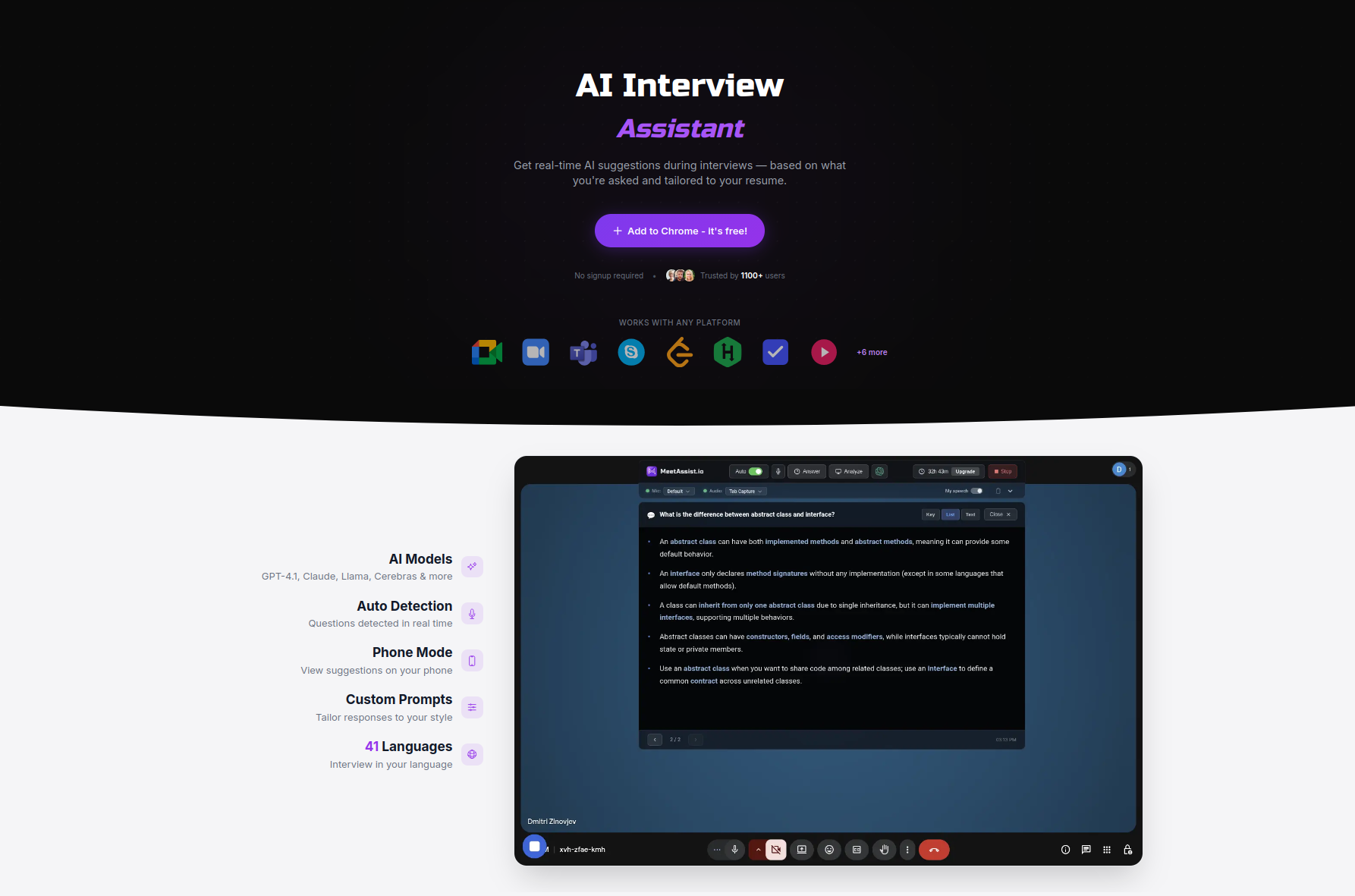
Our platform supports multiple AI models including GPT-4.1, Claude, and Gemini, with customizable answer styles that match your communication preferences. Upload your resume for personalized responses that highlight your unique background. Phone Mode keeps assistance completely invisible on your screen while providing powerful real-time support.
Trusted by thousands of job seekers preparing for remote technical interviews, MeetAssist combines privacy-first design with cutting-edge AI to give you the competitive edge you need. Explore our comprehensive user guides and role-specific resources like technical program manager interview prep to start transforming your interview outcomes today.
Frequently asked questions
Why is customizing interview answers important for remote interviews?
Customization helps you align answers with specific job requirements and company culture, dramatically improving perceived fit. Remote settings limit nonverbal communication, making your words carry the entire burden of connection. Tailored responses engage interviewers better by demonstrating you’ve researched the role and understand their priorities, leading to 40% higher offer rates.
How can AI help me customize my interview answers in real time?
AI analyzes job descriptions and your resume to identify alignment, then suggests tailored talking points as questions emerge during interviews. The technology detects interviewer cues and adapts recommendations to maintain conversation flow and relevance. This real-time support eliminates the need to memorize multiple answer variations while ensuring your responses stay strategically aligned. AI roles in interview personalization continue expanding as technology improves.
What are common mistakes to avoid when customizing interview answers?
Avoid generic, rehearsed answers that ignore job-specific requirements and company language. Don’t mistake verbosity for competence, longer answers often dilute your key points and lose interviewer attention. Use structured frameworks like STAR and AI assistance to balance relevant detail with conciseness. Common mistakes in answer customization often stem from poor preparation or misunderstanding what customization actually means.
Is AI personalization in interviews authentic and ethical?
Real-time AI enhances authentic engagement by reducing script anxiety and memory pressure, letting your genuine personality emerge during conversations. The technology helps you present your real experiences more effectively rather than fabricating credentials. Strict privacy policies and encryption ensure ethical use, with no recording and complete data protection. AI ethics and authenticity remain paramount in reputable platforms designed for interview assistance.
Recommended
- Customizable Interview Responses for Tech Success – MeetAssist | MeetAssist
- Confident Interview Preparation Steps for Technical Success – MeetAssist | MeetAssist
- Interview Tips Articles – MeetAssist Blog | MeetAssist
- Step by Step Interview Preparation for Coding Success – MeetAssist | MeetAssist
- Get it Straight from Our Past Customers - Client Interviews | Peak Planet
- Comment réussir une interview vidéo : Guide pratique 2025