

Generic interview answers cost you job offers. When you respond with the same scripted stories every candidate shares, interviewers tune out. Personalizing your answers by connecting them directly to the company’s needs and the specific role transforms your responses from forgettable to compelling. Structured frameworks like STAR and CARL give your stories clarity and impact, while AI assistance helps you tailor responses efficiently. This guide shows you exactly how to customize your interview answers to stand out and win more offers.
Table of Contents
- Key takeaways
- Preparing to personalize your interview answers
- Using structured frameworks to craft personalized answers
- Leveraging AI tools to enhance and customize your interview answers
- Practicing, troubleshooting, and verifying your personalized answers
- Enhance your interview preparation with MeetAssist
- FAQ
Key Takeaways
| Point | Details |
|---|---|
| Personalize for company needs | Research the company, mission, and role to tailor answers to their needs and keyword requirements. |
| Use STAR or CARL | Use structured frameworks like STAR or CARL to shape clear, outcome focused narratives. |
| Highlight measurable results | Highlight specific, measurable results to demonstrate impact and credibility. |
| Leverage AI assistance | Leverage AI tools to customize responses efficiently while keeping authenticity. |
Preparing to personalize your interview answers
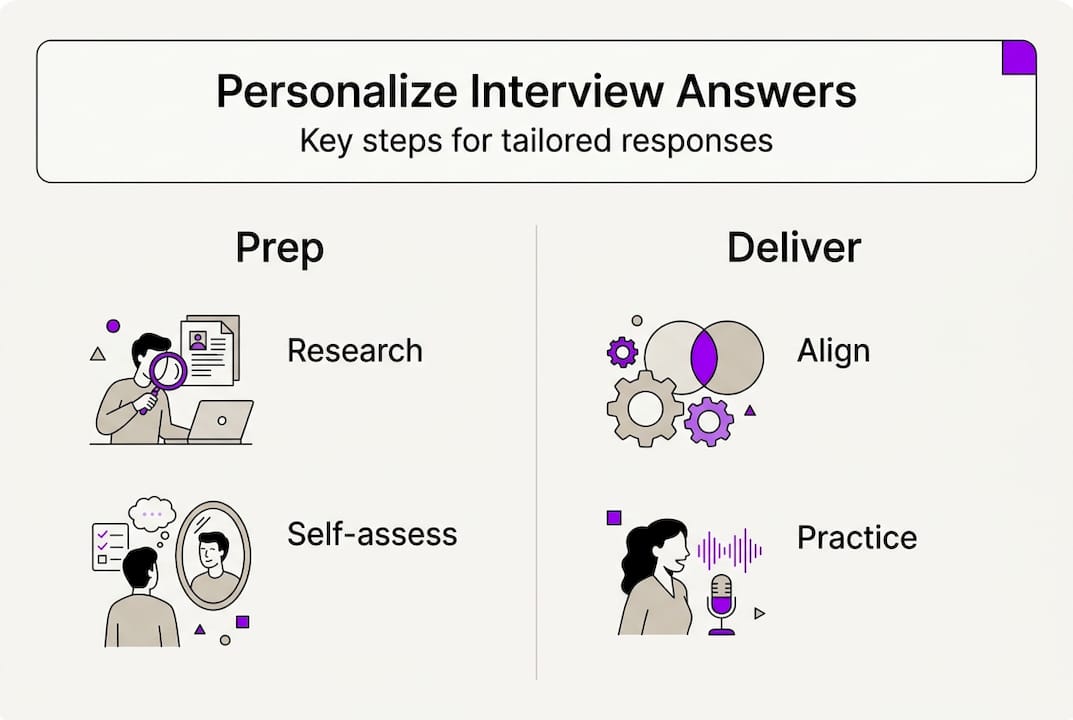
Before you can customize your responses, you need solid research and self-awareness. Start by diving deep into the company’s website, mission statement, and recent news. Look for their core values, product launches, community initiatives, or leadership changes. This context helps you understand what matters most to the organization and what they look for in candidates.
Next, analyze the job description like a detective. Tailor interview answers by researching the company and aligning personal stories to their specific needs and job description keywords using frameworks like STAR+. Highlight keywords related to required skills, preferred qualifications, and desired competencies. If the posting mentions collaboration five times, you know teamwork stories will resonate. If it emphasizes data-driven decision making, prepare examples showing how you used metrics to guide choices.
Now turn inward and inventory your own experiences. Match your past roles, projects, and achievements to the keywords and values you identified. Create a master list of 8 to 10 stories covering common competencies like leadership, problem solving, conflict resolution, adaptability, and communication. For each story, jot down the situation, your actions, the measurable outcome, and any lessons learned. This preparation ensures you have relevant material ready to deploy during the interview.
Pro Tip: Keep a spreadsheet mapping each story to specific job requirements. This visual reference helps you quickly select the best example for any question and ensures you never repeat the same story twice unless it perfectly fits multiple scenarios.
For more guidance on building a strong foundation, explore job interview answer strategies 2026 and interview prep resources that break down preparation into actionable steps.
Using structured frameworks to craft personalized answers
Structured frameworks transform scattered thoughts into coherent, compelling narratives. The two most effective approaches are STAR and CARL. STAR stands for Situation, Task, Action, Result. You set the scene, explain your responsibility, describe what you did, and share the outcome. Use structured frameworks like STAR (Situation, Task, Action, Result) for behavioral questions, customizing stories to match job requirements from research. This method works exceptionally well when interviewers want to see concrete achievements and measurable impact.
CARL takes a slightly different approach: Context, Action, Result, Learning. Alternative CARL (Context, Action, Result, Learning) adds reflection, better for showing growth mindset over STAR’s focus on results. The Learning component demonstrates self-awareness and continuous improvement, which appeals to employers who value adaptability and development. Use CARL when the role emphasizes growth, innovation, or navigating ambiguity.
| Framework | Best for | Key strength |
|---|---|---|
| STAR | Results-focused roles | Highlights measurable achievements and clear outcomes |
| CARL | Growth-oriented positions | Shows reflection and learning from experiences |
To apply either framework effectively, follow these steps:
- Choose a story from your preparation list that aligns with the question and job requirements
- Set up the context briefly, spending no more than 20% of your answer on background
- Focus most of your response on your specific actions, using “I” statements to clarify your role
- Quantify results whenever possible with percentages, dollar amounts, or time saved
- If using CARL, end with what you learned and how you applied that lesson later
Align each element with what you learned during research. If the company values innovation, emphasize creative problem solving in your Action section. If they prioritize customer satisfaction, highlight how your Result improved user experience scores by a specific percentage.

Pro Tip: Record yourself answering practice questions using both frameworks. Listen for places where you ramble or lose focus, then tighten those sections. The best answers feel natural but stay laser-focused on demonstrating relevant skills.
For deeper strategies on behavioral responses, check out how to answer behavioral questions effectively and behavioral interview tips for developers.
Leveraging AI tools to enhance and customize your interview answers
AI interview assistants revolutionize how you personalize responses by analyzing job descriptions and suggesting tailored improvements in seconds. These tools scan for keywords, identify competencies the employer prioritizes, and recommend ways to adjust your language and examples to match. Instead of manually cross-referencing your stories against job requirements, AI does the heavy lifting while you focus on authentic delivery.
Here’s how AI adds value to your preparation:
- Refines language to mirror the terminology used in the job posting, making your answers feel custom-built for the role
- Suggests relevant metrics or achievements from your background that align with company goals
- Improves clarity by identifying vague phrases and recommending concrete alternatives
- Generates multiple variations of the same answer so you can choose the version that feels most natural
- Provides real-time feedback during practice sessions, pointing out areas where you lose focus or fail to quantify results
Many AI platforms let you upload your resume, which enables even more personalized suggestions. The system pulls specific accomplishments from your work history and weaves them into answers that directly address the interviewer’s concerns. Tailoring beats generic applications; use STAR+ for interview answers. This approach saves hours compared to manually crafting each response from scratch.
The time-saving impact is substantial. What might take 30 minutes of manual editing per answer drops to 5 minutes with AI assistance. You can prepare for an entire interview in the time it used to take to perfect two or three responses. This efficiency boost also increases confidence because you enter the interview knowing your answers are polished, relevant, and aligned with what the employer seeks.
Pro Tip: Use AI to generate a baseline answer, then personalize it with specific details only you know. This hybrid approach combines AI’s analytical power with your authentic voice and unique experiences, creating responses that sound both professional and genuine.
Explore tools designed for this purpose at customizable interview responses tech and build confidence through confident interview preparation steps.
Practicing, troubleshooting, and verifying your personalized answers
Crafting great answers is only half the battle. You must practice delivering them until they feel natural and conversational. Follow these steps to refine your performance:
- Read each answer aloud at least five times, adjusting phrasing that feels awkward or forced
- Record yourself on video to check body language, eye contact, and pacing
- Conduct mock interviews with a friend or mentor who can ask follow-up questions
- Time your responses to ensure they stay between 90 and 120 seconds for most behavioral questions
- Practice transitioning smoothly between stories without repeating the same introduction
Common mistakes sabotage even well-researched answers. Avoid sounding overly scripted by varying your word choice and sentence structure across different responses. Don’t be too vague by skipping specific numbers or outcomes. Interviewers want evidence, not generalizations. Also, resist the urge to memorize answers word for word. Instead, memorize the framework and key points, then let the details flow naturally based on how the conversation unfolds.
Mock interviews provide invaluable feedback. Ask your practice partner to note moments when you lose clarity, ramble, or fail to connect your story to the job requirements. Use this input to tighten weak sections and add missing details. Verify that your responses align with employer priorities by cross-checking them against the job description one final time before interview day.
Data supports the effectiveness of structured approaches. Structured behavioral interviews predict performance better; STAR/CARL reduce bias, with no gender difference. This means your preparation directly translates to better interview outcomes and fairer evaluations.
| Practice method | Benefit | Frequency |
|---|---|---|
| Solo rehearsal | Builds muscle memory and confidence | Daily for one week before interview |
| Video review | Identifies body language issues | At least twice |
| Mock interview | Simulates real pressure and follow-up questions | Two to three times |
For additional strategies on using your background effectively, visit resume based answers boost interview success.
Enhance your interview preparation guides with MeetAssist
Personalizing interview answers takes effort, but the right tools make the process faster and more effective. MeetAssist offers AI-driven assistance that helps you customize responses in real time, whether you’re practicing or in the actual interview. The platform analyzes conversations, suggests tailored answers based on your resume and the job requirements, and keeps everything private with encrypted data streams.
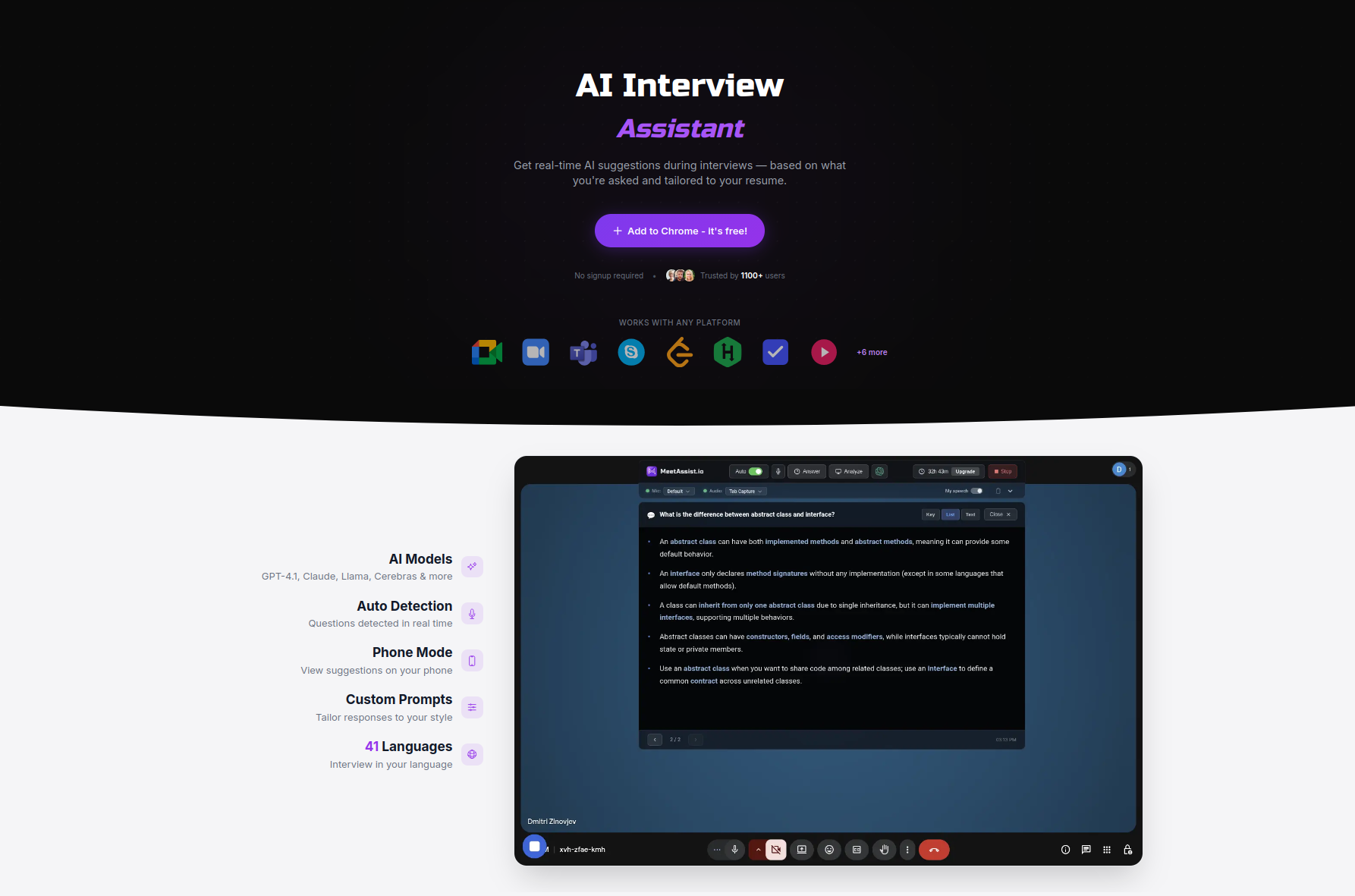
If you’re exploring options, check out AI interview assistant alternatives to compare features and find the best fit for your needs. You can also learn how to integrate AI seamlessly into your workflow with guides like AI interview assistant in Google Meet, ensuring you’re prepared no matter which platform your interviewer uses.
FAQ
How can I quickly research a company for interview preparation?
Start with the company’s official website, focusing on their mission statement, values, and recent news or blog posts. Use LinkedIn to review employee profiles, understand team structure, and identify common career paths within the organization. Check recent press releases or industry news to spot major initiatives or challenges the company faces. This research typically takes 30 to 45 minutes but provides critical context for tailoring your answers.
When should I use the CARL method instead of STAR?
Use CARL when the role emphasizes continuous learning, adaptability, or innovation. Startups, roles involving change management, or positions requiring creative problem solving benefit from the reflection component in CARL. If the job description mentions growth mindset, learning agility, or professional development multiple times, CARL demonstrates you align with those values. STAR works better for results-driven roles in established companies where measurable outcomes matter most.
How does AI help improve interview answers?
AI analyzes job descriptions to identify keywords and competencies the employer prioritizes, then suggests ways to incorporate those elements into your responses. It refines sentence structure for clarity, recommends relevant metrics from your background, and ensures your language mirrors what the company values. This customization happens in minutes rather than hours, letting you prepare thoroughly without sacrificing authenticity. AI also provides objective feedback on areas where your answers lack specificity or fail to demonstrate required skills.
What are common mistakes to avoid when personalizing answers?
Avoid memorizing answers word for word, which makes you sound robotic and inflexible when follow-up questions arise. Don’t use generic stories that could apply to any job instead of tailoring examples to the specific role and company. Skip vague language like “I worked on a team project” without explaining your individual contribution or the measurable result. Finally, resist over-explaining context at the expense of action and outcomes. Interviewers care most about what you did and what happened because of it, not lengthy background details.
Recommended
- Customizable Interview Responses for Tech Success – MeetAssist | MeetAssist
- Why interview answer customization matters for remote success – MeetAssist | MeetAssist
- Job Interview Answer Strategies 2026: Boost Success 35% – MeetAssist | MeetAssist
- Interview Tips Articles – MeetAssist Blog | MeetAssist