

TL;DR:
- Prepare thoroughly with tech tests, environment setup, and company research before the interview.
- Use structured STAR responses to deliver clear, impactful answers and practice them aloud.
- Leverage AI tools and hybrid strategies to enhance performance and build genuine social connection.
Virtual interviews are now the standard first step in most hiring processes, yet even experienced candidates regularly stumble in them. The camera, the lag, the inability to read a room — these aren’t trivial obstacles. A 2025 study on async interview formats found that over 50% of applicants drop out of the process when interviews move fully asynchronous. That stat alone tells you how much the format matters. This article breaks down the most effective, research-backed strategies to sharpen your virtual interview performance — from pre-call setup to AI-powered tools — so you walk away with a clear, actionable plan.
Table of Contents
- Set yourself up for success before the interview
- Master structure and substance: Answering with impact
- Leverage technology and AI-driven tools
- Build connection and overcome virtual barriers
- Why hybrid strategies (not just best practices) win in virtual interviews
- Take your interview performance even further
- Frequently asked questions
Key Takeaways
| Point | Details |
|---|---|
| Preparation is key | Testing your technology and environment before the interview drastically reduces avoidable errors. |
| Structure your answers | Using the STAR method with metrics makes your responses more compelling and memorable. |
| Leverage AI tools | AI-assisted interview platforms can boost your performance and hiring odds. |
| Overcome virtual distance | Actively build rapport and personal connection to stand out in virtual interviews. |
| Blend strategies | Combining technology with strong communication skills yields the best long-term results. |
Set yourself up for success before the interview
Most candidates spend their prep time rehearsing answers. That’s important, but the candidates who consistently perform well also control everything they can before the call even starts. Virtual interviews punish technical failures in a way that in-person ones don’t. A frozen screen or a cluttered background can overshadow a perfectly crafted answer.
Start with your hardware and software. Test your camera, microphone, and internet connection at least 24 hours before the interview. Use the exact platform — Google Meet, Microsoft Teams, Zoom — that the employer specified. Don’t assume it works; confirm it. Check out these video interview tech tips to run through a complete pre-call checklist that covers both hardware and platform-specific settings.
Your environment matters just as much as your equipment. Position yourself with a light source in front of you, not behind. A window behind you turns you into a silhouette. Use a plain or professionally neutral background. Remove anything distracting from the frame. Silence your phone and close unnecessary browser tabs.
Research is non-negotiable. Prepare specific questions like “How do you define success in this role?” and avoid bringing up salary too early. Interviewers consistently rate candidates lower when they show no knowledge of the company. Read recent news, the job description, and the LinkedIn profiles of your interviewers.
Here’s a quick pre-interview checklist to run through:
- Test audio and video on the exact platform being used
- Confirm your internet speed (aim for at least 10 Mbps upload)
- Set up proper front-facing lighting
- Prepare a clean, distraction-free background
- Have your resume, portfolio links, and notes open and ready
- Research the company, the team, and your interviewers
- Write out 3 to 5 thoughtful questions to ask at the end
Pro Tip: Log into the meeting link 10 minutes early. This gives you time to fix any last-minute tech issues without the interviewer watching you panic.
Companies that optimize their tech hiring workflow increasingly expect candidates to arrive prepared and polished from the first second. Treat your pre-interview setup as part of the interview itself.
Master structure and substance: Answering with impact
With your environment and mindset ready, focus next on what you say and how you say it. Strong answers in virtual interviews need to be cleaner and more structured than in-person ones. Without the natural back-and-forth of a physical room, rambling comes across much worse on camera.
The STAR method is the most reliable framework for behavioral questions. STAR stands for Situation, Task, Action, and Result — a four-part structure that keeps your answer focused and easy to follow. It prevents you from going off on tangents and signals to the interviewer that you think clearly under pressure.
“Structured responses using the STAR format consistently outperform unstructured answers in recruiter evaluations because they reduce ambiguity and highlight measurable impact.” — Harvard Business Review, 2025
Here’s how to build answers that land:
- Set the scene briefly. Give just enough context for the interviewer to understand the situation. One or two sentences max.
- State your specific role. Clarify what you were responsible for, not the team as a whole.
- Describe the actions you took. Focus on your decisions and behaviors, not what happened around you.
- Quantify the result. Numbers make answers memorable. “Reduced onboarding time by 30%” beats “improved the process.”
- Tie it back to the role. End with a brief connection to why this experience is relevant to the job you’re applying for.
Practice answering behavioral questions out loud, not just in your head. Recording yourself on video is uncomfortable but invaluable — you’ll catch filler words, pacing issues, and weak transitions you’d never notice otherwise.

Pro Tip: Prepare 3 to 5 STAR stories that you can adapt to different questions. A story about leading a project under pressure can answer questions about leadership, conflict resolution, and time management with small adjustments.
For developers and technical candidates, these same principles apply. Learn how to apply behavioral interview tips for developers to frame technical accomplishments in language that resonates with both engineers and non-technical hiring managers.
Leverage technology and AI-driven tools
Effective answers go further when you understand how technology shapes both the process and the scoring. More employers are using AI-assisted platforms to screen candidates before a human ever reviews the application. Understanding how these tools work gives you a real edge.
Research from micro1 shows that AI-assisted interviews yield a 54% candidate pass rate compared to just 34% in standard processes — a 20 percentage point improvement. The same data shows that structured remote interviews score 5% higher than unstructured ones, and AI-assisted pipelines reduce the number of human interviews needed by 44%.
| Interview format | Pass rate | Rapport potential | Engagement risk |
|---|---|---|---|
| Traditional in-person | Moderate | High | Low |
| Live virtual (structured) | Higher (+5%) | Medium | Medium |
| AI-assisted async | Highest (54%) | Low | High (dropout risk) |
The takeaway isn’t that AI interviews are always better. They’re more efficient and more consistent, but they carry a real engagement risk — especially for candidates who perform better in conversational settings.
To prepare for AI-assessed formats:
- Practice with mock interview tools that simulate async video prompts
- Speak clearly and at a measured pace; AI transcription penalizes mumbling
- Structure every answer using STAR or a similar framework
- Avoid filler words like “um” and “like” — they show up clearly in transcripts
- Review the role of AI in job interviews to understand how scoring algorithms evaluate your responses
The candidates who do best in AI-screened interviews treat them like a structured writing exercise delivered out loud. Clarity and specificity win. You can also explore remote interview performance strategies and customized interview strategies to tailor your approach based on the specific format you’re facing.
Build connection and overcome virtual barriers
Beyond structure and tools, real success depends on bridging the social gap that virtual formats create. Virtual interviews reduce what researchers call “social presence” — the feeling that you’re genuinely connecting with another person. That reduction affects how interviewers perceive you, even when your answers are strong.
Eye contact is the most common mistake. Looking at the interviewer’s face on your screen feels like eye contact to you, but it actually makes you appear to be looking slightly downward. Train yourself to look directly at your camera lens when speaking. It’s uncomfortable at first, but it reads as confident and engaged on the other side.
Voice and gesture matter more than most candidates realize. In-person, your full body communicates energy and enthusiasm. On camera, only your face and shoulders are visible. Speak with slightly more energy than feels natural. Use hand gestures within the camera frame. Nod when the interviewer speaks. These micro-signals tell the interviewer you’re present and engaged.
| Format | Rapport potential | Fairness perception | Engagement risk |
|---|---|---|---|
| In-person | High | High | Low |
| Live virtual | Medium | Medium | Medium |
| Async video | Low | Lower (esp. for women) | Very high |
For async interviews specifically, over 50% of candidates stop the application process when they encounter them, with women disproportionately affected. To make async formats feel more personal, record in a well-lit space, speak as if the interviewer is in the room, and reference the company by name in your responses.
Here are the top fixes for common engagement drop-offs:
- Use the interviewer’s name once or twice during the conversation
- Reference something specific from your company research early in the call
- Ask at least one question that shows you’ve thought about the role deeply
- Smile naturally at the start and end of each answer
- Keep answers to 90 to 120 seconds unless asked to elaborate
For candidates navigating remote interview assistance and trying to build confidence in virtual settings, the social layer is often what separates good candidates from great ones. You can also explore equitable remote interview strategies that help level the playing field across different formats.
Why hybrid strategies (not just best practices) win in virtual interviews
Here’s something most interview prep guides won’t tell you: following best practices perfectly can still cost you the job. The candidates who consistently advance combine technical preparation with genuine human connection — and they know when to lean on each.
Research comparing virtual and hybrid interview formats confirms that hybrid interviews outperform purely virtual ones by balancing accessibility with social presence. Virtual interviews are efficient and remove geographic barriers, but they consistently score lower on perceived fairness and rapport. Hybrid formats capture both advantages.
What does this mean for you as a candidate? Don’t treat your preparation as a checklist to complete. Treat it as two parallel tracks running at the same time: one track is data-driven (structure, metrics, frameworks, tech setup), and the other is human (warmth, curiosity, storytelling, connection). The mistake most candidates make is optimizing hard for one track and neglecting the other.
Overreliance on scripted STAR answers, for example, can make you sound rehearsed and robotic. Overreliance on personality without structure makes you forgettable. The sweet spot is a candidate who feels both prepared and real. That’s what builds interview confidence that actually shows up on camera.
Pro Tip: Before every virtual interview, spend two minutes thinking about what genuinely excites you about the role. That energy is hard to fake and easy to transmit — even through a screen.
Take your interview performance even further
The strategies above give you a strong foundation, but putting them into practice under real interview pressure is a different challenge. That’s where MeetAssist comes in.
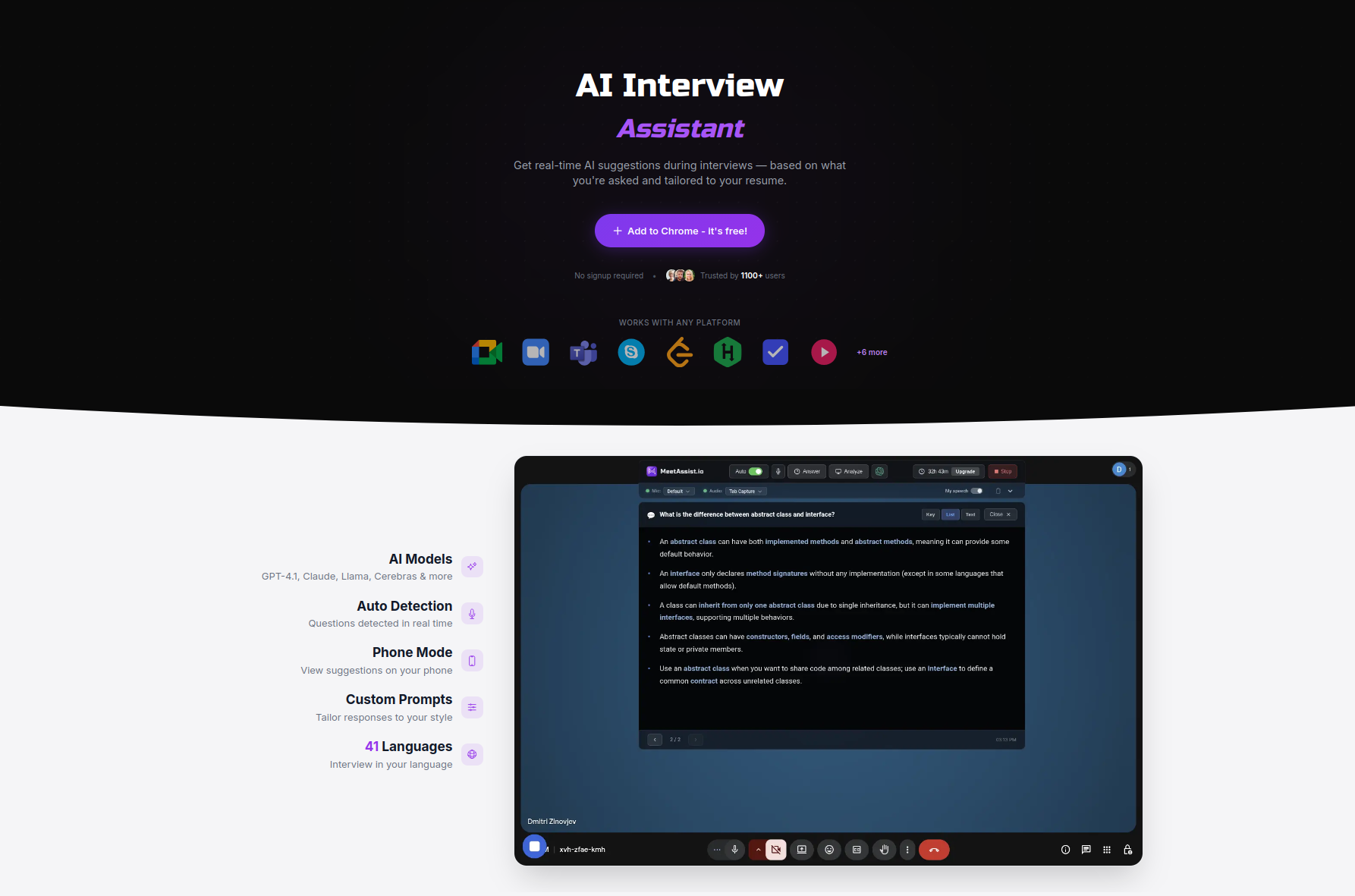
MeetAssist is a Chrome extension that listens to your interview in real time and surfaces AI-powered answer suggestions as the conversation unfolds. It supports STAR-style responses, concise answers, and bullet-point formats — all customizable to your style. With Phone Mode, everything moves to your phone so nothing appears on your computer screen. You can also analyze live coding challenges and technical assessments remotely. Explore top AI interview alternatives or browse the MeetAssist how-to guides to find the setup that fits your next interview.
Frequently asked questions
What is the STAR method and why is it effective for virtual interviews?
The STAR method structures answers to behavioral questions into four clear parts — Situation, Task, Action, Result — making responses easier to follow and more memorable for interviewers. It’s especially effective in virtual settings where rambling is harder to recover from.
How can I make a virtual interview feel more personal and engaging?
Look directly at your camera lens, use the interviewer’s name, and ask specific questions about the role to build rapport. Reduced social presence is a known challenge in virtual formats, so small human signals carry extra weight.
Do AI-powered interviews really improve my chances of getting hired?
Yes — AI-assisted interviews yield a 54% pass rate compared to 34% in standard processes, a 20 percentage point improvement. Practicing for structured, AI-evaluated formats gives you a measurable advantage.
What should I avoid during a virtual interview?
Avoid poor tech setup, vague answers without metrics, and bringing up salary too early. Common mistakes include failing to research the company and giving unstructured responses that leave interviewers without a clear takeaway.
Recommended
- Video Interview Success: 80% Fewer Tech Failures Guaranteed – MeetAssist | MeetAssist
- Top remote interview tips to ace your 2026 job interview | MeetAssist
- How to improve interview performance in 2026: remote & AI | MeetAssist
- Confident Interview Preparation Steps for Technical Success – MeetAssist | MeetAssist
- Find Remote IT Jobs: Proven Strategies for 2026
Looking for help with your next interview? MeetAssist provides real-time AI assistance during your video interviews on Google Meet, Zoom, and Teams. Browse our interview preparation guides to get started.