

Walking into a technical interview can feel daunting when you know behavioral questions are coming your way. For early-career American software developers, hiring managers consistently focus on real-world experiences instead of hypothetical scenarios. Mastering responses to these questions lets you demonstrate your adaptability, teamwork, problem-solving, and communication skills. This guide helps you recognize the predictable question patterns and prepare authentic, impactful stories that show your strengths.
Table of Contents
- Step 1: Identify Common Behavioral Questions
- Step 2: Analyze Your Key Experiences
- Step 3: Structure Answers With The STAR Method
- Step 4: Customize Responses For Each Role
- Step 5: Review And Refine Your Answers
Quick Summary
| Key Insight | Explanation |
|---|---|
| 1. Familiarize with behavioral questions | Understand common themes like adaptability and teamwork to anticipate interview queries. |
| 2. Identify personal experience stories | Compile 5-7 relevant projects that showcase the skills hiring managers seek. |
| 3. Use the STAR method for structure | Organize answers into Situation, Task, Action, and Result for clarity and effectiveness. |
| 4. Customize stories for specific roles | Tailor your responses to align with the job description and emphasize relevant skills. |
| 5. Practice and refine your responses | Regularly rehearse answers aloud to improve clarity and confidence, ensuring they’re naturally presented. |
Step 1: Identify common behavioral questions
Before walking into your interview, you need to know what’s actually coming your way. Behavioral questions follow predictable patterns because hiring managers ask about the same workplace challenges repeatedly. Getting familiar with these patterns takes the mystery out of the interview.
Behavioral questions are designed to understand your past real-life experiences rather than hypothetical “what would you do” scenarios. Interviewers use them to evaluate how you actually work with others, manage multiple demands, and face challenges. This means they’re looking for concrete stories from your career, not polished theoretical answers.
Here are the core categories hiring managers focus on:
- Adaptability and change management: How you handle shifting priorities, new technologies, or unexpected project pivots
- Teamwork and collaboration: Your experience working across different personalities and skill levels
- Problem-solving and analytical thinking: How you approach bugs, system design challenges, or technical debt
- Communication and clarity: Your ability to explain complex code or technical concepts to non-technical stakeholders
- Initiative and ownership: Times you took on additional responsibility or led a solution without being asked
- Conflict resolution: How you’ve navigated disagreements with teammates or stakeholders
- Time management and prioritization: Your approach when juggling multiple sprints, code reviews, and bug fixes
Research shows that common behavioral interview questions focus heavily on these workplace skills. For software developers specifically, expect questions that probe your technical decision-making, your approach to code reviews, and how you handle feedback on your work.
The patterns are consistent across companies because they’re predictable. A hiring manager at a startup will ask about teamwork the same way a FAANG recruiter will. Understanding this consistency means you can prepare targeted stories that address multiple question variations.
Your goal isn’t to memorize answers—it’s to recognize the underlying skill being tested so you can share genuine stories that demonstrate competence.
Pro tip: Create a personal inventory of 5-7 significant projects or challenges from your coding experience that highlight different skills (a difficult debugging session, a time you refactored messy code, when you advocated for better testing practices, etc.). You’ll mix and match these stories across different questions rather than memorizing one answer per question.
Step 2: Analyze your key experiences
Now that you know what behavioral questions are testing for, it’s time to excavate your own career for relevant stories. This isn’t about creating fictional narratives—it’s about recognizing the moments where you already demonstrated the skills interviewers care about.
Start by listing 5-7 significant projects or challenges from your coding experience. These don’t need to be massive undertakings. A difficult debugging session counts. So does refactoring messy code, advocating for better testing practices, or helping a junior developer work through a problem.
For each experience, write down what happened in simple terms:
- The situation: What was the context? Were you building a feature, fixing a critical bug, joining a new team?
- Your specific action: What did you actually do? Not what the team did—what was your contribution?
- The outcome: What was the result? Did performance improve, did a deadline get met, did the codebase become more maintainable?
When analyzing past experiences for behavioral interviews, focus on moments that demonstrate adaptability, problem-solving, teamwork, or taking initiative. These are the competencies that predict job performance.
Now connect each story to the job description. If the role emphasizes code quality and the team uses peer reviews, highlight an experience where you improved code through constructive feedback. If the position requires quick learning, surface a time you picked up an unfamiliar technology under pressure.
This alignment is what separates a memorable answer from a generic one. You’re not just telling a story—you’re showing the hiring manager that you’ve solved problems exactly like the ones they care about.
The strongest behavioral answers aren’t the most impressive accomplishments—they’re the ones that directly match what the employer needs.
Pro tip: Write your stories in a simple Google Doc or Notes app using the situation-action-outcome format, keeping each to 3-4 sentences. This brevity forces you to focus on what actually matters and makes your answers sharper and easier to recall under pressure.
Step 3: Structure answers with the STAR method
You’ve identified your experiences and know what skills matter. Now you need a framework that turns those stories into polished, professional answers. The STAR method does exactly that.

The STAR method organizes responses into four clear components that help interviewers follow your thinking and evaluate your decision-making process. This structure works because it mirrors how real work happens: you face a situation, handle it, and produce results.
Here’s how each component works for software developers:
-
Situation: Set the scene in 2-3 sentences. What was the context? Were you joining a legacy codebase, facing a production outage, or building a new feature under a tight deadline? Give just enough detail so the interviewer understands the stakes.
-
Task: Clarify your specific responsibility. Don’t say “we fixed the bug.” Say “I was assigned to diagnose why our API response times had tripled overnight.” This shows what you owned.
-
Action: This is where you explain your approach. Walk through the steps you took, the tools you used, and the decisions you made. For developers, this might include debugging techniques, code reviews you conducted, or architectural choices you proposed.
-
Result: Quantify the outcome whenever possible. Instead of “the code was better,” say “reduced query time from 2.3 seconds to 340 milliseconds” or “prevented 47 potential bugs through automated testing.”
The power of STAR is that it keeps you from rambling. Without structure, nervous candidates drift into tangents or spend too much time on context nobody cares about. STAR keeps you focused on what matters.
When you practice your stories, time yourself. Your complete STAR answer should take 60-90 seconds. If you’re consistently hitting two minutes, trim the situation and task sections.
Here’s how the STAR method compares to unstructured interview responses:
| Aspect | STAR Method | Unstructured Response |
|---|---|---|
| Organization | Follows clear, logical steps | May have unclear or rambling order |
| Clarity | Easy for interviewers to follow | Can be confusing or incomplete |
| Focus on Results | Highlights impact and outcomes | May miss concrete results |
| Candidate Confidence | Increases with practice | Often leads to nerves or repetition |
STAR isn’t about memorizing scripts—it’s about organizing your thinking so you sound prepared without sounding rehearsed.
Pro tip: Practice your STAR stories out loud with a friend or even record yourself on your phone. Hearing yourself speak reveals awkward phrasing, filler words (“um,” “like,” “you know”), and places where you lose clarity. Record, listen, refine, repeat.
Step 4: Customize responses for each role
You have solid STAR stories ready to go. But here’s the trap most candidates fall into: they tell the same story to every company. That’s a missed opportunity.
The job description is your roadmap for customization. Read it carefully and identify the top 3-5 required skills the role emphasizes. Does it mention React, system design, mentoring junior developers, or working in fast-paced environments? That’s what the hiring manager actually cares about.
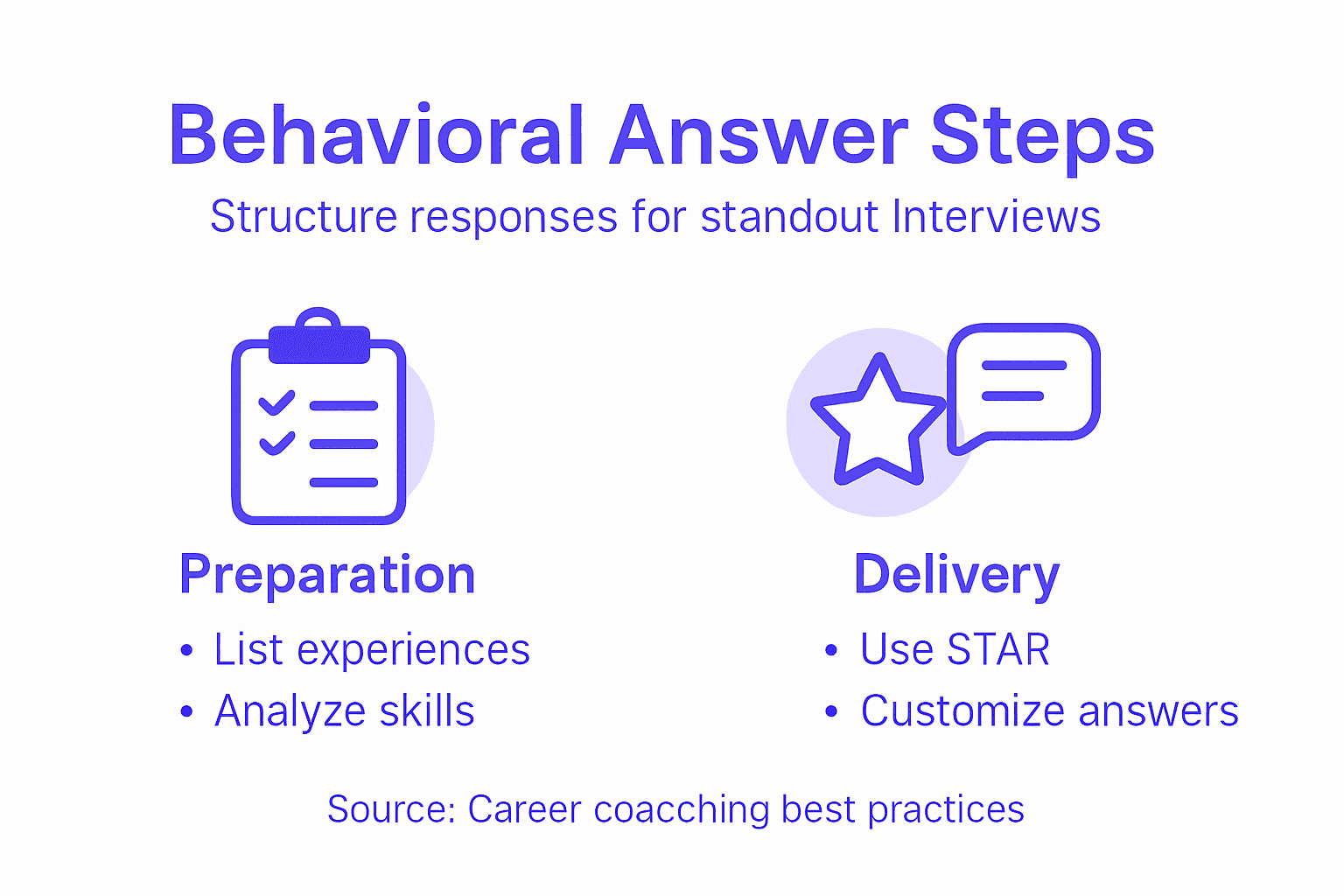
Now match your stories to those specific requirements. You probably have five experiences already prepared. One might highlight adaptability, another shows strong communication, a third demonstrates your problem-solving approach. For a startup role that values speed and flexibility, lead with your adaptability story. For a senior position emphasizing code quality and mentorship, pull out your code review and teaching experience.
Here’s how to customize without reinventing:
- Scan the job posting: Highlight technical skills, soft skills, and company values mentioned multiple times
- Connect your stories: For each required skill, identify which of your prepared examples demonstrates it best
- Adjust emphasis: Keep the core story the same, but emphasize different aspects of your action and results based on what matters to that role
- Research the team: Check the company’s engineering blog, GitHub, or Glassdoor to understand their challenges and culture
When tailoring responses to specific roles, you’re showing that you’ve done your homework and understand what success looks like in that position. A generic answer says you’re unprepared. A customized answer says you’ve thought about the role.
This doesn’t mean lying or stretching the truth. You’re simply choosing which true story to tell and which parts of it to emphasize. The debugging story you tell at a startup focused on reliability looks different from the same story told at a company struggling with technical debt.
See how customizing your behavioral answers benefits your interview performance:
| Strategy | Benefit | Risk if Ignored |
|---|---|---|
| Tailor to job description | Demonstrates preparation | Answers feel generic |
| Emphasize relevant skills | Shows role fit | Overlooks key requirements |
| Research company culture | Aligns with expectations | May mismatch company values |
| Update stories for audience | Boosts engagement | Stories lack impact |
Customization isn’t about fabricating experiences—it’s about strategic selection and emphasis of experiences you already have.
Pro tip: Create a simple spreadsheet with your story titles in one column and the skills each demonstrates in another column. Before every interview, scan the job description, identify required skills, and note which stories to lead with. This takes 10 minutes and prevents the “what story should I tell” panic during the interview.
Step 5: Review and refine your answers
You’ve built your STAR stories and customized them for specific roles. Now comes the part that separates confident candidates from nervous ones: actually practicing them out loud.
Rehearsing answers with feedback is where the magic happens. When you read your story silently, it sounds brilliant. When you say it aloud, you discover awkward phrasing, unnecessary details, and filler words that kill your credibility. The only way to know is to hear yourself speak.
Here’s what to look for when reviewing your answers:
- Length: Does your complete answer fit in 60-90 seconds? If you’re consistently running long, trim the situation or task section.
- Clarity: Can someone who knows nothing about your project follow your explanation? Remove jargon or explain it briefly.
- Specifics: Did you quantify results? “Improved performance” is weak. “Reduced load time from 3.2 seconds to 890 milliseconds” is strong.
- Your contribution: Does it sound like you led the effort, or did you just participate? Use “I decided,” “I proposed,” or “I diagnosed” rather than “we did.”
- Authenticity: Does it sound like you or like a rehearsed script? Some polish is good. Sounding robotic is not.
When practicing interview responses with feedback, ask someone to listen and point out where you lose momentum or where they got confused. A friend from your coding bootcamp, a mentor, or even a family member can spot problems you won’t see yourself.
Redo problem answers multiple times. If a story about conflict resolution feels weak, rewrite the action section to show more initiative. If your example of adaptability doesn’t emphasize the result enough, strengthen the outcome.
After each practice session, update your story. Keep a document with the refined versions so you’re not starting from scratch each time.
Refinement isn’t about memorizing perfect answers—it’s about becoming so familiar with your stories that you can tell them naturally, even under interview pressure.
Pro tip: Record yourself answering mock questions on your phone. Listen back to the recording during your commute or while exercising. You’ll catch verbal tics (“like,” “um,” “you know”), rushed pacing, and places where you need more emphasis. After hearing yourself three times, you’ll internalize the story in a way that feels genuinely conversational.
Master Behavioral Interviews With Real-Time AI Support
Preparing for behavioral questions is all about crafting authentic stories with clear structure like the STAR method and tailoring answers to match what employers want. Yet during the pressure of an interview, it can be tough to recall your best experiences, stay concise, and emphasize the outcomes that hiring managers care about most. That is where MeetAssist steps in to transform your preparation and live interviews.
MeetAssist is a powerful Chrome extension designed to listen and support you in real time during interviews. By providing AI-powered answer suggestions based on your resume and the conversation, it helps you deliver STAR-style responses with confidence. Whether you are practicing your adaptability story or need quick prompts on teamwork and problem-solving under pressure, MeetAssist’s Phone Mode keeps everything private and invisible on screen — so you focus fully on engagement while receiving discreet coaching. Don’t leave your behavioral interview guide success to chance. Visit MeetAssist now to unlock tailored AI guidance and master your answers for every role. Explore how to tailor your stories for impact with customizing behavioral answers, and start practicing with smart, dynamic prompts today.
Frequently Asked Questions
What are behavioral questions, and why are they important for interviews?
Behavioral questions are queries that ask about your past experiences to gauge how you’ve handled work situations. They are important because they help employers predict your future performance based on your demonstrated skills and competencies.
How can I prepare for behavioral questions before an interview?
To prepare, identify 5-7 significant projects or challenges from your career that showcase your skills. Write them in a situation-action-outcome format to easily recall and share during the interview.
What is the STAR method, and how can I use it to answer behavioral questions?
The STAR method stands for Situation, Task, Action, and Result. Use this structure to organize your responses, ensuring you clearly outline the context of your story, what you were responsible for, what actions you took, and the outcomes of those actions.
How can I customize my behavioral answers for different roles?
To customize your answers, carefully read the job description and identify the top 3-5 required skills. Match your prepared stories to these skills, adjusting the emphasis on different aspects of each story to show how your experience aligns with the specific role.
What should I focus on when practicing my answers for interviews?
When practicing, focus on the clarity and length of your answers. Aim to keep your STAR responses between 60-90 seconds, ensuring they are clear and quantifiable to make a strong impression.
How can I refine my stories to sound more authentic during an interview?
To refine your stories, practice them out loud and seek feedback from others. Listen for awkward phrasing or filler words and adjust your presentation until your answers feel natural and conversational.