

TL;DR:
- AI transcripts reveal subtle gaps and patterns missed during live interview practice.
- Reviewing transcripts helps candidates improve behavioral stories, technical reasoning, and communication clarity.
- Combining AI tools with human feedback creates an effective, data-driven interview preparation guides system.
Most candidates believe that practicing answers out loud is enough to ace an interview. It feels productive, it builds confidence, and it mimics the real thing. But AI transcripts reveal blind spots that even experienced applicants miss completely. Vague language, missing metrics, skipped edge cases — these patterns repeat silently until you see them written down. This article walks you through exactly how to use AI-generated transcripts to analyze and sharpen both your behavioral and technical interview responses, turning raw practice into a real competitive edge.
Table of Contents
- Why transcripts matter in interview preparation
- How to leverage AI transcripts for behavioral interviews
- AI transcripts in technical and coding interviews
- AI, objectivity, and human review: finding balance
- Rethinking interview mastery: use transcripts as your secret weapon
- Unlock better interview outcomes with MeetAssist
- Frequently asked questions
Key Takeaways
| Point | Details |
|---|---|
| Objective self-assessment | AI transcripts highlight vague responses and help you target real improvement. |
| Behavioral and coding boost | Using transcripts with frameworks accelerates mastery in both interview types. |
| AI plus human review | Blend AI analysis with manual checks for the best results. |
| Faster, smarter prep | Transcript-guided practice uncovers insights and saves time compared to guessing alone. |
Why transcripts matter in interview preparation
Most people treat interview practice as a performance exercise. You answer the question, it feels okay, and you move on. The problem is that memory is unreliable. You remember the general shape of your answer, not the specific words you used or the details you skipped. A transcript removes that filter entirely.
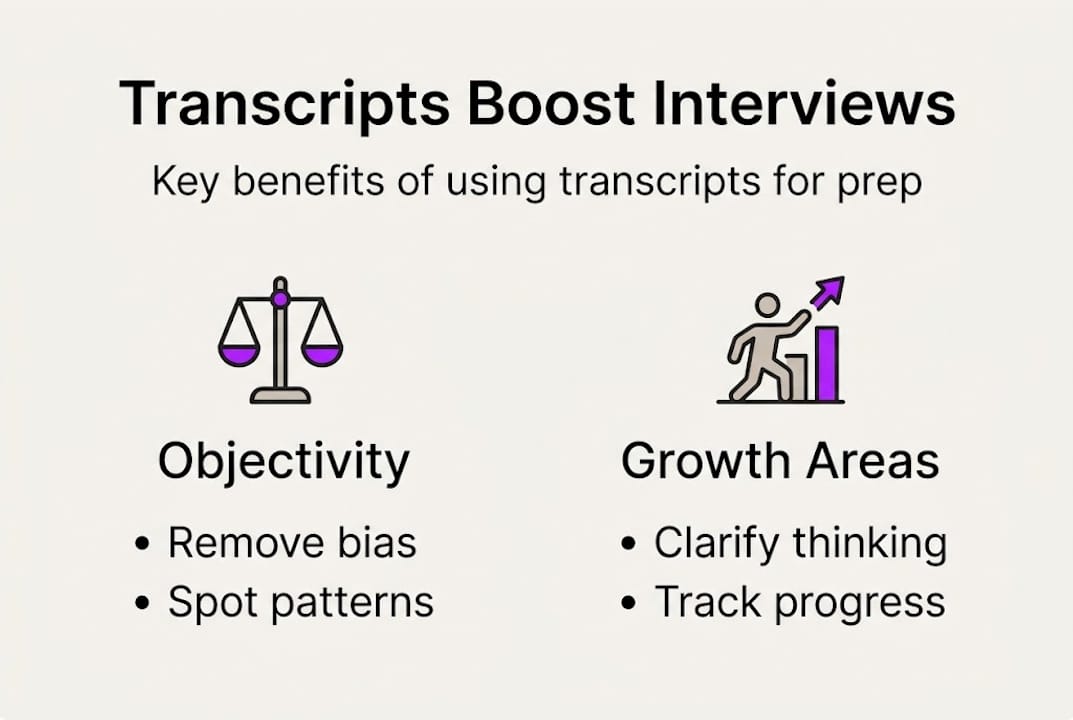
Transcripts give you an objective, word-for-word record of exactly what you said. That objectivity is powerful. When you read your own answer back, you immediately notice things you never would have caught in the moment. Filler phrases. Vague claims like “I helped improve the process” with no numbers attached. Technical explanations that jump straight to the solution without walking through the reasoning.
Here is what transcripts consistently expose:
- Vague behavioral stories that lack a clear Situation, Task, Action, or Result
- Generic language that could apply to any candidate at any company
- Missing quantifiable outcomes that make your impact impossible to measure
- Incomplete technical walkthroughs that skip edge cases or trade-off discussions
- Filler words and hedging phrases that undercut your confidence
“Transcripts reduce bias and enable evidence-based decision-making for recruiters and candidates alike.”
This matters for you as a candidate because it means your review process becomes data-driven, not gut-driven. You are not guessing what went wrong. You are reading it.
AI accelerates this process significantly. AI-based transcripts speed up mastery of behavioral frameworks like STAR and structured technical problem-solving by giving you instant, repeatable feedback loops. Instead of waiting for a coach or a friend to review your mock interview, you get analysis within seconds.
That said, AI review works best when combined with human judgment. Think of AI as your first-pass editor. It catches the obvious gaps fast. A human reviewer, whether a mentor, peer, or career coach, then adds the contextual layer that AI can miss. For using AI transcripts for self-review effectively, the goal is to build a rhythm: record, transcribe, analyze, revise, repeat. Pair that with confident interview preparation steps and you have a system, not just a habit.
How to leverage AI transcripts for behavioral interviews
Behavioral interviews reward structure and specificity above almost everything else. A great story told vaguely is a missed opportunity. Transcripts make the difference between a story that lands and one that falls flat visible in plain text.
Here is a step-by-step approach to using AI transcripts for behavioral prep:
- Record a mock answer to a common behavioral question, such as “Tell me about a time you resolved a conflict.”
- Generate a transcript using an AI tool that captures your exact words.
- Run the transcript through an AI review prompt asking it to evaluate your answer against the STAR framework: Situation, Task, Action, Result.
- Identify missing elements. Did you explain the specific situation clearly? Was your action described in concrete steps? Did you quantify the result?
- Rewrite the answer based on the gaps identified, then record and transcribe again.
- Check role alignment. Ask whether the story demonstrates skills the job description specifically calls for.
“Behavioral transcripts help candidates master STAR structure, specificity, and role alignment.”
The iterative loop here is the key. Most candidates do step one and stop. They record once, feel satisfied, and never revisit. Transcript-driven prep forces you to close the loop every single time.
Pro Tip: When reviewing your transcript, highlight every sentence that contains a number or a measurable outcome. If you finish a full STAR answer with fewer than two highlighted sentences, your result section is too vague. Quantify it before your next run-through.
For soft skills interview tips that go beyond the STAR method, look at how your transcript reads emotionally. Does your language show ownership and initiative, or does it sound passive? Phrases like “we kind of tried” versus “I led the team to” signal very different things to a hiring manager. For a deeper look at ethics and tips for AI interviews, it is worth understanding how AI feedback tools work before you rely on them fully.
AI transcripts in technical and coding interviews
Coding interviews are not just about getting the right answer. They are about showing your thinking out loud. Interviewers want to hear you reason through the problem, consider trade-offs, and catch edge cases before they prompt you. Transcripts expose exactly where that narration breaks down.

The most common mistake technical candidates make is going silent while they code. They focus on the solution and forget to verbalize their approach. When you review a transcript of that session, you see long stretches of nothing, followed by a sudden jump to the answer. That silence costs you points.
Here is what to watch for when reviewing technical transcripts:
- Gaps in reasoning where you jumped to a solution without explaining why
- Missing edge case discussions such as null inputs, empty arrays, or overflow conditions
- No trade-off analysis comparing time complexity versus space complexity
- Unclear variable naming explanations that make your logic harder to follow
| Area | Before transcript review | After transcript review |
|---|---|---|
| Problem approach | Jumped straight to coding | Verbalized approach and constraints first |
| Edge cases | Skipped entirely | Addressed null inputs and boundary values |
| Trade-offs | Not mentioned | Compared two approaches with reasoning |
| Communication | Silent during coding | Narrated each step clearly |
Pro Tip: Before your next coding practice session, set a rule: you must speak every 30 seconds. Narrate what you are thinking, even if it is incomplete. Then review the transcript to see how well your verbal reasoning matched your written code.
Transcripts enable candidates to analyze problem-solving approach, edge case coverage, and communication clarity in ways that watching a recording alone cannot match. Text is scannable. You can search for specific words, highlight patterns, and compare versions side by side. Explore coding interview AI tools designed specifically for this kind of analysis, and review technical interview automation impact to understand how these tools are reshaping hiring. For a broader preparation foundation, a solid coding prep interview guide can complement your transcript-based practice.
AI, objectivity, and human review: finding balance
AI transcripts are fast, consistent, and available at any hour. That makes them genuinely useful for high-volume practice. But they are not perfect, and understanding their limits helps you use them smarter.
| Dimension | AI transcript review | Human review |
|---|---|---|
| Speed | Instant | Hours or days |
| Consistency | High, same criteria every time | Variable by reviewer |
| Technical nuance | Often misses domain-specific jargon | Catches subtle errors |
| Emotional tone | Limited detection | Strong contextual reading |
| Cost | Low or free | Varies widely |
| Availability | 24/7 | Scheduled |
AI-generated transcripts save time and increase consistency but may miss technical nuance and jargon. That is not a flaw to avoid. It is a limitation to plan around. Use AI for your first three or four iterations. Then bring in a human reviewer for the final polish before a real interview.
Here is where human review still wins clearly:
- Complex technical domains where AI may misread specialized terminology
- Cultural and contextual fit signals that require lived experience to interpret
- Emotional intelligence cues in behavioral answers that AI scores inconsistently
- Final interview simulation where realistic pressure and rapport matter
AI is a tool for practice, not a final judge. Human review remains crucial for accuracy, especially when the stakes are high. The smartest approach treats AI as your always-available training partner and human reviewers as your pre-game coaches. For guidance on AI interview privacy tips and how to protect your data while using these tools, it is worth reading up before you start. And if you want to understand how the feedback actually works, the AI answer suggestion guide breaks it down clearly.
Rethinking interview mastery: use transcripts as your secret weapon
Here is the uncomfortable truth most interview guides skip: doing more mock interviews without reviewing transcripts is like practicing golf with your eyes closed. You are swinging, but you are not learning.
The candidates who improve fastest are not the ones who practice the most. They are the ones who review the most. Transcripts force you to confront the exact words you used, not the words you thought you used. That gap is where all the growth lives.
Patterns only become visible over multiple transcripts. One vague answer might be a bad day. Three vague answers on the same type of question is a habit. No live coach catches that in real time. A stack of transcripts makes it undeniable.
Smart candidates use AI interview tool alternatives to compare approaches and find what works for their specific gaps. The goal is not to practice until you feel confident. It is to practice until the transcript shows you are consistent. Feeling and data are very different things, and in a competitive job market, data wins.
Unlock better interview outcomes with MeetAssist
You now have a clear framework for turning transcripts into a genuine prep advantage. The next step is having the right tool to make it effortless in real time.
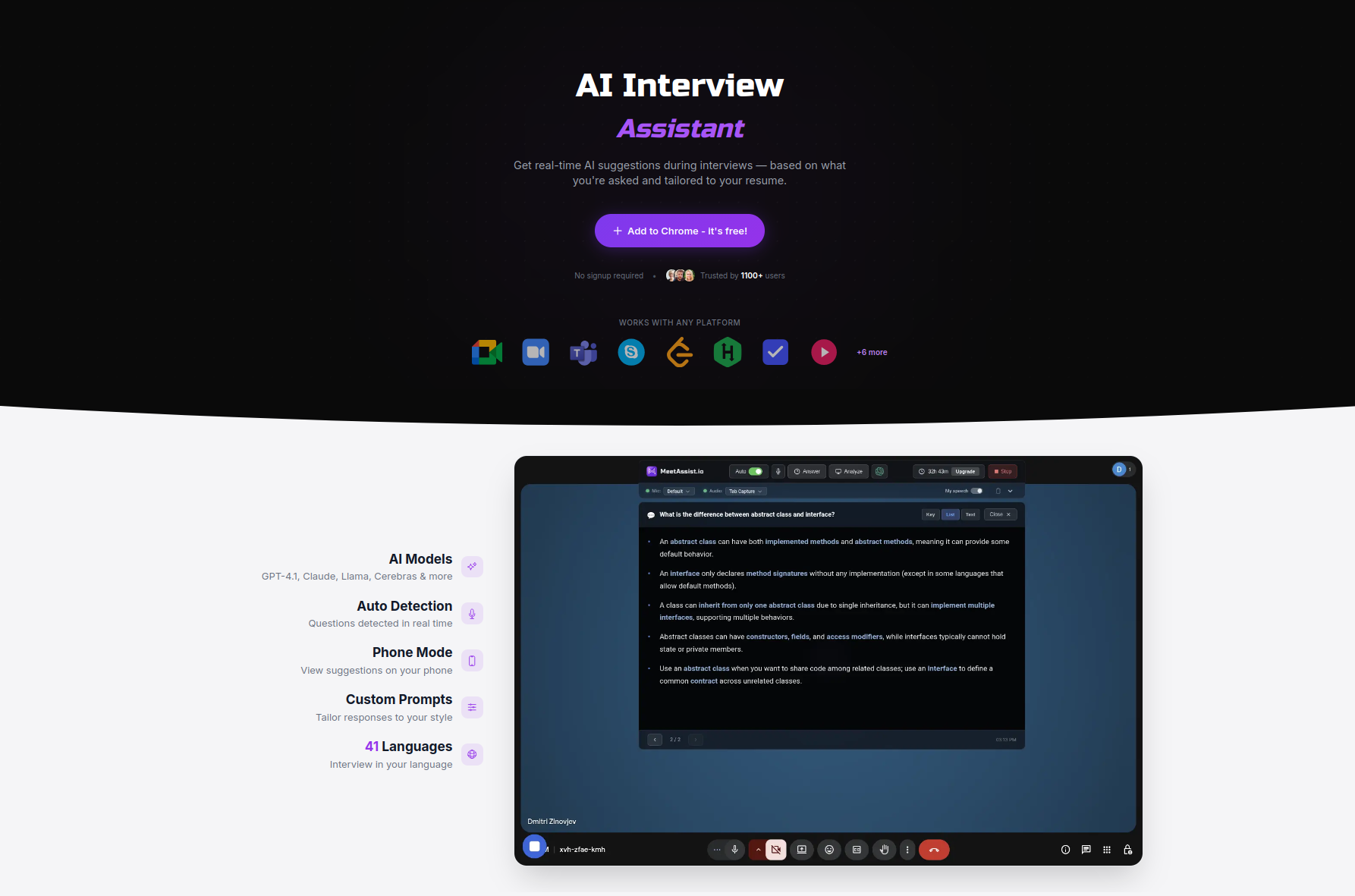
MeetAssist is a Chrome extension that generates live AI-powered suggestions during your actual interviews on Google Meet, Microsoft Teams, and other platforms. With Phone Mode, all transcripts and AI feedback move to your phone so nothing appears on your screen. You can even analyze coding challenges remotely from your phone. Explore top transcript tools to compare your options, or go straight to MeetAssist’s AI transcript features to see how real-time support can sharpen every answer you give. No subscription required.
Frequently asked questions
How do AI transcripts improve interview performance?
AI transcripts let candidates spot vague language, missed details, and repeating mistakes, so practice becomes targeted rather than repetitive. Transcripts accelerate mastery of structure and specificity faster than unreviewed practice alone.
Are AI transcripts accurate for technical terms and jargon?
Not always. Manual review is recommended for technical nuance, since AI may misinterpret domain-specific terminology and specialized phrasing.
Can recruiters use transcripts for decision-making?
Yes. Transcripts reduce bias and provide objective evidence that supports fairer, more consistent hiring decisions across candidates.
What frameworks can AI transcripts help improve?
They are especially effective for the STAR method in behavioral interviews and structured reasoning in coding walkthroughs. Transcripts clarify STAR structure and help candidates identify where their logic breaks down under pressure.
Recommended
- MeetAssist
- How NLP transforms job interviews: boost confidence & success | MeetAssist
- Master the STAR Interview Method for Interview Success | MeetAssist
- Video Interview Success: 80% Fewer Tech Failures Guaranteed – MeetAssist | MeetAssist
- TEFL interview tips to boost confidence in 2026 | TEFL Institute
- 6 Smart Tips for Successful Visa Interview Preparation