

As the landscape of remote interviewing changes rapidly, understanding what remote interview assistance truly entails is key to preparing effectively. Cheating rates in remote and proctored technical assessments have surged sharply in recent years, creating both challenges and opportunities for job seekers. Remote interview assistance, especially AI driven tools, is a growing but misunderstood phenomenon among professionals seeking career advancement. This article clarifies what remote interview assistance means and how it can help you succeed while maintaining privacy and authenticity throughout your interview journey.
Table of Contents
- Why Remote Interviews Need AI Assistance: Context And Challenges
- What Is Remote Interview Assistance? Exploring Tools, Features, And AI Capabilities
- Detection, Privacy, And Ethics: The Nuanced Reality Of AI Assistance In Remote Interviews
- Practical Ways To Prepare And Succeed Using Remote Interview Assistance
- Discover MeetAssist For Seamless Remote Interview Support
- Frequently Asked Questions About Remote Interview Assistance
Key takeaways
| Point | Details |
|---|---|
| Live interviews defend against cheating | Human interviewers observe real-time problem solving, making authentic evaluation possible even with AI assistance available. |
| AI provides tailored real-time guidance | Modern tools deliver contextual support for coding challenges, system design questions, and behavioral interview guide responses. |
| Privacy features enable discreet assistance | Stealth modes, voice commands, and invisible overlays help candidates access support without obvious detection. |
| Ethical use requires balance | Combining AI assistance with genuine skills demonstrates authentic competence while leveraging modern workplace tools. |
Why remote interviews need AI assistance: context and challenges
Remote work’s rise means more technical interviews happen virtually than ever before. 61% of individuals now prefer working from home, transforming how companies evaluate technical talent and conduct hiring processes. This shift creates unique pressures for both employers seeking qualified candidates and job seekers demonstrating their capabilities through screens rather than face to face interactions.
Fraud and cheating attempts in proctored and unproctored online assessments have surged, challenging hiring integrity across industries. Organizations struggle to verify authentic skills when candidates complete assessments in unmonitored environments. These trends create pressure for authentic evaluation methods and support systems that help candidates demonstrate real skills while maintaining fairness throughout the hiring process.
Cheating and fraud attempt rates for proctored assessments more than doubled in 2025, rising from 16% to 35%, according to CodeSignal detection systems.
Candidates face several common challenges in remote technical interviews:
- Increased anxiety from performing under virtual observation without physical presence cues
- Technical distractions including connectivity issues, unfamiliar platforms, and screen sharing complications
- Unfair practices by other candidates creating perceived disadvantages for honest job seekers
- Need for privacy preserving assistance that enhances rather than replaces authentic demonstration of skills
- Pressure to compete against candidates potentially using unauthorized support without detection
These realities explain why AI interview assistance has emerged as a crucial tool for candidates seeking fair opportunities. Understanding these challenges clarifies why remote interview assistance has become essential for modern job seekers navigating virtual hiring processes.
What is remote interview assistance? Exploring tools, features, and AI capabilities
Remote interview assistance refers to real-time AI support during virtual interviews that enhances your thinking, answers, and confidence without obvious intrusion. These tools analyze conversation context, provide relevant suggestions, and help you articulate responses more effectively while maintaining your authentic voice and problem solving approach.

Tools like Cluely offer interactive prompts, context memory, and real-time guidance in coding, system design, and behavioral interview segments. The technology adapts to different interview formats, providing specialized support whether you’re debugging code, explaining architectural decisions, or responding to behavioral questions using frameworks like STAR method.
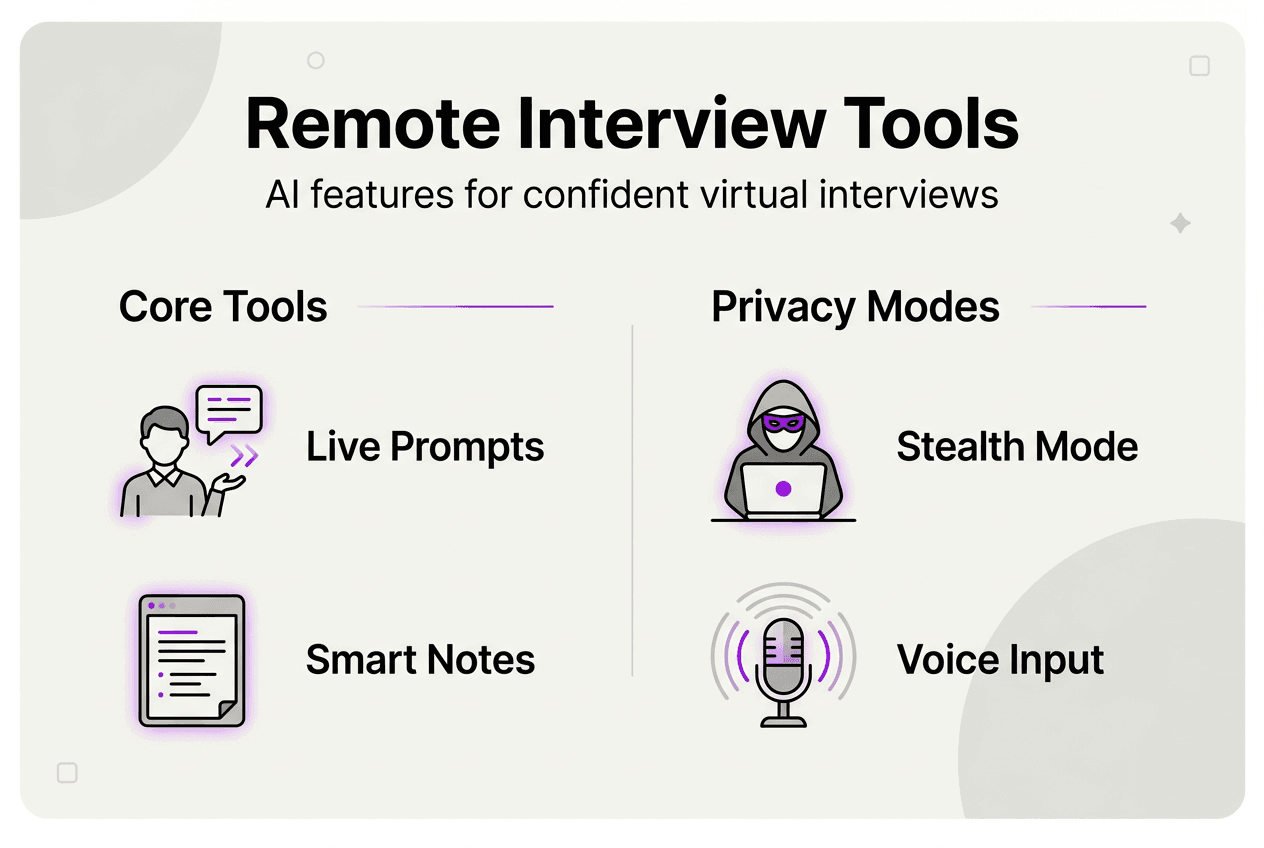
Privacy protections include stealth mode features such as invisible overlays, voice commands, and click through UI designed to avoid detection. Cluely delivers live, in-call assistance with contextually relevant responses that drive in the moment productivity without creating obvious visual indicators that might alert interviewers to external support.
| Feature | AI Assistance Tools | Human Coaching | Self Prep Only | | — | — | — | | Real-time guidance | Live suggestions during interview | Pre-interview advice only | No live support | | Context awareness | Analyzes conversation flow | Limited to practice scenarios | Relies on memory | | Privacy features | Stealth mode, voice commands | Not applicable | Fully private | | Cost | One-time or subscription | High hourly rates | Free but time intensive | | Availability | 24/7 on demand | Scheduled sessions | Self directed |
Key features that distinguish modern AI interview assistance include:
- Live transcription capturing interview dialogue for reference and analysis
- Automated summaries highlighting key discussion points and commitments
- Action item detection identifying follow up tasks and next steps
- Objection handling suggestions for sales oriented interviews
- Resume integration for personalized response recommendations
- Multi-model AI support including GPT-4.1, Claude, Llama, and Cerebras
Pro Tip: Start using AI assistance tools during confident interview preparation mock sessions to familiarize yourself with features and minimize distraction during actual interviews. Practice helps you integrate assistance naturally without obvious pauses or screen checking that might raise interviewer concerns.
Having defined what remote interview assistance entails, we next explore the nuances around detection, privacy, and ethical considerations that shape responsible use of these emerging technologies.
Detection, privacy, and ethics: the nuanced reality of AI assistance in remote interviews
How human interviewers detect cheating and improper AI use during live interviews centers on observing candidate behavior and response patterns. Experienced interviewers recognize when answers lack authentic thought processes or when candidates demonstrate inconsistent knowledge across related topics.
Most misuse of AI is easy to detect by looking for continuous screen switching, instant solutions without visible problem solving, inconsistent explanations that suggest external input, and pasted code that candidates cannot adequately explain. These red flags signal to interviewers that candidates rely on unauthorized assistance rather than demonstrating genuine competence.
Live interviews are still the strongest defense against cheating because interviewers observe how candidates think and problem solve, according to Karat’s research on technical interview integrity.
Privacy is enhanced through tools featuring stealth mode capabilities using invisible overlays and voice commands. These technologies allow candidates to access assistance without creating obvious visual indicators that might alert interviewers. Encrypted data streams and lack of audio or video recording further protect candidate privacy throughout the interview process.
Ethical considerations create tension between gaining assistance and preserving authenticity and fairness in hiring. The debate centers on whether AI support levels the playing field for nervous candidates or creates unfair advantages that undermine merit based evaluation.
Ethical perspectives on AI interview assistance:
- Pros: Reduces anxiety, compensates for communication challenges, mirrors real workplace tool usage, helps neurodiverse candidates, levels access to coaching
- Cons: May mask genuine skill gaps, creates detection arms race, disadvantages honest candidates, undermines interview validity, raises fairness questions
The technical interview automation impact extends beyond individual candidates to reshape how organizations evaluate talent. Companies increasingly recognize that banning all AI assistance ignores workplace realities where employees regularly use AI tools for daily tasks.
Pro Tip: Use remote interview assistance to enhance your authentic capabilities rather than mask deficiencies. Focus on tools that help you articulate knowledge you genuinely possess rather than generating answers to questions beyond your expertise. This approach maintains ethical boundaries while leveraging legitimate support.
Understanding these detection and ethical factors helps clarify responsible and effective use of AI interview assistance in ways that benefit both candidates and employers seeking authentic talent evaluation.
Practical ways to prepare and succeed using remote interview assistance
Integrating AI assistance ethically requires deliberate preparation and strategic implementation. Follow these steps to maximize benefits while maintaining authenticity:
- Research tool capabilities thoroughly to understand what support each platform provides and which features align with your interview needs
- Practice using tools extensively in low stakes mock interviews to build familiarity and reduce cognitive load during actual interviews
- Focus on genuine understanding of concepts rather than memorizing AI generated responses that you cannot explain or defend
- Test stealth modes and privacy features to ensure they function reliably without creating obvious visual indicators
- Review feedback from practice sessions to identify where assistance helps most and where you need deeper knowledge development
- Combine AI suggestions with your own analytical thinking to create responses that reflect authentic problem solving approaches
| Outcome Measure | AI Assistance Used | Self Prep Only | Over-reliance on AI | | — | — | — | | Confidence level | High with support | Moderate to low | False confidence | | Response quality | Enhanced articulation | Variable consistency | Inconsistent depth | | Interviewer perception | Natural competence | Authentic but unpolished | Suspicious patterns | | Skill demonstration | Augmented abilities | Raw capabilities | Masked deficiencies | | Long-term success | Sustainable performance | Growth potential | Risk of exposure |
Balance assistance with your own skills to demonstrate authentic competence that translates to actual job performance. Employers increasingly value candidates who effectively combine human judgment with AI tools, recognizing this reflects modern workplace realities.
Pro Tip: Practice with tools during step by step interview preparation to minimize latency or distraction issues. Run multiple mock sessions to identify optimal settings, understand response timing, and develop smooth integration between your thinking and AI suggestions.
Human plus AI interviews are the clearest way to see who will thrive in an AI enabled workplace, according to Karat’s assessment framework. This perspective suggests that demonstrating effective AI collaboration during interviews actually provides valuable signals about your readiness for modern technical roles.
The key is viewing AI powered interview guidance as a complement to your expertise rather than a replacement for genuine knowledge. Candidates who master this balance position themselves as forward thinking professionals ready to leverage emerging technologies while maintaining the critical thinking skills that drive innovation.
With these practical strategies, you can confidently harness remote AI assistance for your interview success while maintaining the authenticity and ethical standards that lead to sustainable career growth.
Discover MeetAssist for seamless remote interview support
After learning how to prepare using AI tools, MeetAssist offers a practical, trustworthy solution to enhance your remote interviews. The platform provides AI powered, real-time guidance designed specifically for coding challenges, system design questions, and behavioral interviews that job seekers face daily.
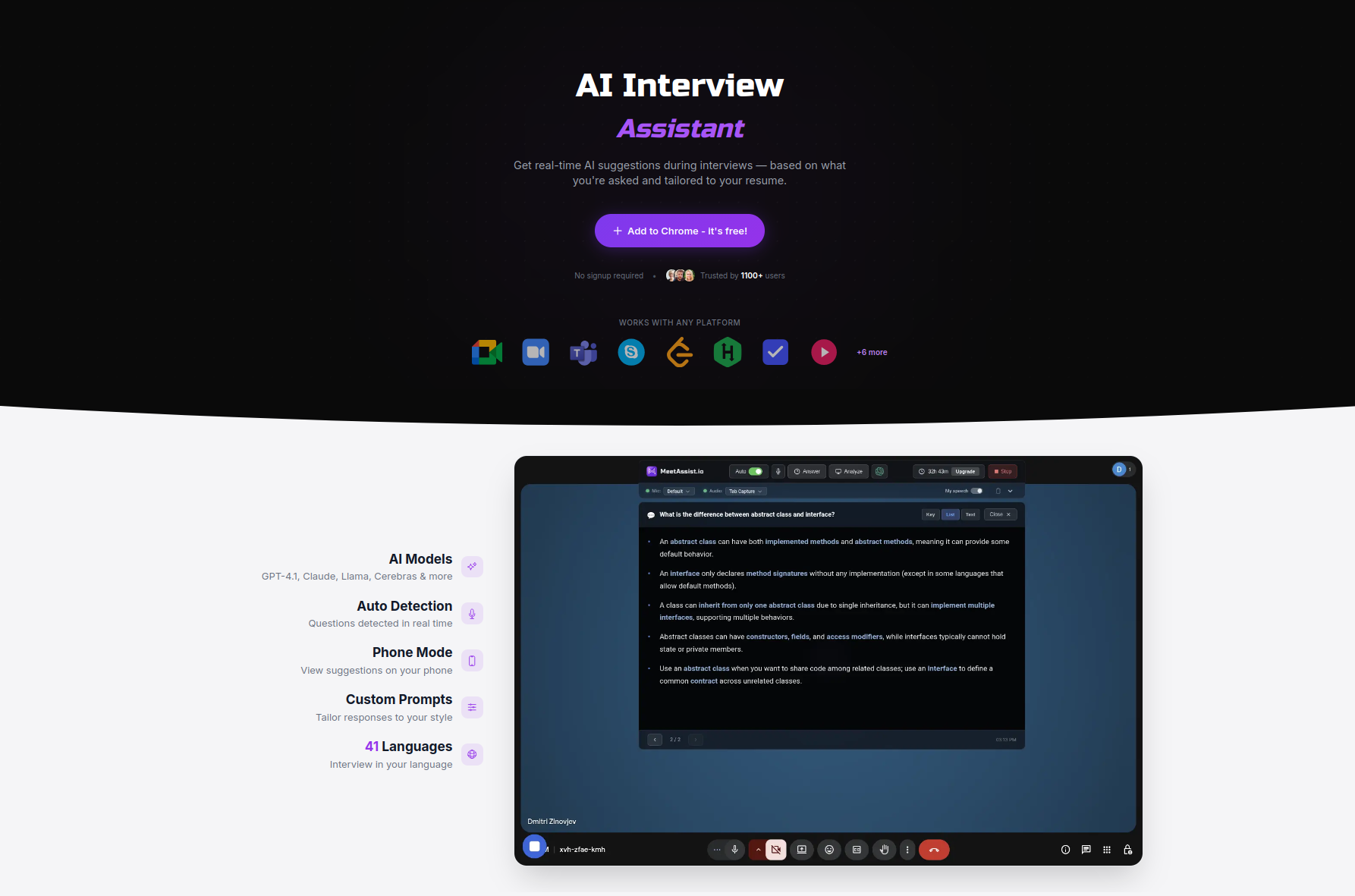
MeetAssist features privacy respecting real-time assistance including voice commands and stealth UI elements that keep support invisible on your screen. Phone Mode syncs all transcripts, AI suggestions, and screen analysis to your mobile device, removing any visible extension from your computer entirely. Users benefit from live transcripts, automated summaries, and actionable interview coaching that adapts to your unique background when you upload your resume.
Key benefits include:
- Multiple AI model support including GPT-4.1, Claude, Llama, and Cerebras for diverse response styles
- Customizable answer formats from concise bullet points to detailed STAR method responses
- Remote screen capture analyzing any active Chrome tab from your phone
- Encrypted data streams with no audio or video recording for maximum privacy
- One-time purchase pricing with no recurring subscriptions
Explore the MeetAssist platform to see how real-time AI assistance transforms your interview performance. Whether you’re preparing for technical assessments or behavioral interviews, MeetAssist provides the discrete, powerful support you need. Check out specialized resources like UX designer interview questions to see how the platform adapts to different roles and interview formats.
Frequently asked questions about remote interview assistance
What is remote interview assistance and how does it work?
Remote interview assistance uses AI to provide real-time guidance during virtual interviews by analyzing conversation context and generating relevant suggestions. The technology listens to interview dialogue, processes questions and responses, then offers tailored recommendations that help you articulate answers more effectively while maintaining your authentic voice and problem solving approach.
Is using AI assistance during interviews ethical and safe?
Using AI assistance ethically depends on how you implement it and whether it enhances genuine capabilities rather than masks skill gaps. Many employers recognize that AI collaboration reflects modern workplace realities where professionals regularly use technology to augment their performance. The key is maintaining authenticity and using assistance to articulate knowledge you actually possess rather than fabricating expertise you lack.
How can I maintain privacy when using AI assistance?
Maintain privacy through tools offering stealth mode features like invisible overlays, voice commands, and phone based interfaces that remove visible extensions from your computer screen. Look for platforms using encrypted data streams without recording audio or video. Practice with privacy features extensively before actual interviews to ensure they function reliably without creating detection risks.
Does AI assistance improve actual interview performance?
AI assistance improves interview performance by reducing anxiety, helping you articulate complex ideas clearly, and providing structured frameworks for responses. The technology works best when you possess genuine knowledge and use assistance to enhance communication rather than generate answers beyond your expertise. AI interview prep can boost confidence and help you present your authentic capabilities more effectively.
What are the risks of relying too much on AI during remote interviews?
Over-reliance on AI creates risks including inconsistent explanations that raise interviewer suspicions, inability to defend or elaborate on AI generated responses, and false confidence that leads to accepting roles beyond your actual skill level. Excessive dependence also prevents you from developing genuine problem solving abilities and may result in poor job performance if hired based on artificially inflated interview capabilities.
Recommended
- AI interview assistance: boost job success in 2026 – MeetAssist | MeetAssist
- Job Interview Answer Strategies 2026: Boost Success 35% – MeetAssist | MeetAssist
- AI Interview Prep in 2026: Boost Confidence by 35% – MeetAssist | MeetAssist
- Confident Interview Preparation Steps for Technical Success – MeetAssist | MeetAssist