

TL;DR:
- AI-driven platforms now generate adaptive questions and assess soft skills in remote, asynchronous formats.
- Success requires understanding AI scoring, practicing with realistic tools, and strengthening communication.
- Combining AI prep with soft skills, system design, and tailored strategies is essential for 2026 technical interviews.
Technical interviews in 2026 look almost nothing like they did just three years ago. AI-driven platforms now generate adaptive questions on the fly, remote and asynchronous formats have become the default rather than the exception, and soft skills carry as much weight as your ability to reverse a binary tree. If you’re preparing for a software engineering or data science role, the rules of the game have shifted dramatically. This article walks you through what hiring teams now look for, how AI is reshaping every stage of the process, and the specific tools and strategies you need to walk into your next interview with a real edge.
Table of Contents
- Key criteria for success in 2026 technical interviews
- How AI is transforming technical interviews
- The rise of remote and asynchronous interview formats
- In-demand skill areas and what companies evaluate now
- Tools and resources to get ahead in 2026 technical interviews
- Why embracing AI and soft skills is now the only interview strategy that works
- Level up your interview prep with AI-powered support
- Frequently asked questions
Key Takeaways
| Point | Details |
|---|---|
| AI and remote are standard | Most technical interviews now use AI-driven questions and remote platforms. |
| Soft skills matter | Communication and adaptability are as important as technical know-how. |
| Prep with smart tools | Using AI-based prep platforms boosts your interview confidence and performance. |
| Master asynchronous formats | You must be ready to excel in timed and video-based remote assessments. |
| Blend tech and people skills | The most successful candidates combine strong technical abilities with real human insight. |
Key criteria for success in 2026 technical interviews
With the stakes higher than ever, it’s essential to know exactly what sets successful candidates apart. The checklist has grown. Technical depth still matters, but it’s no longer enough on its own. Hiring managers now screen for a much broader set of qualities, and missing even one can knock you out of a competitive process.
Here’s what strong candidates bring to the table in 2026:
- AI-assessment readiness: You need to understand how automated scoring works and how to perform well under it.
- Data structure and algorithm fluency: Arrays, trees, graphs, dynamic programming. These remain the core of most coding rounds.
- Clear verbal reasoning: Explaining your thought process out loud is now a scored criterion on many platforms.
- Collaboration signals: Pair programming rounds and scenario-based questions test how you work with others, not just whether you can code.
- A polished remote setup: Lighting, audio quality, and a clean background directly affect first impressions on video.
- Practice with realistic AI tools: Using AI interview prep strategies before your interview simulates the actual conditions you’ll face.
Soft skills are now a standard part of technical interviews, according to current hiring trends. That means your communication style, adaptability, and ability to handle ambiguity are being evaluated right alongside your code output.
Pro Tip: Record a mock session and watch it back. Most candidates are surprised by how rarely they vocalize their thinking. Narrating your problem-solving process is a skill that needs practice just like any algorithm.
How AI is transforming technical interviews
Mastering the key criteria often means leveraging the latest technology, especially AI. Artificial intelligence has moved from a novelty to the backbone of most major technical interview platforms. Companies like HackerRank, Codility, and Karat now use AI engines to generate questions, score responses, and detect patterns in candidate behavior.

| Feature | Traditional interviews | AI-powered interviews |
|---|---|---|
| Question difficulty | Fixed by the interviewer | Adapts in real time to your responses |
| Scoring | Subjective, interviewer-dependent | Consistent, rubric-based |
| Feedback speed | Days or weeks | Immediate or within hours |
| Bias risk | Higher | Reduced (though not eliminated) |
| Prep requirement | General problem practice | Platform-specific strategy needed |
AI-driven platforms provide instant feedback and adjust question difficulty based on how you respond, which means a slow start can snowball into harder problems faster than you’d expect. Understanding this dynamic changes how you approach the first few questions: treat them as anchors for your difficulty ceiling, not warm-ups.
The candidates who succeed aren’t the ones who cram the most LeetCode problems. They’re the ones who understand why an AI platform is asking what it’s asking, and adjust their communication accordingly.
The challenge is that AI-scored rounds offer less human nuance. You won’t get the subtle nod that tells you you’re on the right track. Learning how to use AI for interviews effectively means training yourself to self-calibrate without those cues.
Pro Tip: Run timed practice sessions on the actual platform you’ll be assessed on, not just generic coding sites. Each platform has its own interface quirks, and familiarity buys you mental bandwidth during the real thing.
The rise of remote and asynchronous interview formats
As AI-driven platforms take center stage, so too do remote and flexibly timed interview formats. Remote and asynchronous formats now dominate technical interviews, requiring new preparation strategies that many candidates underestimate.
You’ll likely encounter one of these common formats:
- Live video coding: A shared code editor over Zoom or Google Meet, with a human or AI observer.
- Timed take-home assessments: You get a window of hours to complete a project or problem set independently.
- One-way video responses: You record yourself answering behavioral questions with no live interviewer present.
- Asynchronous pair programming: Collaborative tools with a delayed review cycle.
| Format | Key challenge | How to prepare |
|---|---|---|
| Live video coding | Managing nerves and narrating simultaneously | Practice talking while coding |
| Timed take-home | Time management and scope control | Set internal checkpoints every 30 minutes |
| One-way video | No feedback loop or body language cues | Record and review multiple practice takes |
For remote interview success, your technical setup matters more than most candidates realize. A laggy connection or a noisy background costs you cognitive points with reviewers, even subconsciously. Test everything 24 hours in advance.
The biggest pitfall is treating asynchronous formats as lower stakes. They’re not. Reviewers often hold recorded responses to a higher standard because they can rewatch them. Resources on improving remote interview performance show that candidates who prepare specifically for async formats significantly outperform those who use generic prep alone.
Pro Tip: For one-way video rounds, practice answering with a two-sentence structure: first, state your conclusion, then explain your reasoning. Reviewers skim, and leading with your answer keeps them engaged.
In-demand skill areas and what companies evaluate now
Remote platforms and AI support are only part of the equation. Your skills are still central. There is increased emphasis on practical coding, real-time problem solving, and collaborative communication across virtually every tech hiring process in 2026.
Here’s what employers are actively screening for:
- System design competency: Can you architect a scalable service under time pressure? This is now tested at every level, not just senior roles.
- Behavioral adaptability: How you respond to a problem you’ve never seen before reveals more than a rehearsed solution.
- Ethics and responsible AI awareness: As more roles touch AI systems, companies want to know you can reason about the implications of your code.
- Communication under uncertainty: Talking through incomplete information without freezing is a core skill.
To build these skills, follow this sequence:
- Build a project portfolio with one or two real problems you’ve solved, not just tutorial clones.
- Do at least 10 mock interviews using AI-powered tools to simulate actual conditions.
- Study system design fundamentals with resources like Grokking the System Design Interview.
- Practice out-loud reasoning every day, even on simple problems.
- Seek feedback from a senior engineer at least once before your target interview date.
Customizing your interview strategy to the specific company and role dramatically improves your conversion rate. Generic prep gets generic results.
Tools and resources to get ahead in 2026 technical interviews
With the skills in mind, the right resources can make all the difference in your preparation. Not every tool is worth your time, so here’s how to evaluate what actually moves the needle.
Key qualities to look for in any prep tool:
- Personalization: Does it adapt to your skill gaps, or does it just throw random problems at you?
- Coverage: Does it cover coding, system design, behavioral, and communication skills?
- Feedback quality: Is the feedback specific and actionable, or just a score?
- Cost vs. value: Free tools are great for volume practice. Paid tools often deliver the structured feedback you need to break through plateaus.
Follow this sequence to build an effective toolkit:
- Start with free platforms (LeetCode, HackerRank) to build coding volume.
- Add an AI-powered mock interview tool for realistic behavioral and system design practice.
- Use an analytics-driven platform to identify your specific weak spots.
- Practice under timed, realistic conditions at least twice a week for four weeks before your interview.
- Review every session with a critical eye, not just to feel good about what went right.
Integrating AI prep tools can increase interview confidence by up to 35%, which compounds into better performance when you’re actually in the hot seat. Confidence directly affects how clearly you communicate and how quickly you recover from a stumble.
Pro Tip: Combine AI tool feedback with at least one human mock interview per week. AI is excellent at consistency and scale. Humans catch the subtle communication habits that automated tools miss entirely.
Why embracing AI and soft skills is now the only interview strategy that works
After covering the practical steps, there’s a bigger-picture truth worth saying plainly. A lot of candidates still think there’s a single magic formula: grind enough LeetCode, memorize enough patterns, and the job offer follows. That worked in 2019. It doesn’t anymore.
The candidates we see succeed with AI interview assistance are not just technically sharp. They’re self-aware. They know when their explanation isn’t landing. They adjust mid-conversation. They treat communication as a skill to train, not a personality trait they either have or don’t.
Here’s the uncomfortable reality: AI-powered interviews expose gaps that human interviewers sometimes overlook out of politeness or familiarity. The platform doesn’t know you’re nervous. It just scores what it sees. That means your preparation has to be honest. You have to practice until the discomfort disappears, not until you feel ready.
The candidates who consistently land offers in 2026 are the ones who treat technical skill and human communication as equally non-negotiable. Neither alone is enough. Together, they’re close to unstoppable.
Level up your interview prep with AI-powered support
Having mastered these trends and strategies, the right prep partner can take your performance even further. MeetAssist is built exactly for this moment in hiring. It provides real-time AI suggestions during live interviews, syncs entirely to your phone via Phone Mode so nothing is visible on screen, and supports multiple AI models including GPT-4.1 and Claude for personalized, adaptive responses.
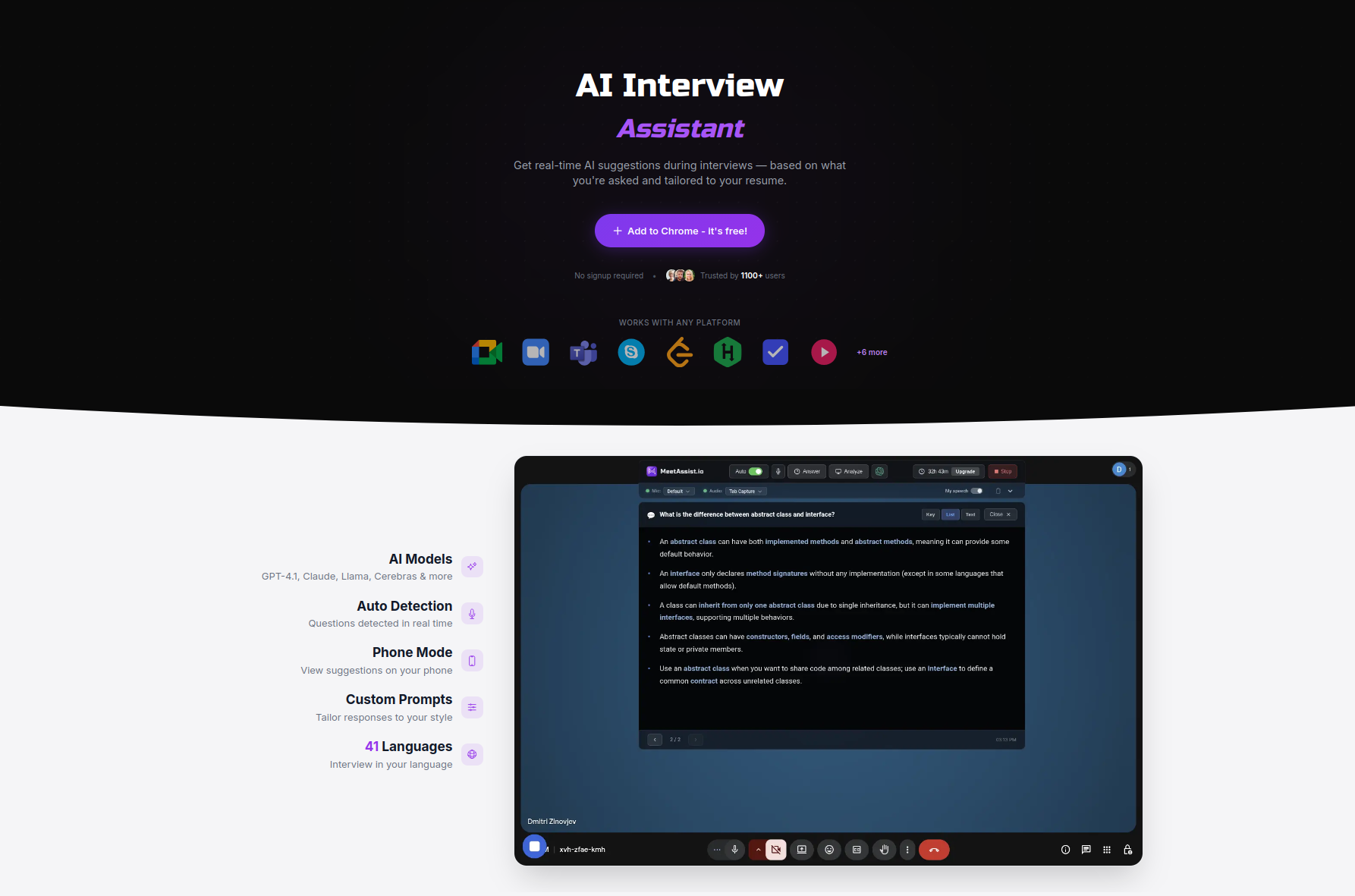
Whether you’re facing a timed coding challenge, a behavioral round, or an async video response, MeetAssist adapts to your format. You can upload your resume for tailored answers and choose your preferred response style, from concise bullet points to full STAR method. If you want to explore AI interview assistant alternatives or go straight to the MeetAssist platform, both are worth a look before your next interview date.
Frequently asked questions
What are the biggest changes in technical interviews for 2026?
AI, remote, and soft skills are the three dominant shifts reshaping technical interviews this year. Candidates who ignore any one of these three areas will find themselves at a serious disadvantage compared to peers who train for all of them.
How can I practice for AI-powered technical interviews?
Use AI-driven mock interview tools and practice solving adaptive coding questions under timed conditions on the actual platforms your target companies use. Familiarity with the platform mechanics reduces cognitive load during the real interview.
Are remote interviews harder than in-person ones?
Remote interviews require more self-direction and deliberate preparation, but most candidates who invest in setup and async-specific practice find them manageable and sometimes less stressful than sitting across a table.
What technical skills are employers prioritizing in 2026?
Strong coding ability, system design fluency, and collaborative communication skills top the employer priority list. Ethics awareness and adaptability to ambiguous problems are rapidly becoming expected at mid-level and above.
Can AI interview prep tools really improve my performance?
Yes. AI tools boost candidate confidence by up to 35%, and higher confidence directly correlates with clearer communication and faster recovery when you hit a hard question mid-interview.
Recommended
- How to improve interview performance in 2026: remote & AI | MeetAssist
- AI Interview Prep in 2026: Boost Confidence by 35% – MeetAssist | MeetAssist
- Remote interview assistance for confident job success 2026 – MeetAssist | MeetAssist
- Soft skills interview tips for tech candidates in 2026 | MeetAssist
Looking for help with your next interview? MeetAssist provides real-time AI assistance during your video interviews on Google Meet, Zoom, and Teams. Browse our interview preparation guides to get started.