

TL;DR:
- Coding challenge AI aids with implementation, logic, and debugging but struggles with novel algorithms and edge cases.
- Effective use involves practicing independently, reviewing solutions with AI, and balancing ethical considerations.
- Combining AI tools with human review and strategic preparation enhances interview success and long-term skill development.
Most engineers already know what coding challenge AI can do. 76% of engineers use AI daily for coding tasks, yet a surprising number of job seekers still walk into technical interviews without a clear plan for using these tools effectively. The gap isn’t access. It’s strategy. Knowing which tools to use, when to use them, and how to avoid the pitfalls that trip up even experienced candidates can be the difference between an offer and a rejection. This guide breaks down everything you need to know about coding challenge AI so you can prepare smarter and perform with real confidence.
Table of Contents
- What is coding challenge AI?
- Strengths and limitations of coding challenge AI
- How job seekers use coding challenge AI for interviews
- Choosing and combining coding challenge AI tools
- The uncomfortable truth most experts miss about coding challenge AI
- Next steps: Find the best coding challenge AI tool
- Frequently asked questions
Key Takeaways
| Point | Details |
|---|---|
| AI powers faster interview prep | Coding challenge AI gives instant feedback, boosts practice, and helps candidates sharpen skills. |
| Benchmarks show real limits | AI tools excel at medium difficulty but struggle with edge cases and hard coding problems. |
| Ethics and detection matter | Stealth tools carry risks, ethical use is vital, and you should always check platform compatibility. |
| Human review is essential | Combine AI tools with hands-on practice and human review for genuine interview readiness. |
What is coding challenge AI?
Coding challenge AI refers to any artificial intelligence tool designed to help you solve, analyze, or optimize programming problems, specifically in the context of technical interviews and coding assessments. These tools range from simple hint generators to full code assistants that can write, debug, and explain solutions in real time.
Understanding what coding challenge AI does at a functional level helps you use it more intentionally. At its core, this category of AI sits at the intersection of code generation, natural language understanding, and real-time feedback.
Here’s a breakdown of the main types:
- Hint generators: Nudge you toward the right approach without giving away the full solution. Great for learning.
- Full code assistants: Generate complete solutions based on a problem prompt. Useful for practice but risky in live settings.
- Stealth interview helpers: Tools designed to run invisibly during live coding sessions, often with screen-reading and audio-capture capabilities.
- Debugging tools: Identify errors, suggest fixes, and flag edge cases in your existing code.
- Explanation engines: Break down complex algorithms in plain language so you understand the logic, not just the output.
Who uses these tools? Mostly job seekers preparing for technical rounds at companies ranging from startups to top-tier tech firms. But engineers at all levels use them for daily work, and some interviewers even use AI to generate new problem sets.
“Some interview tools claim 100k+ users with zero detections and documented offers at FAANG companies.”
That kind of reach tells you this isn’t a niche trend. Coding challenge AI has become a real part of the technical interview ecosystem, and candidates who ignore it are preparing with one hand tied behind their back. The key is knowing which type of tool fits your situation and using it with enough discipline to actually build skill alongside speed.
Strengths and limitations of coding challenge AI
Knowing what these tools can do is only half the picture. The other half is knowing where they fall apart, and that’s where most candidates get blindsided.
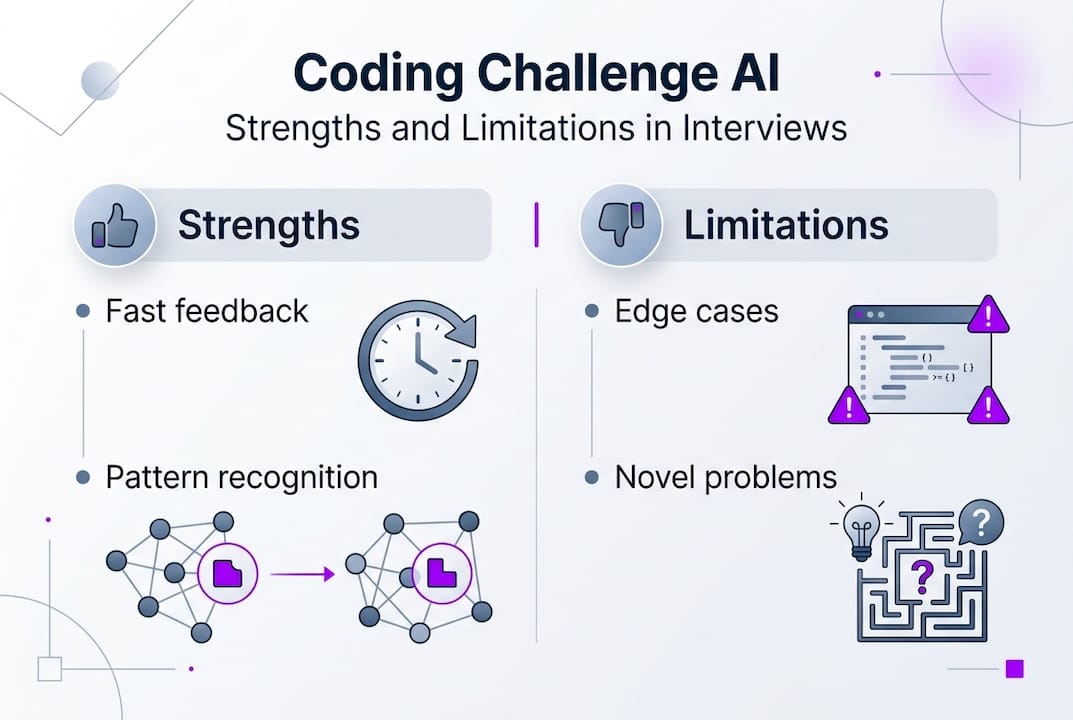
Where coding challenge AI genuinely excels:
- Implementation tasks: Writing boilerplate, translating pseudocode to working code, and handling standard data structures.
- Logic flow: Structuring loops, conditionals, and recursion correctly on the first pass.
- Medium-difficulty problems: Most AI tools perform well on LeetCode medium problems that follow recognizable patterns.
- Debugging: Catching syntax errors, off-by-one mistakes, and common runtime issues quickly.
Here’s a quick look at how top models benchmark across challenge types:
| Tool | HumanEval score | Medium LeetCode | Hard/Novel problems |
|---|---|---|---|
| Claude 3.5 Sonnet | 64% pass rate | Strong | Weak |
| GPT-4.1 | ~70%+ | Strong | Moderate |
| Llama 3 | ~55% | Moderate | Weak |
| Gemini 1.5 Pro | ~60% | Strong | Moderate |
Where coding challenge AI consistently struggles:
- Novel algorithm design: Problems that require inventing a new approach rather than applying a known pattern.
- Edge case handling: Tools fail on edge cases in interactive problems and problems with heavy observation requirements.
- Hard competitive coding: Top-tier competitive problems that require multi-step reasoning and creative insight.
- Conceptual gaps: If your understanding of the underlying concept is wrong, AI will often reinforce the mistake rather than correct it.
For deeper context on how these benchmarks are evaluated, benchmarking coding AI research shows that benchmark saturation is a real problem. Tools can score well on standardized tests while still failing on real-world interview problems that deviate slightly from the training distribution.
Before you factor in AI risks and ethics or the broader AI impact in interviews, you need to understand this core limitation: AI is a pattern matcher, not a thinker.
Pro Tip: Use AI to check your solution after you’ve attempted it yourself. This builds real understanding and helps you catch the gaps AI misses.
How job seekers use coding challenge AI for interviews
Now that you know where coding challenge AI shines and stumbles, let’s walk through how job seekers actually use these tools in interview scenarios.
The workflow looks different depending on whether you’re at home practicing or sitting in a live interview.
At-home practice workflow:
- Use tools like GitHub Copilot or Gemini Code Assist for ethical prep and coding practice. These are well-documented, widely accepted, and genuinely improve your speed.
- Attempt the problem first without AI. Then use AI to review your solution, not write it.
- Ask AI to generate variations of the same problem so you can stress-test your understanding.
- Use explanation features to understand why a solution works, not just that it works.
During live interviews:
This is where the landscape gets more complex. Some candidates use stealth tools that run invisibly in the background. Stealth tools like Interview Coder are built specifically for live interview use, with features designed to avoid detection. The risk is real, though. Many platforms are increasing their monitoring capabilities, and the ethical stakes are high.

Here’s a quick comparison of tool types:
| Tool type | Best for | Detection risk | Ethical standing |
|---|---|---|---|
| GitHub Copilot | Practice, daily coding | Low | Accepted |
| Stealth helpers | Live interviews | Moderate to high | Controversial |
| Hint generators | Learning, prep | None | Fully ethical |
| Screen AI tools | Real-time analysis | Varies | Depends on context |
For candidates preparing for a Google interview with AI or following a structured interview prep with AI plan, the ethical path is always the stronger long-term strategy. You can find nuanced AI interview strategies that balance performance with integrity, and understanding AI privacy for interviews matters especially when tools are capturing screen content.
Pro Tip: Always test your chosen tool with the specific interview platform before the actual interview. Compatibility issues are common and can cost you critical minutes when it matters most.
Choosing and combining coding challenge AI tools
Once you understand how coding challenge AI fits your workflow, the next step is choosing and combining the right tools for maximum results.
No single tool does everything well. The candidates who perform best in technical interviews usually run a layered approach: one tool for practice, one for real-time hints, and their own brain for the final call.
How to choose the right tool:
- Match the tool to the task. Use mainstream assistants for practice and learning. Use specialized tools for interview-specific workflows.
- Check benchmark scores for the problem types you’ll face. A tool that scores high on HumanEval may still fail on dynamic programming or graph problems.
- Consider your interview platform. Some coding environments block browser extensions. Others don’t. Know your setup before the day of the interview.
- Prioritize tools with strong explanation features. Understanding why a solution works is more valuable than getting a correct answer you can’t defend.
Combining tools effectively:
AI is strong on implementation and logic but weak on novel reasoning and edge cases. The fix is combining AI output with human review. After AI generates a solution, you should manually trace through it with two or three edge cases before trusting it. This catches the errors that cost you the most in live settings.
You can explore top coding challenge AI tools to find options that fit your specific interview type, and if you’re considering stealth tools, reviewing Interview Coder alternatives gives you a solid comparison of what’s available and how they differ in features and risk profile.
Benchmarks matter, but they saturate quickly. A tool that ranked first six months ago may now be outpaced by newer models. Prioritize tools with active development and real user feedback from candidates who’ve used them in actual interviews.
Pro Tip: Spend at least two sessions per week solving problems completely on your own, without any AI. This is the only way to know what you actually understand versus what you’ve been borrowing from the model.
The uncomfortable truth most experts miss about coding challenge AI
Most guides treat coding challenge AI like a cheat code. Get the tool, pass the interview, collect the offer. But that framing skips something important.
Over-reliance on AI during prep creates a specific kind of blind spot. You get faster at producing correct-looking code without getting better at reasoning through problems. That gap shows up the moment an interviewer asks you to explain your approach or modify your solution on the fly.
Detection risk isn’t theoretical either. Platforms are catching up faster than most candidates realize. The tools that claimed zero detections last year are facing a different landscape today. Ethical use of AI for interviews isn’t just a moral stance. It’s a practical one.
The candidates who land and keep top roles are the ones who used AI to accelerate their learning, not replace it. They practiced with AI, reviewed with AI, and then solved problems without it. That combination builds the kind of real fluency that survives a tough technical round.
Next steps: Find the best coding challenge AI tool
You now have a clear picture of what coding challenge AI can and can’t do, how to use it responsibly, and how to combine tools for the best results. The next move is finding the right setup for your specific interviews.
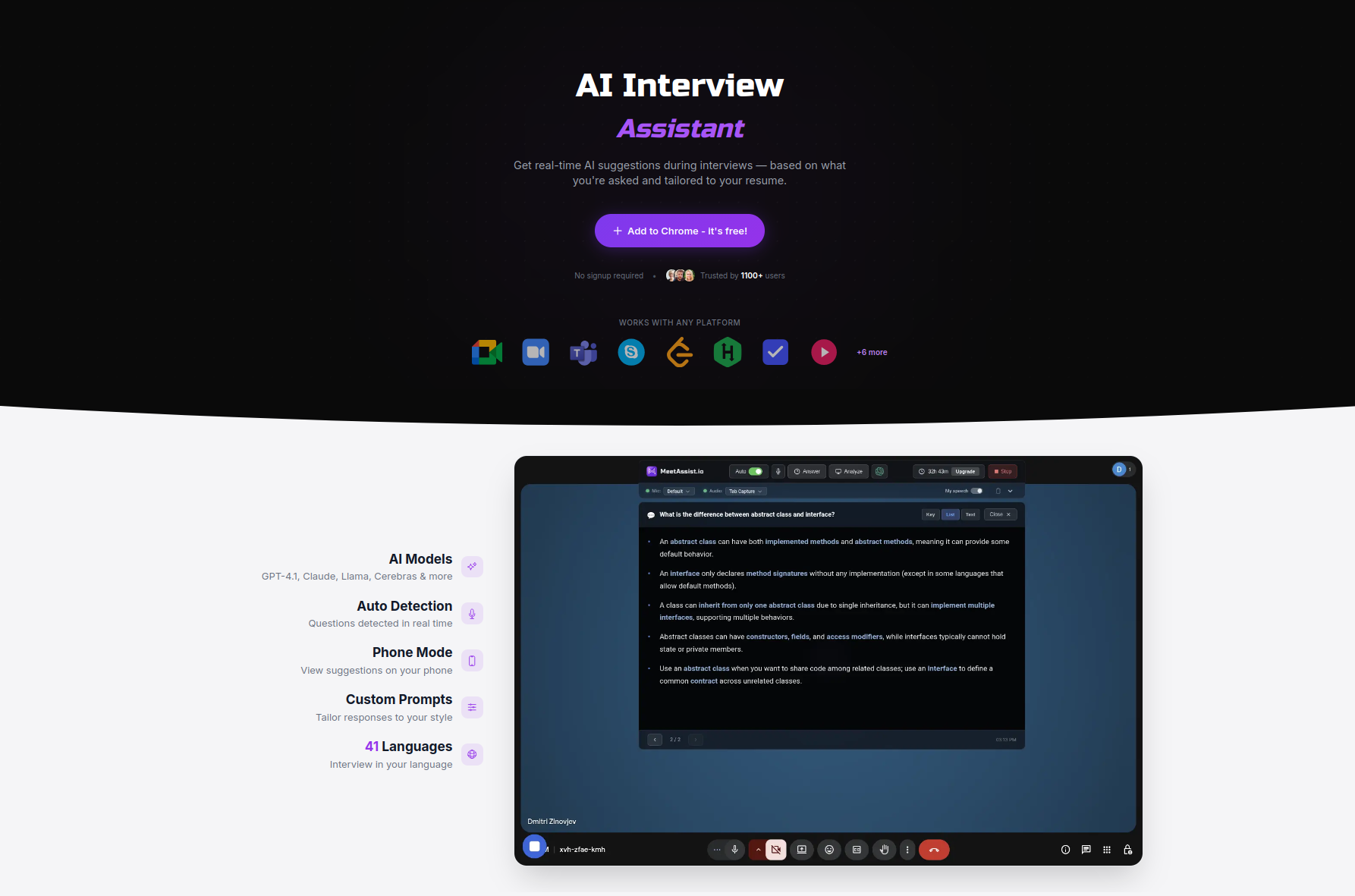
MeetAssist gives you real-time AI assistance during live interviews and technical assessments, with Phone Mode keeping everything off your screen entirely. You can compare AI interview assistants side by side, explore ethical usage guides, and get personalized AI responses based on your resume. No subscriptions, no recordings, and full encryption on every session. If you’re serious about your next technical interview, this is where to start.
Frequently asked questions
Are coding challenge AI tools detectable during live interviews?
Detection isn’t guaranteed, but many platforms are increasing scrutiny. While some tools claim zero detections at FAANG companies, stealth tools carry real risk and ethical use remains the stronger long-term strategy.
What are the main limitations of coding challenge AI?
AI struggles with novel algorithms, edge cases, and hard competitive problems. Human review is essential for catching conceptual gaps that AI tends to miss or reinforce.
Can coding challenge AI help me prepare for FAANG interviews?
Yes, especially for practice and pattern recognition. Some tools document FAANG offers from users, but combining AI with hands-on problem solving gives you the strongest preparation.
Is it ethical to use coding challenge AI in job interviews?
Ethics depend on employer policy and how the tool is used. AI excels on benchmarks but real-world gaps exist. Use AI for practice, not live answers, and disclose if the employer requires it.
Recommended
- AI in job interviews: tools, ethics, and success tips | MeetAssist
- AI Interview Assistant Alternatives — Compare Top Tools (2026) | MeetAssist
- How to use AI in interviews for job success in 2026 | MeetAssist
- What are AI answer suggestions? A guide for job seekers | MeetAssist
- Choose the best AI interview tools for confident answers | Pavone Academy
Looking for help with your next interview? MeetAssist provides real-time AI assistance during your video interviews on Google Meet, Zoom, and Teams. Browse our interview preparation guides to get started.