Landing a technical role in 2026 requires more than coding prowess. Companies like Google now weigh soft skills 50/50 with technical ability in hiring rubrics, yet 72% of ML hiring managers report candidates struggle to explain technical concepts clearly. The disconnect is real: brilliant engineers fumble interviews because they can’t articulate their problem-solving process or collaborate effectively under pressure. AI-powered interview preparation guides tools now offer real-time feedback to bridge this gap, transforming how tech candidates master communication, adaptability, and emotional intelligence. This guide delivers actionable soft skills interview tips tailored to technical roles, leveraging AI insights to help you showcase both your code and your character.
Table of Contents
- Why Soft Skills Matter Equally In Technical Interviews
- Top 5 Soft Skills Interview Tips Powered By Ai Feedback
- Comparing Traditional Vs Ai-Assisted Soft Skills Interview Preparation
- Deciding When And How To Integrate Ai Tools In Your Interview Preparation
- Boost Your Interview Soft Skills With Meetassist
- FAQ
Key takeaways
| Point | Details |
|---|---|
| Soft skills equal technical skills | Top tech firms now split hiring decisions 50/50 between hard and soft competencies. |
| Communication clarity is critical | 72% of hiring managers cite poor technical explanation as a top candidate weakness. |
| AI feedback drives improvement | Real-time AI coaching improves non-verbal communication scores by 15% on average. |
| AI boosts hiring accuracy | AI-assisted interview preparation increases hiring success rates by 20 percentage points. |
Why soft skills matter equally in technical interviews
The technical interview landscape has shifted dramatically. Hiring managers no longer evaluate candidates solely on algorithm efficiency or system design chops. Soft skills like communication clarity, teamwork, adaptability, and emotional intelligence now carry equal weight in hiring rubrics at leading tech companies. This evolution reflects the collaborative nature of modern software development, where engineers must explain complex architectures to non-technical stakeholders, resolve conflicts in code reviews, and pivot quickly when product requirements change.
Recent data reveals the gap: 72% of ML hiring managers note candidates fail to communicate technical concepts in accessible language, even when their solutions are technically sound. This communication breakdown costs talented engineers job offers. Recruiters want candidates who can translate their technical brilliance into clear narratives that demonstrate problem-solving processes, not just final answers.
Soft skills encompass several dimensions:
- Communication clarity: Explaining technical decisions without jargon overload
- Teamwork: Demonstrating collaboration in past projects and conflict resolution
- Adaptability: Showing flexibility when requirements shift or feedback challenges your approach
- Emotional intelligence: Reading interviewer cues and adjusting your communication style accordingly
These competencies aren’t innate talents reserved for extroverts. They’re learnable skills that improve with deliberate practice and feedback. Understanding why soft skills matter sets the foundation for targeted preparation. The next step is mastering specific techniques to showcase these abilities effectively, which is where AI-powered tools create measurable advantages. For deeper strategies on behavioral questioning, explore behavioral interview tips for developers to complement your soft skills preparation.
Top 5 soft skills interview tips powered by AI feedback
AI tools revolutionize how candidates prepare for the soft skills portion of technical interviews. These platforms analyze your practice sessions in real time, providing objective feedback that traditional methods can’t match. Here are five actionable techniques enhanced by AI coaching:
-
Practice verbal clarity with AI speech analysis: Record yourself explaining a technical project using an AI tool that evaluates pacing, filler words, and jargon density. The AI flags moments where you lose clarity or speak too quickly, helping you refine your delivery. Aim for explanations a non-technical friend could follow, using analogies to bridge complex concepts.
-
Monitor non-verbal communication with AI video feedback: AI platforms track eye contact patterns, posture shifts, and hand gestures during mock interviews. Real-time feedback mechanisms enhance candidate self-awareness and improve interview delivery measurably. You’ll discover unconscious habits like looking away during difficult questions or crossing your arms defensively.
-
Master storytelling through AI-guided STAR method practice: Use AI tools to structure your project narratives using Situation, Task, Action, Result frameworks. The AI evaluates whether your stories highlight collaboration, problem-solving, and impact clearly. Strong technical storytelling transforms dry project descriptions into compelling evidence of your soft skills.
-
Simulate behavioral questions with AI-driven scenarios: AI interview simulators generate common behavioral questions tailored to technical roles, then score your responses on relevance, specificity, and emotional intelligence. This repetition builds muscle memory for handling curveball questions about conflict resolution or failed projects.
-
Refine adaptability responses using AI suggestion analysis: When AI tools generate alternative answers to your practice responses, analyze why certain phrasings work better. This meta-analysis sharpens your ability to pivot your communication style based on interviewer feedback or unexpected question angles.
Pro Tip: Schedule AI practice sessions weekly starting two months before your interview. Consistency matters more than cramming. Each session reveals incremental improvements in your soft skills delivery that compound over time.
For comprehensive guidance on leveraging AI throughout your preparation, review ai-powered interview guidance and confident interview preparation steps to build a complete strategy.
Comparing traditional vs AI-assisted soft skills interview preparation
Choosing the right preparation method impacts your interview performance significantly. Traditional approaches and AI-assisted tools each offer distinct advantages and limitations. Understanding these differences helps you design a balanced prep strategy.
Traditional preparation typically includes mock interviews with peers or mentors, self-study of common behavioral questions, and video recording for self-review. These methods provide human intuition and personalized advice based on the mentor’s experience. However, they suffer from scheduling constraints, potential bias in feedback, and limited objectivity in scoring your performance.
AI-assisted preparation delivers real-time feedback, objective scoring based on linguistic and behavioral analysis, and infinite scalability. You can practice at 2 AM without coordinating schedules. AI-assisted interviews improve hiring accuracy by nearly a fifth compared to traditional screening methods. Candidates using AI tools report higher conversational quality and improved soft skill scores across communication, adaptability, and problem-solving dimensions.

Here’s a direct comparison:
| Feature | Traditional Prep | AI-Assisted Prep |
|---|---|---|
| Feedback speed | Delayed, post-session | Instant, real-time |
| Objectivity | Subject to human bias | Data-driven scoring |
| Availability | Limited by schedules | 24/7 access |
| Cost | Often free or low-cost | Subscription or one-time fee |
| Personalization | High, based on mentor insight | Adaptive algorithms |
| Scalability | Limited practice volume | Unlimited sessions |
Drawbacks exist for both approaches. Traditional prep may reinforce bad habits if your mentor lacks interviewing expertise or shares outdated advice. AI tools can feel impersonal and may miss nuanced cultural fit signals that human interviewers detect. Overreliance on AI-generated answers risks sounding scripted rather than authentic.
The optimal strategy combines both methods. Use AI tools for volume practice and objective baseline assessments, then supplement with human mentorship for nuanced feedback on industry-specific expectations and company culture alignment. This hybrid approach maximizes the strengths of each method while mitigating their weaknesses.
Pro Tip: After each AI practice session, discuss one flagged weakness with a human mentor. This bridges the gap between data-driven insights and contextual understanding.
Explore using AI for interview success and technical interview automation impact to understand how AI reshapes technical hiring beyond soft skills alone.
Deciding when and how to integrate AI tools in your interview preparation
Timing and integration strategy determine how effectively AI tools enhance your soft skills. Starting too late limits the iterative improvement cycle, while poor integration creates workflow friction that reduces practice consistency.
Begin AI-assisted practice early, ideally 6 to 8 weeks before your interview timeline. This window allows you to establish baseline measurements, identify specific weaknesses, and track improvement across multiple practice cycles. Early adoption builds comfort with the technology, so the tools feel natural rather than distracting during high-stakes preparation.
Use AI feedback after completing traditional prep to identify blind spots objectively. Your self-assessment and peer feedback provide one perspective, but AI analysis reveals patterns you might miss. For example, you might believe you maintain good eye contact, but AI tracking could show you look away 40% of the time during technical explanations. This data-driven insight targets your practice more effectively.
Complement AI tools with human mentorship for nuanced feedback that algorithms can’t capture. While AI excels at measuring speech patterns and body language, experienced mentors understand company-specific culture fit and industry expectations. They provide context about why certain soft skills matter more at startups versus enterprise companies, or how communication styles differ between product and infrastructure teams.
Integrate AI tools into daily practice by focusing on specific soft skills each week. Week one might target communication clarity, week two adaptability responses, week three non-verbal communication. This focused approach prevents overwhelm and allows you to measure progress incrementally. Set concrete goals like reducing filler words by 50% or increasing direct eye contact to 70% of speaking time.
The data supports this approach. AI-selected finalists reported new jobs at rates 17 percentage points higher than traditionally screened candidates. This hiring advantage stems from the compound effect of consistent, targeted practice guided by objective feedback.
Pro Tip: Export your AI feedback reports weekly and track metrics in a simple spreadsheet. Visualizing your improvement curve motivates continued practice and helps you identify which techniques deliver the fastest gains.
For remote interview scenarios where AI assistance becomes even more valuable, review remote interview assistance tips and phone-assisted interview preparation impact to understand the full range of AI capabilities.
Boost your interview soft skills with MeetAssist
Mastering soft skills interview tips requires more than reading advice. You need real-time feedback during actual practice that mirrors live interview pressure. MeetAssist delivers AI-driven analysis of your interview performance across communication clarity, body language, and confidence markers. The platform provides tailored coaching on improving how you explain technical concepts, maintain engaging eye contact, and adapt your responses based on interviewer cues.
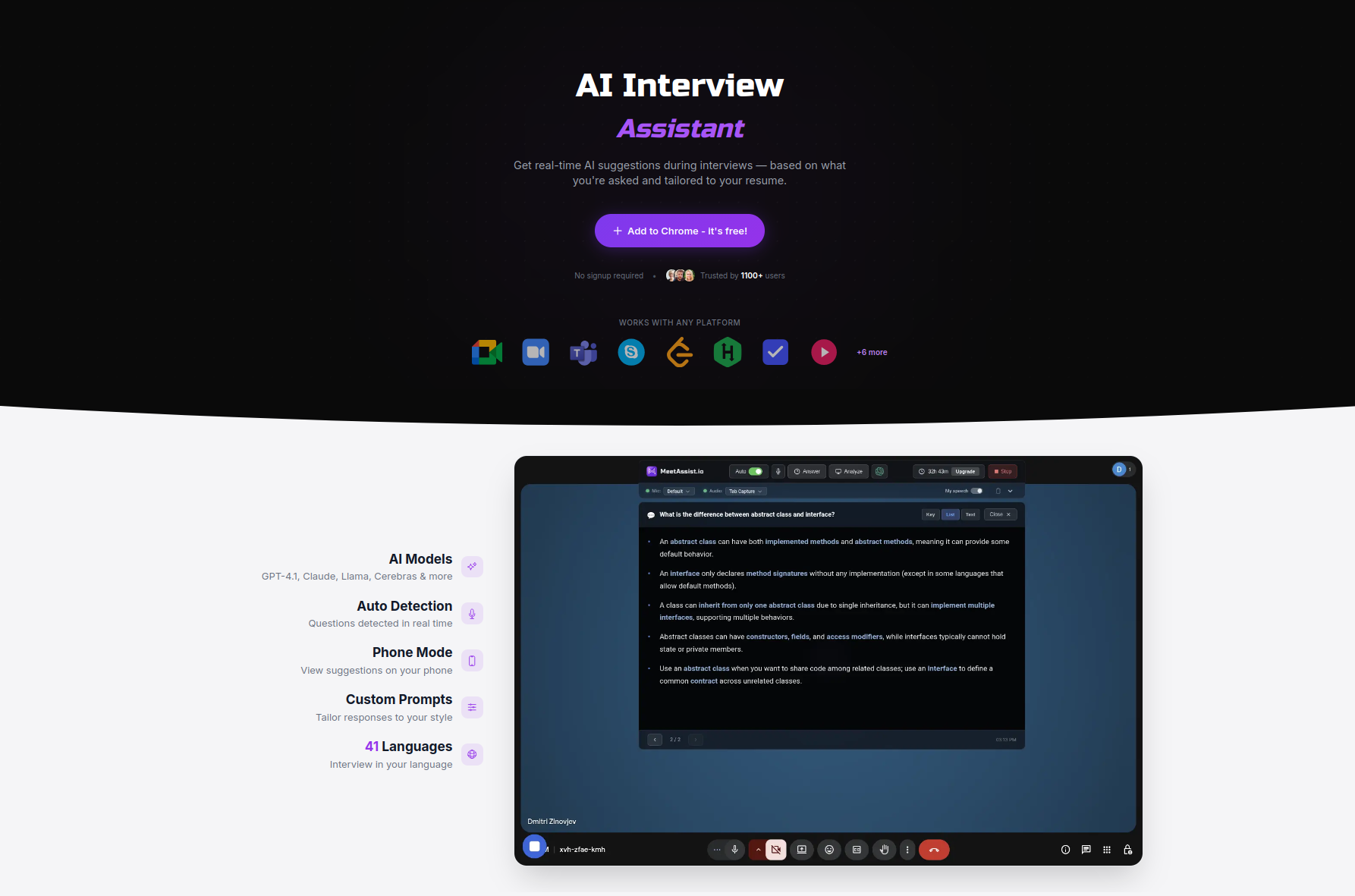
Thousands of tech candidates have elevated their hiring success using MeetAssist’s real-time guidance. The Chrome extension integrates seamlessly with Google Meet and Microsoft Teams, analyzing your practice sessions or actual interviews to deliver instant improvement suggestions. Phone Mode removes all visible traces from your screen, syncing feedback directly to your mobile device for maximum discretion. Try MeetAssist early in your preparation cycle to maximize your interview readiness and transform your soft skills from weakness to competitive advantage.
FAQ
What are the key soft skills to highlight in technical interviews?
Communication clarity, problem-solving, teamwork, and adaptability top the list of soft skills technical recruiters evaluate. Emphasize your ability to explain complex concepts simply, using analogies that non-technical stakeholders understand. Demonstrate teamwork through specific examples of collaborative debugging or cross-functional project work. Show adaptability by describing how you pivoted when requirements changed mid-sprint or when initial technical approaches failed.
How does AI improve interview preparation compared to traditional methods?
AI provides real-time feedback, objective scoring, and personalized coaching that traditional methods can’t match at scale. This leads to a 20% increase in hiring accuracy over traditional prep alone. AI tools analyze hundreds of micro-behaviors in your speech patterns, body language, and response structure, identifying improvement opportunities that human observers miss. You can practice unlimited scenarios at any time without scheduling constraints.
Can AI interview tools help with non-verbal communication skills?
Yes, AI tools analyze and coach eye contact, posture, and gestures in real time during practice sessions. Candidates using real-time feedback features showed a 15% improvement in non-verbal communication scores. The technology tracks where your eyes focus during responses, whether you lean forward engagingly or slouch defensively, and how your hand gestures either reinforce or distract from your verbal messages. Users report measurable improvements in non-verbal communication scores within weeks of consistent practice.
When should I start using AI tools to prepare for my technical interview?
Begin AI-assisted practice early, ideally 6 to 8 weeks before your interview timeline. This window allows multiple practice cycles where you establish baselines, receive feedback, implement changes, and measure improvement. Early adoption builds familiarity with the technology so it feels natural rather than distracting during high-pressure preparation. Use AI tools alongside traditional prep methods like mock interviews with mentors for best results, combining objective data insights with human intuition about company culture and role-specific expectations.