

Landing your dream job in 2026 means mastering how to use AI in interviews. Traditional preparation methods leave candidates underprepared for modern interview formats where AI assistance is becoming standard. This guide shows you practical ways to leverage AI tools throughout your interview journey, from researching companies to crafting follow-up emails. You’ll discover how platforms like MeetAssist provide real-time support during video interviews, helping you deliver confident, personalized responses that showcase your genuine skills and land offers.
Table of Contents
- Understanding The Problem: Why AI Matters In Modern Interviews
- Preparing To Use AI In Your Interviews: Tools And Prerequisites
- Using AI To Prepare And Perform In Interviews Step By Step
- Verifying Your AI-Driven Interview Success And Common Pitfalls
- Maximize Your Interview Success With MeetAssist’s AI Tools
- Is Using AI Assistance In Interviews Considered Cheating?
Key takeaways
| Point | Details |
|---|---|
| AI boosts hiring accuracy | AI-assisted interviews improve accuracy by 20% while reducing recruiter workload significantly |
| Preparation tools matter | Using AI platforms helps tailor responses, simulate realistic conversations, and track your progress systematically |
| Real-time assistance works | Tools like MeetAssist provide invisible support during live interviews on Google Meet, Teams, and Zoom |
| STAR-C method wins | Adapting your answers to AI-optimized formats like STAR-C increases effectiveness in modern interview environments |
| Skills beat detection | Focus on genuine knowledge since AI detection tools are unreliable and employers value real capabilities |
Understanding the problem: why AI matters in modern interviews
Interviews have fundamentally changed. Companies now use AI to screen candidates, analyze responses, and identify talent that traditional methods miss. AI-assisted interviews improve hiring accuracy by nearly a fifth while cutting recruiter time per hire by almost 44%. This shift surfaces genuine talent from beyond conventional candidate pools, giving you opportunities that didn’t exist before.
But there’s a catch. Interviewers struggle to identify whether candidates use AI assistance during conversations. This creates a new dynamic where your actual skills matter more than ever, since detection methods fail consistently. The focus shifts from catching AI use to evaluating whether you truly understand what you’re saying.
Natural Language Processing powers this transformation. NLP algorithms analyze your responses for:
- Sentiment patterns that reveal confidence levels
- Keyword usage that demonstrates domain knowledge
- Topic coherence that shows genuine understanding
- Response timing that indicates preparation depth
Candidates who ignore this technical interview automation impact risk falling behind competitors who embrace AI strategically. The playing field has leveled in some ways, but only for those who adapt.
“The most successful candidates in 2026 treat AI as a preparation partner, not a replacement for knowledge. They use it to sharpen their thinking, not to fake expertise they don’t have.”
Your preparation strategy needs to match this new reality. Understanding how AI evaluates you helps you prepare responses that resonate with both algorithmic screening and human final rounds.
Preparing to use AI in your interviews: tools and prerequisites
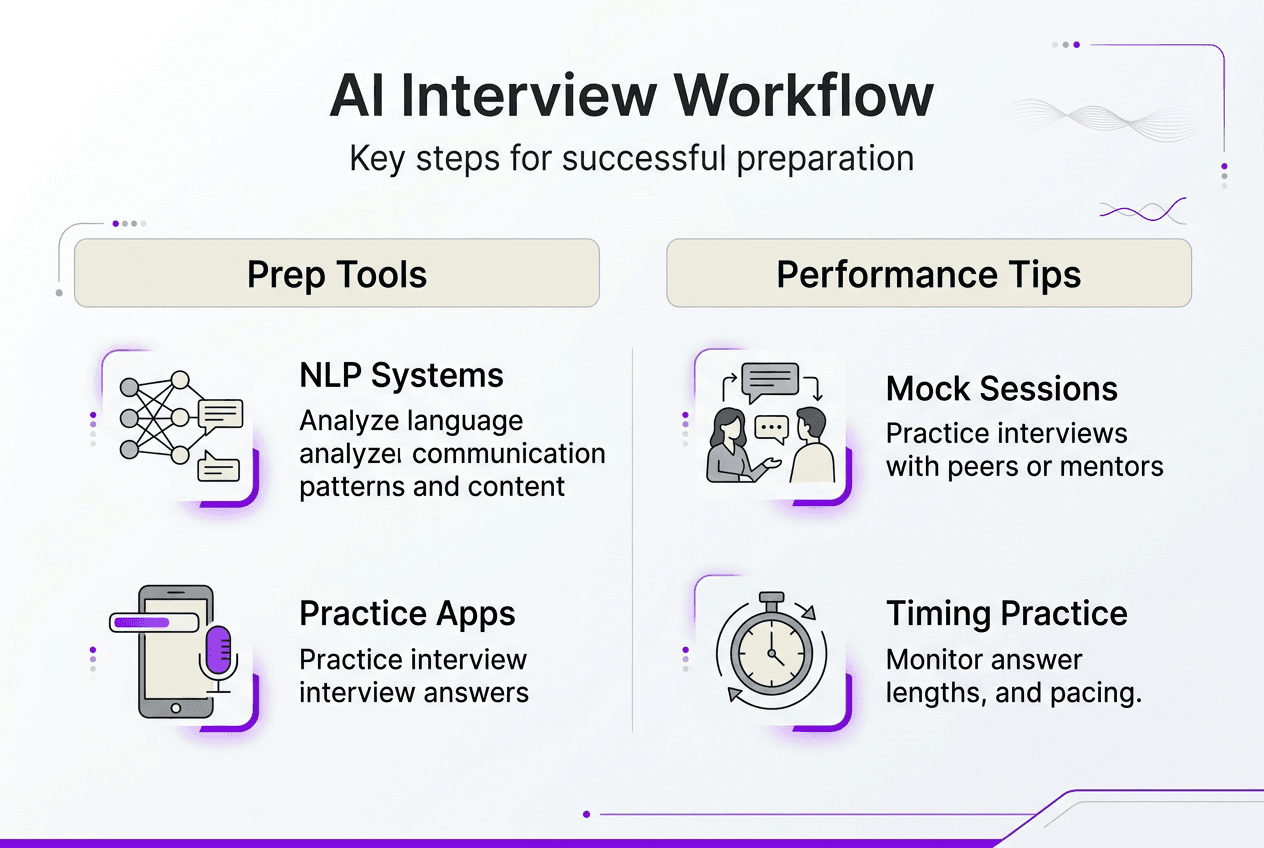
Starting your AI-powered interview preparation guides requires the right toolkit. Several categories of AI tools exist, each serving specific preparation needs. NLP-based feedback systems analyze your practice answers and highlight areas for improvement. Mock interview bots simulate realistic conversations with varying difficulty levels. Voice AI platforms like those built on modular architectures deliver accurate, low-latency practice at reduced costs compared to traditional coaching.
The numbers tell a compelling story. 65% of candidates already use AI in their job search and interview preparation, gaining measurable competitive advantages. If you’re not among them, you’re starting from behind.

| Tool Category | Primary Function | Best For |
|---|---|---|
| NLP Feedback Systems | Analyze response quality | Refining answer structure |
| Mock Interview Bots | Simulate conversations | Building confidence |
| Voice AI Platforms | Practice verbal delivery | Improving speaking skills |
| Real-time Assistants | Live interview support | Reducing anxiety |
Your technical environment matters too. You need reliable internet, a quality microphone, and a webcam that doesn’t make you look like you’re calling from a cave. Test your setup before important interviews. Audio issues destroy credibility faster than wrong answers.
Understanding basic AI functionality maximizes your benefits. Learn how these tools process information, what triggers their suggestions, and how to interpret their feedback. This knowledge helps you use them strategically rather than blindly following every prompt.
Pro Tip: Start with free AI tools to learn the basics before investing in premium platforms. ChatGPT can analyze your resume and suggest talking points, while Google’s AI can help research company information and generate practice questions.
Platforms like MeetAssist for AI interview prep integrate multiple functions into one interface, reducing the learning curve. They connect research, practice, and real-time support into cohesive workflows. This integration matters because juggling multiple disconnected tools during preparation wastes mental energy you need for actual learning.
Your preparation checklist should include accessing quality platforms, understanding their capabilities, and building familiarity through practice sessions. Remote interview assistance tools become second nature when you invest time upfront learning their features.
Using AI to prepare and perform in interviews step by step
Implementing AI in your interview process follows a clear sequence. Each step builds on the previous one, creating a comprehensive preparation and execution strategy.
-
Analyze your past performance with AI feedback. Upload recordings or transcripts of previous interviews to AI analysis tools. They identify patterns in your responses, flag weak areas, and suggest specific improvements. This objective assessment reveals blind spots you miss when self-evaluating.
-
Generate and practice customized questions. Successful candidates use AI to predict likely questions based on job descriptions and company research. Input the role requirements and let AI generate relevant scenarios. Practice these until your answers feel natural, not rehearsed.
-
Master the STAR-C method for AI-optimized responses. Traditional STAR (Situation, Task, Action, Result) gets an upgrade. The STAR-C format adds Context, making your answers more effective in AI-driven environments. Structure every behavioral answer this way: set the context, describe the situation, explain your task, detail your actions, and quantify results.
-
Run AI-driven mock interviews under realistic conditions. Schedule practice sessions that mirror actual interview timing and format. Use AI tools that adapt question difficulty based on your responses, simulating how real interviewers adjust their approach. Record these sessions and review them with AI feedback tools.
-
Deploy real-time AI assistance during live interviews. Platforms like MeetAssist provide AI-powered guidance during actual conversations. They listen to questions, suggest relevant talking points from your background, and help you stay on track. The key is using them as prompts, not scripts.
-
Build interconnected AI workflows covering all stages. Your AI toolkit should handle research, practice, live support, and follow-up. Connect these functions so insights from one stage inform the next. For example, weak areas identified in mock interviews should trigger targeted practice sessions.
Pro Tip: Use AI to create a personal question bank organized by competency area. When preparing for Google interviews with AI or other tech companies, categorize questions by technical depth, behavioral complexity, and company-specific culture fit.
The execution phase requires subtlety. Real-time AI tools work best when you internalize their suggestions rather than reading them verbatim. Glance at prompts to jog your memory, then speak in your own words. This approach maintains authenticity while benefiting from AI support.
Timing matters too. Practice with AI tools at the same time of day as your scheduled interviews. Your mental sharpness varies throughout the day, and you want your practice conditions matching your performance conditions.
Verifying your AI-driven interview success and common pitfalls
Measuring effectiveness separates strategic AI users from those just going through motions. Candidates using AI-assisted interviews pass human final rounds 54% of the time versus 34% without AI support. That 20-point gap represents the competitive advantage you’re building.
Your success metrics should track multiple dimensions. Monitor your confidence levels before and after implementing AI tools. Track how often you successfully answer unexpected questions. Measure the quality of your follow-up communications. These indicators reveal whether your AI usage translates to real improvement.
Common mistakes sabotage even well-intentioned AI adoption:
- Over-relying on AI suggestions without building genuine knowledge
- Ignoring practice in favor of just using real-time tools
- Failing to customize AI outputs to match your personal communication style
- Using AI as a crutch rather than a training partner
- Neglecting to verify AI-generated information for accuracy
Detection concerns often distract candidates from what matters. AI interview detection tools remain ineffective, so employers focus on evaluating your actual skills instead. This reality should free you to use AI openly for preparation while ensuring you truly understand the material.
| Approach | Time Investment | Skill Development | Interview Performance |
|---|---|---|---|
| Traditional Prep | High | Moderate | Variable |
| AI-Enhanced Prep | Moderate | High | Consistently Strong |
| AI-Only (No Practice) | Low | Minimal | Poor |
The comparison shows AI works best when combined with deliberate practice. You can’t shortcut the learning process, but you can make it dramatically more efficient.
Continuous improvement requires regular performance reviews. After each interview, whether successful or not, analyze what worked and what didn’t. Use AI tools to identify specific moments where your responses could improve. This iterative approach compounds your gains over time.
Confident interview preparation means knowing your material so well that AI tools simply remind you of what you already know. When you reach this level, the technology becomes invisible, supporting rather than replacing your expertise.
Maximize your interview success with MeetAssist’s AI tools
Transforming your interview performance requires tools designed specifically for real-world interview scenarios. MeetAssist delivers real-time AI guidance during live interviews, keeping you confident when stakes are highest. The platform integrates seamlessly with Google Meet, Microsoft Teams, and Zoom, so you don’t need to learn new meeting software.
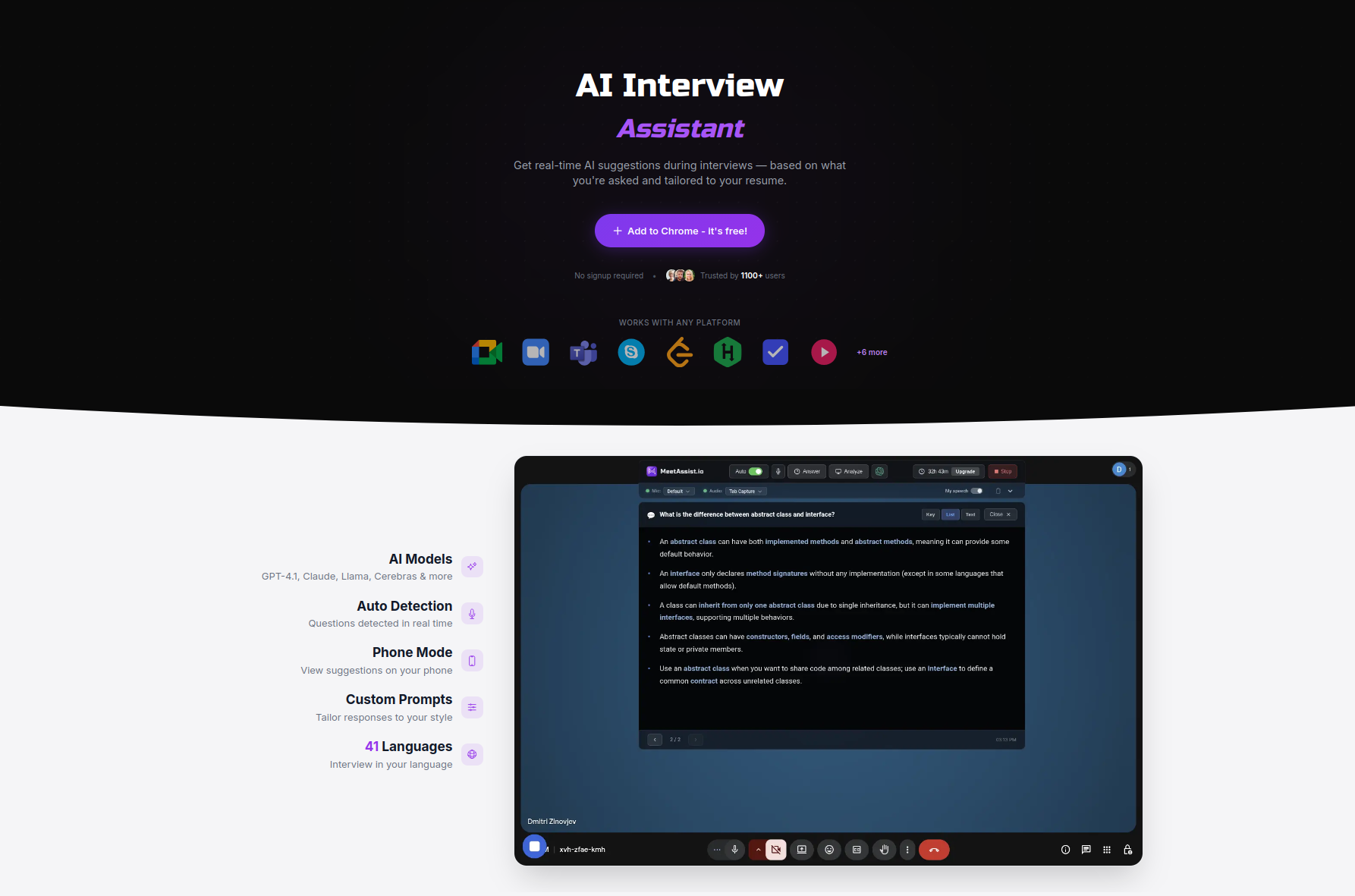
Users report significantly enhanced performance and reduced stress when using MeetAssist during actual interviews. The platform’s Phone Mode removes all visible traces from your computer screen, displaying transcripts and AI suggestions only on your mobile device. This invisible support lets you focus entirely on the conversation while having intelligent backup when you need it.
Whether you’re preparing for AI interview assistance in Google Meet sessions or need an AI coding interview helper on your phone for technical assessments, MeetAssist adapts to your specific needs.
Pro Tip: Pair MeetAssist with personalized practice sessions where you upload your resume and job descriptions. This combination covers all preparation angles, from research through live performance to follow-up communications.
Is using AI assistance in interviews considered cheating?
Ethical AI use focuses on preparation and skill enhancement, not deception. Think of AI tools like study guides or practice tests. They help you learn and organize your knowledge, but you still need to understand the material. Most employers recognize AI as a helpful tool when used transparently to showcase your genuine capabilities.
The line gets drawn at misrepresentation. Using AI to generate answers you don’t understand crosses into dishonesty. But leveraging AI to recall relevant experiences from your background, structure your thoughts clearly, or reduce anxiety? That’s smart preparation that benefits everyone.
How can I ensure AI tools improve my skills without making me reliant?
Use AI primarily for feedback and practice, actively studying and internalizing the concepts it teaches. Set a rule where you explain every AI suggestion in your own words before using it. This forces genuine understanding rather than blind copying.
Pair AI insights with mock interviews and human coaching when possible. Real people catch nuances that algorithms miss. The combination of AI efficiency and human insight creates the strongest preparation foundation.
What are the best AI tools for interview preparation in 2026?
Platforms like MeetAssist offer comprehensive AI guidance covering research, practice, and real-time support. Deepgram performed best for pricing, accuracy, and low latency, especially for diverse English accents. ChatGPT excels at generating practice questions and analyzing your responses.
Your ideal toolkit depends on your specific needs. Technical candidates need coding assessment support, while those targeting behavioral interviews benefit from STAR-C structure tools. Experiment with multiple platforms during low-stakes practice before committing to one for important interviews.
How do AI interviews differ from traditional human interviews?
AI interviews provide more consistent dialogue and sharper interactions than human first rounds. They score better on conversational quality and reduce unconscious bias that affects human judgment. This consistency means your performance matters more than subjective factors like whether the interviewer had a bad morning.
AI systems also identify candidates based on genuine skills rather than superficial characteristics. They analyze what you say and how you structure arguments, not how you look or whether you went to a prestigious school. This shift creates opportunities for talented candidates who might get overlooked in traditional screening processes.
Recommended
- AI Interview Prep in 2026: Boost Confidence by 35% – MeetAssist | MeetAssist
- AI interview assistance: boost job success in 2026 – MeetAssist | MeetAssist
- AI for Google Meet: boost your interview game in 2026 – MeetAssist | MeetAssist
- AI-powered interview guidance: confidence boost for 2026 – MeetAssist | MeetAssist