

You’ve spent weeks grinding through coding problems, watching system design videos, and reading every prep guide you can find. Then the interview starts, and your mind goes blank. Most candidates struggle to communicate efficiently and perform under clock pressure even after extensive preparation. The good news is that freezing up isn’t a talent problem. It’s a strategy problem. This guide gives you a targeted, step-by-step approach to technical interview prep, covering what to study, how to practice, and which tools actually help you perform when it counts.
Table of Contents
- Know what to expect from technical interviews
- Set up your preparation timeline and plan
- Master essential DSA patterns and problem-solving
- Practice with purpose: mock interviews and real-time tools
- Demonstrate clear thinking and communication
- Tips and frameworks for technical system design rounds
- Myths, mindsets, and what really matters
- Take your prep further with AI interview tools
- Frequently asked questions
Key Takeaways
| Point | Details |
|---|---|
| Focus on patterns | Mastering 15-20 fundamental coding patterns prepares you for nearly all technical questions. |
| Practice with feedback | Timed mock interviews and real-time tools build confidence and reveal improvement areas. |
| Communicate clearly | Explaining your thinking and solutions aloud is often more important than perfect code. |
| Background is not destiny | Skills, not degrees or elite schools, best predict interview success—self-taught candidates excel too. |
| Structured prep wins | Following a sequence of planning, practicing, and reviewing gives you the best shot at your next technical interview. |
Know what to expect from technical interviews
Before diving into specific prep steps, it’s crucial to understand what’s coming in a typical technical interview. Most companies run candidates through several distinct rounds, and each one tests something different.
Technical interviews test algorithms, system design, and communication across multiple formats. Here’s a quick breakdown of the most common ones:
| Format | What it tests | Typical length |
|---|---|---|
| Online assessment | Coding speed, accuracy, edge cases | 60-90 minutes |
| Live coding round | Problem-solving, communication | 45-60 minutes |
| System design round | Architecture, scalability, trade-offs | 45-60 minutes |
| Behavioral round | Soft skills, culture fit, past experience | 30-45 minutes |
Beyond getting the right answer, interviewers watch for how you think. They want to see you break down a problem, ask clarifying questions, and explain your reasoning out loud. Check out these interview tips to understand what evaluators actually score.
Here are the core skill areas you’ll be tested on:
- Data structures and algorithms: Arrays, trees, graphs, dynamic programming
- Coding fluency: Writing clean, readable code under time pressure
- System design: Designing scalable, fault-tolerant architectures
- Communication: Explaining your approach clearly and handling feedback
- Problem decomposition: Breaking complex problems into manageable steps
Familiarize yourself with common technical questions early so you’re not surprised by the format or difficulty level.
Set up your preparation timeline and plan
Now that you know what to expect, let’s break down how to organize your effort for consistent improvement. Without a structured timeline, most candidates over-invest in one area and neglect others.
A 4-8 week coding window paired with a 3-6 week system design phase is the recommended structure for most candidates. Here’s a sample schedule:
| Week | Focus area | Daily time |
|---|---|---|
| 1-2 | Easy coding problems, core patterns | 1-1.5 hours |
| 3-4 | Medium problems, pattern repetition | 1.5-2 hours |
| 5-6 | Hard problems, timed mock sessions | 2 hours |
| 7-8 | System design fundamentals | 1.5-2 hours |
| 9-10 | Full mock interviews, behavioral prep | 1-2 hours |
Here’s a numbered action plan to get your weeks organized:
- Audit your current skill level with a diagnostic set of 10-15 problems
- Identify your weakest DSA categories and prioritize them first
- Block daily prep time on your calendar like a work meeting
- Review every problem you got wrong within 24 hours
- Add a weekly mock interview starting in week three
- Revisit previously solved problems every two weeks to reinforce retention
Research on interview success factors shows that consistency and deliberate review cycles outperform raw hours spent grinding. Quality beats quantity every time.

Pro Tip: Use a simple spreadsheet to track every problem you solve, the pattern it uses, and whether you solved it independently. This turns your practice into a feedback loop instead of a checklist.
Explore structured interview prep resources to find curated problem sets that match your target companies.
Master essential DSA patterns and problem-solving
With your plan in place, here’s how to focus your energy on the concepts that matter most. The biggest mistake candidates make is treating every new problem as unique. Most aren’t.
15-20 DSA patterns cover 80-90% of real interview problems. Learning to recognize these patterns is far more efficient than solving 500 random problems. Here are the ones worth mastering:
- Sliding window: Subarray and substring problems with a moving range
- Two pointers: Sorted array problems, pair sums, and palindrome checks
- Fast and slow pointers: Cycle detection in linked lists
- Binary search: Any problem involving a sorted structure or search space
- BFS and DFS: Tree traversal, graph connectivity, shortest paths
- Dynamic programming: Overlapping subproblems, optimal substructure
- Merge intervals: Scheduling, calendar, and range overlap problems
- Topological sort: Dependency resolution and course scheduling
Once you recognize the pattern, the solution path becomes much clearer. Practice popular DSA questions grouped by pattern, not by difficulty alone.
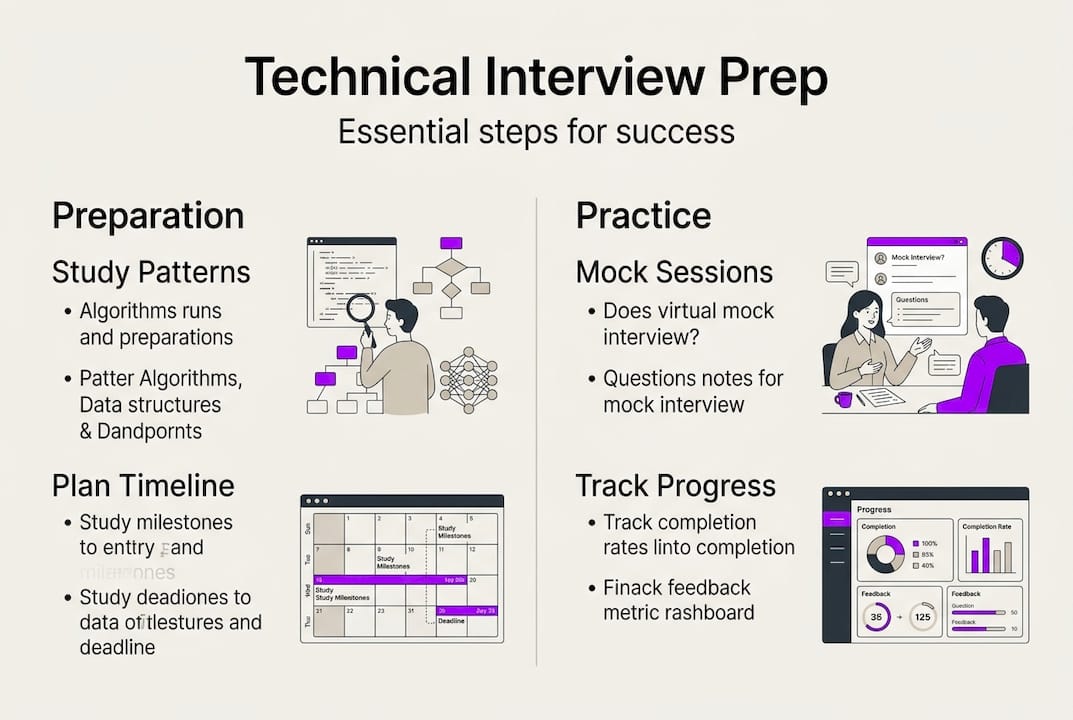
Pro Tip: Search for curated lists specific to your target company. Many companies reuse problem types, and practicing their known patterns gives you a real edge over generic prep.
For a deeper breakdown of how to structure your coding practice, the step-by-step coding prep guide walks through exactly how to build this skill progressively.
Practice with purpose: mock interviews and real-time tools
Building on conceptual mastery, your next focus is practicing under real conditions. Solving problems in silence at your desk is very different from explaining your thinking to a live interviewer.
Mock interviews 1-2 times per week on platforms like interviewing.io significantly reduce inconsistency and build the muscle memory you need for live performance. Here’s how to run them effectively:
- Set a strict timer matching real interview conditions (45-60 minutes)
- Use a peer, mentor, or blind mock platform for realistic pressure
- Record yourself if practicing solo so you can review your communication
- After each session, write down what you got stuck on and why
- Revisit those sticking points within 48 hours before moving on
“The candidates who perform most consistently aren’t the ones who practiced the most problems. They’re the ones who practiced the most realistically.”
For video-based interviews, the video interview guide covers setup, pacing, and how to handle technical questions on camera.
Pro Tip: Track your mock interview scores over time. If you’re not improving after 3-4 sessions in a row, change your review method, not just your problem volume.
Demonstrate clear thinking and communication
Once you’re comfortable with problem-solving, practicing clear communication can set you apart from equally skilled candidates. Two candidates with identical solutions can get very different outcomes based on how they explain their thinking.
Explaining your thought process aloud and checking edge cases is what separates top candidates from the rest. Here’s a step-by-step approach to use during the interview itself:
- Restate the problem in your own words before writing any code
- Ask clarifying questions about input size, edge cases, and constraints
- Talk through your approach before coding, including why you chose it
- Write clean code with meaningful variable names, not just working code
- Test with examples including edge cases like empty inputs and large values
- Analyze complexity by stating time and space trade-offs out loud
This process shows the interviewer how you think, not just what you know. It also gives you a structured way to catch your own mistakes before they become problems.
Building soft skills for interviews alongside your technical skills is what creates a complete candidate. Review how to explain your process clearly under pressure.
Tips and frameworks for technical system design rounds
For those targeting mid-level or higher, system design rounds need strategic prep. These interviews are open-ended by design, and candidates who don’t have a framework often ramble or miss critical components.
A proven system design framework follows these steps: clarify requirements, sketch a high-level design, deep dive into components, address scalability, and discuss failure handling. Use this checklist:
- Clarify functional and non-functional requirements before drawing anything
- Estimate scale: users, requests per second, storage needs
- Sketch a high-level architecture with major components
- Deep dive into the most critical or complex component
- Discuss database choices and trade-offs (SQL vs. NoSQL)
- Address caching, load balancing, and CDN strategies
- Talk through failure scenarios and how the system recovers
The most common pitfall is jumping straight into solutions without clarifying requirements. Interviewers notice this immediately. Practice with real prompts on system design platforms to build your instincts.
For role-specific prep, the software engineer system design question bank includes real prompts used in industry interviews.
Myths, mindsets, and what really matters
Finally, it’s important to address common misconceptions and give you the facts about who actually succeeds at technical interviews. A lot of candidates disqualify themselves before they even apply.
Non-traditional candidates succeed 46% of the time in blind hiring settings, and coding experience adds roughly $5,000 per year in salary over pedigree alone. School name predicts performance poorly. What actually predicts success is your process, your communication, and your pattern recognition.
Language choice also matters less than people think. Python3 is used by 74% of candidates and outperforms degree credentials as a hiring signal. Use the language you’re fastest in, not the one you think sounds most impressive.
Self-taught candidates, bootcamp graduates, and career changers all succeed at technical interviews every day. The data backs this up. What separates them from candidates who don’t make it is structured practice, honest self-assessment, and consistent repetition.
For more data-backed insights on interview success, explore what the research actually says about who gets hired and why.
Take your prep further with AI interview tools
With a solid process and mindset, you can now leverage AI to take your interview success to the next level. Knowing the right strategies is one thing. Having real-time support when you’re in the moment is another.
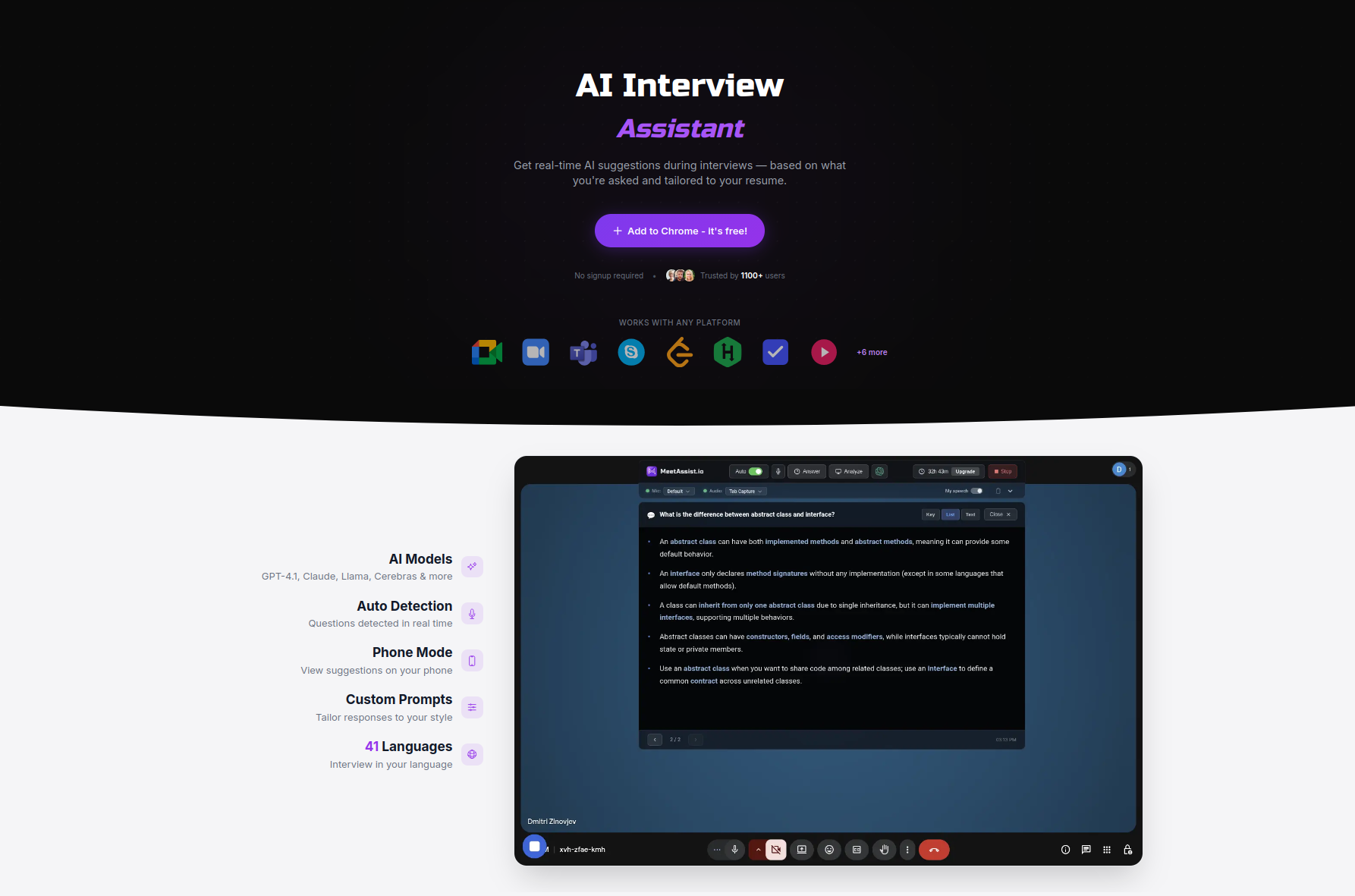
MeetAssist is a Chrome extension that listens to your interview in real time and generates AI-powered answer suggestions as the conversation unfolds. Whether you’re working through a live coding challenge or a system design question, it surfaces relevant hints and structured responses without recording any audio or video. Phone Mode takes this further by moving everything to your phone screen, so nothing is visible on your computer during the interview. You can even use it to analyze an active coding tab remotely. Explore the AI coding interview assistant to see how it fits into your prep, or compare options with the full list of top AI interview assistants.
Frequently asked questions
How many coding problems should I practice for interviews?
Aim for 100-200 problems with roughly 40% easy, 50% medium, and 10% hard, prioritizing pattern variety and company-specific lists over raw volume.
Do I need to attend a top school to get a technical job?
No. Data shows non-traditional candidates succeed 46% of the time in blind interview settings, making school name a weak predictor of performance.
What’s the most important factor in technical interviews?
Communicating your thought process clearly, using proven patterns, and demonstrating strong problem decomposition matter far more than your school or resume.
How do system design rounds differ from coding interviews?
System design interviews focus on architecture, scalability, and trade-offs rather than syntax, requiring a different framework and a broader set of engineering concepts.
Which programming language should I use for coding interviews?
Python3 is most popular at 74% usage, but the best choice is always the language you can write fastest and most accurately under pressure.
Recommended
- Master types of technical interviews for job success | MeetAssist
- Confident Interview Preparation Steps for Technical Success – MeetAssist | MeetAssist
- MeetAssist
- Step by Step Interview Preparation for Coding Success – MeetAssist | MeetAssist
Looking for help with your next interview? MeetAssist provides real-time AI assistance during your video interviews on Google Meet, Zoom, and Teams. Browse our interview preparation guides to get started.