

TL;DR:
- AI-driven assessments enhance hiring quality and candidate confidence through adaptive questions and real-time feedback. Candidates should prepare by practicing with AI tools, understanding assessment mechanics, and being authentic. Awareness of biases and choosing platforms with transparency and fairness are crucial for fair evaluation.
AI-driven assessments are reshaping how companies screen and hire technical talent, yet most candidates walk into these evaluations with outdated assumptions. A 92% improvement in quality-of-hire and a 94% boost in user confidence are not marketing claims — they are benchmarks from platforms actively deploying these tools. The confusion is understandable: terms like “adaptive questioning” and “multimodal analysis” sound abstract until you see them in action. This article breaks down exactly what AI-driven assessment means, how it works behind the scenes, what it means for your job search, and how to prepare so you walk in with a real edge.
Table of Contents
- What is AI-driven assessment? Definitions and features
- How AI-driven assessments work: Behind the scenes
- Practical benefits for job seekers: Evidence and real outcomes
- Risks, biases, and how to prepare: Navigating the nuances
- Our take: What most guides miss about AI-driven assessments
- Where to start: Tools and platforms for your AI-powered prep
- Frequently asked questions
Key Takeaways
| Point | Details |
|---|---|
| Define AI-driven assessment | AI-driven assessment platforms use smart algorithms to evaluate skills through adaptive questioning and real-time analysis. |
| Boost interview outcomes | Candidates using AI-driven tools report higher confidence and improved quality-of-hire rates. |
| Prepare for biases and proctoring | Choose platforms with fairness audits and human oversight to reduce risk from AI biases and automated proctoring. |
| Practice with trusted platforms | Mock interview tools like MeetAssist or Huru.ai help you rehearse technical and soft skills for real-world interviews. |
What is AI-driven assessment? Definitions and features
AI-driven assessment refers to AI-powered platforms and tools used in hiring to evaluate candidates’ skills, particularly in technical interviews and virtual assessments. It is not just a fancier version of a multiple-choice quiz. These systems observe how you think, communicate, and solve problems in real time.
The core technologies powering these platforms include:
- Machine learning (ML): Adapts question difficulty based on your previous answers, so the assessment stays calibrated to your actual skill level.
- Natural language processing (NLP): Converts your spoken responses to text, then analyzes sentiment, clarity, and relevance.
- Multimodal analysis: Evaluates video, audio, and written code simultaneously to build a fuller picture of your performance.
- Real-time feedback loops: Scores your answers as you go, sometimes surfacing suggestions or adjustments mid-session.
These core mechanics include machine learning for adaptive questioning, NLP for speech-to-text and sentiment analysis, multimodal analysis for video, and real-time feedback loops that inform both the candidate and the hiring system.
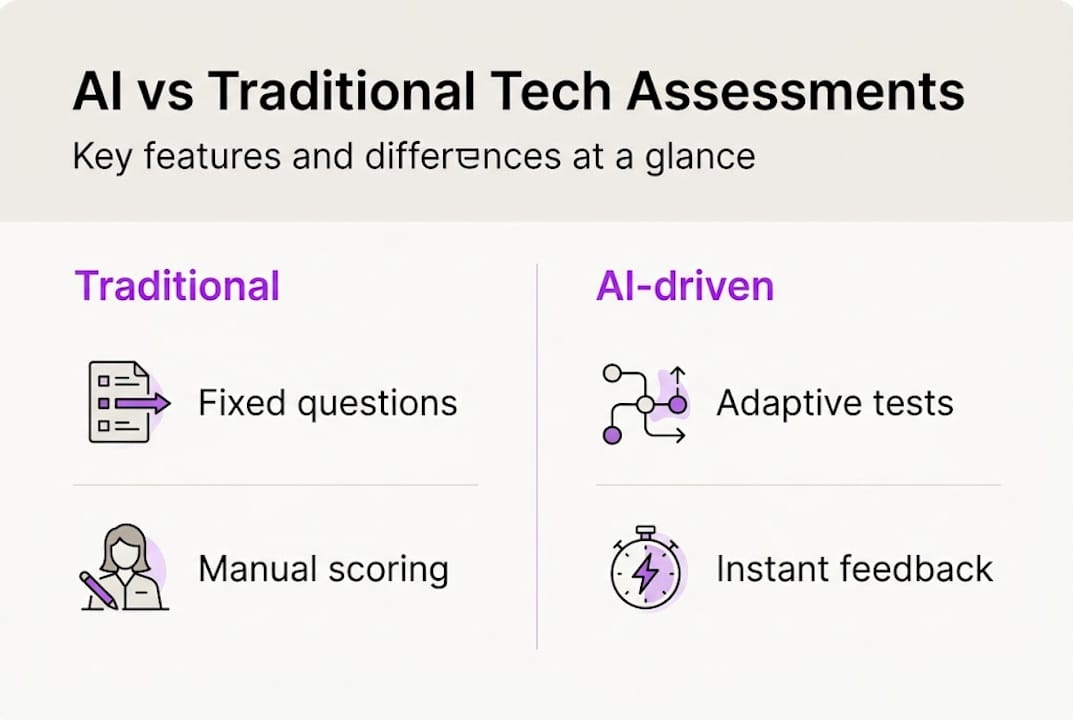
Here is a quick comparison of traditional versus AI-driven assessments:
| Feature | Traditional assessment | AI-driven assessment |
|---|---|---|
| Question difficulty | Fixed | Adaptive |
| Feedback timing | After the interview | Real-time |
| Data analyzed | Written answers only | Audio, video, code, text |
| Bias mitigation | Manual review | Algorithmic + human oversight |
| Scalability | Limited | High |
Understanding the technical interview automation impact on hiring pipelines helps you see why companies are adopting these tools fast. The AI hiring landscape is evolving, and candidates who understand the mechanics are better positioned to perform well rather than feel blindsided.
How AI-driven assessments work: Behind the scenes
Once the basic features are clear, the next question is: what actually happens when you start an AI-driven interview? The process is more structured than most candidates realize.
- Baseline calibration: The platform asks a few warm-up questions to establish your starting skill level.
- Adaptive sequencing: Algorithms adjust the next question based on your answer. Get one right, and the difficulty increases. Struggle, and the system recalibrates.
- Multimodal capture: Your voice, facial expressions, and code output are captured and scored simultaneously.
- Scoring and ranking: Your responses are evaluated against a model answer bank using NLP and pattern recognition.
- Feedback generation: At the end (or in real time), you receive a breakdown of strengths, gaps, and suggested improvements.
Machine learning models like Item Response Theory, the Rasch Model, and Bayesian inference drive the scoring and question adjustment behind the scenes. These are not simple rule-based systems. They learn from thousands of prior candidate responses to refine their accuracy.
Platforms like HackerRank and CoderPad go further. They integrate AI assistants in mock interviews and coding challenges to simulate real workflows, giving candidates a realistic preview of what employer-side tools look like.
Pro Tip: Before your actual assessment, use coding challenge AI tools to practice under timed, adaptive conditions. Familiarity with the format reduces anxiety and improves your actual score.
For a broader view of how employers are using these systems, AI-powered interview tools from platforms like CodeSignal show just how granular the evaluation can get. Knowing this helps you prepare more deliberately rather than just hoping your instincts carry you through. Pairing that preparation with AI interview assistance tools gives you a structured way to close skill gaps before the real thing.
Practical benefits for job seekers: Evidence and real outcomes
Understanding the mechanics is important, but the real question is: what does this mean for you as a candidate?
The numbers are hard to ignore. AI-driven assessments have produced a 36% reduction in time-to-hire, a 92% improvement in quality-of-hire, and a 94% boost in user confidence. That last stat matters most for job seekers. Confidence is not just a feeling — it directly affects how you communicate under pressure.
“AI interviews yield a 53% success rate in human follow-ups, compared to just 29% with traditional screening methods.”
That gap is significant. Candidates who go through AI-driven screening are more prepared, more self-aware, and more likely to land the next round.
Here is what you gain from using AI-driven prep tools before your interview:
- Instant feedback on delivery: Tools like Huru.ai and Revarta flag filler words, pacing issues, and low-confidence speech patterns in real time.
- Content relevance scoring: Your answers are evaluated not just for correctness but for how well they address the actual question.
- Targeted practice: Mock interviews with instant feedback on speech patterns, confidence, and filler words help you fix specific weaknesses instead of practicing blindly.
- Technical task simulation: You can rehearse coding challenges, system design questions, and collaborative scenarios before the real assessment.
Pro Tip: Use AI interview prep tools at least a week before your scheduled interview. That gives you enough time to identify patterns in your weak areas and actually fix them, not just recognize them.
The steps to confident interview preparation start with honest self-assessment. AI tools accelerate that process by giving you data instead of gut feelings. You stop guessing what went wrong and start fixing it. Try Final Round AI practice sessions to experience how structured AI feedback changes your preparation rhythm.

Risks, biases, and how to prepare: Navigating the nuances
AI assessments offer real advantages, but candidates must also prepare for their nuances, including the risk of bias and technical challenges that can affect your results unfairly.
Here is what you need to watch for:
- Position bias: Some LLM-based systems favor first-submitted resumes, meaning the order in which your application is reviewed can influence your score.
- Ordinal bias: Rankings within a batch of candidates can shift based on who was evaluated before or after you, not just your actual performance.
- Proctoring overreach: Some platforms flag innocent behaviors like looking away from the screen or pausing to think as suspicious activity.
- Guarded vs. unguarded AI modes: Cheating detection and proctoring tools vary widely in sophistication, and false positives can hurt your candidacy.
Bias amplification is a real legal and ethical risk. EEOC compliance concerns around AI hiring tools are growing, and domain-specific models consistently outperform general LLMs in fairness and accuracy. This matters because a biased system can disqualify a strong candidate for reasons that have nothing to do with their skills.
How to protect yourself:
- Ask employers which AI platform they use and whether it has been independently audited for fairness.
- Prioritize applying to companies that use platforms with proven fairness audits, human-in-the-loop review, and explainable scoring.
- Practice AI interview ethics by being transparent about how you use AI tools in your preparation.
- Work on soft skills alongside technical skills, since multimodal systems evaluate both.
- Review how to prepare for technical interviews with a focus on explainability — being able to walk through your reasoning step by step.
Platforms like HackerRank are transparent about their AI features, which is a good sign. When a platform cannot explain how it scores you, that is a red flag worth noting.
Our take: What most guides miss about AI-driven assessments
Most articles about AI-driven assessments focus on the technology. We think the more important conversation is about how you show up inside these systems.
Here is what we have observed: candidates who treat AI assessments as a performance to optimize often underperform compared to those who treat them as a genuine skills conversation. The algorithms are designed to detect authenticity. Rehearsed, robotic answers score lower than thoughtful, natural ones — even if the robotic answer is technically correct.
The real advantage comes from transparent, collaborative practice. Assessments emphasize real-world tasks and collaboration, so preparing by practicing transparent AI use is more effective than memorizing model answers. You want the AI to see you thinking, not reciting.
Another overlooked point: scores are not the whole story. A high score on a trivia-style technical quiz does not predict real-world job performance as well as a messy, iterative coding session where you explain your reasoning out loud. Advocate for platforms that use explainable scoring and human oversight. And when you have a choice, use mobile interview tools that let you practice in conditions that mirror the actual interview environment. That context matters more than most candidates realize.
Where to start: Tools and platforms for your AI-powered prep
You now have a clear picture of what AI-driven assessments are, how they work, and where the risks lie. The next step is putting that knowledge into action with the right tools.
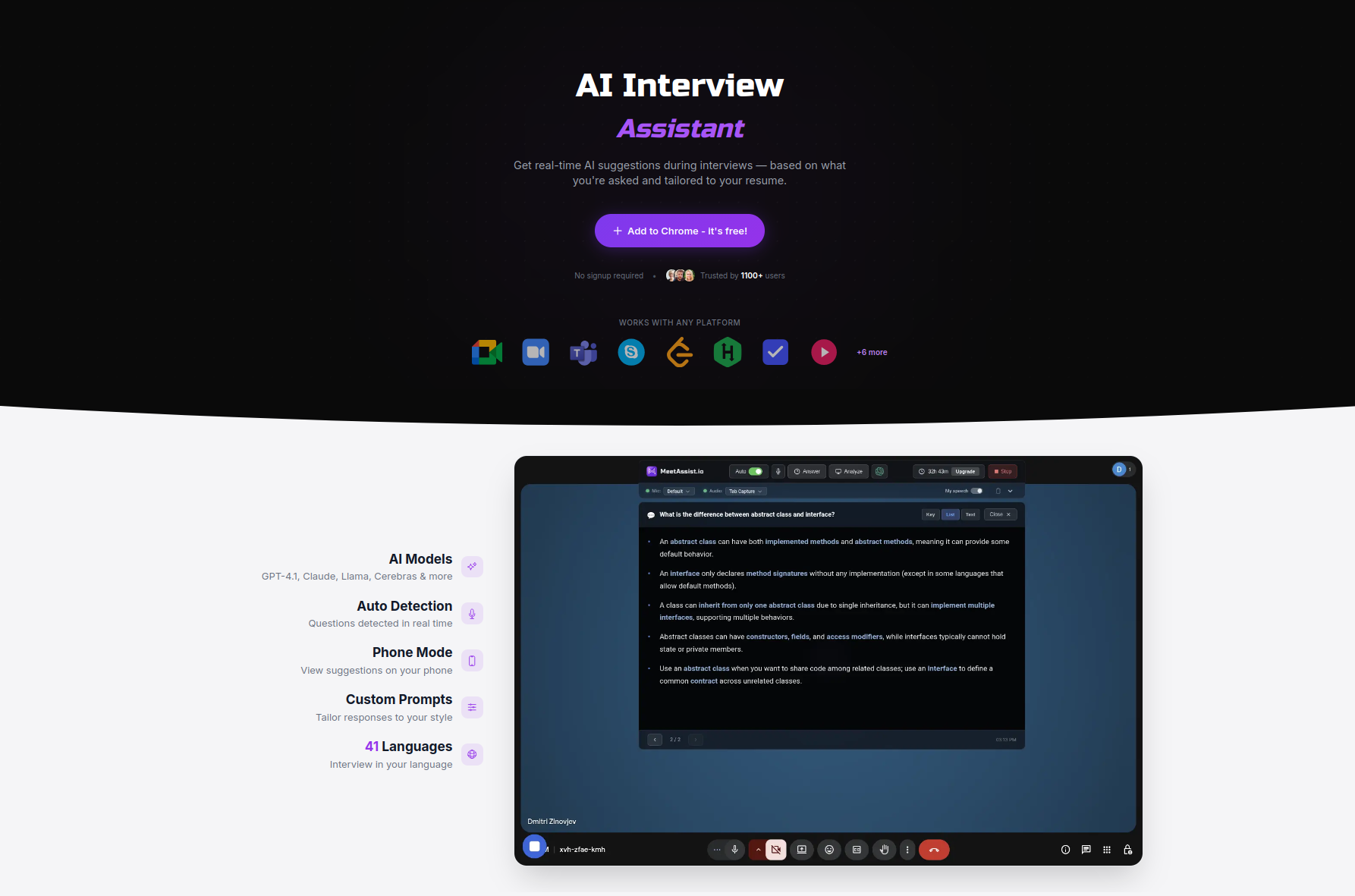
MeetAssist is built specifically for candidates navigating AI-powered interviews, coding challenges, and technical assessments. It provides real-time AI suggestions during live interviews on Google Meet and Microsoft Teams, supports multiple AI models including GPT-4.1 and Claude, and lets you customize answer styles to match the format you are being evaluated on. If you want to compare options before committing, the AI AI interview assistant alternatives page gives you a side-by-side look at what is available. For a discreet, screen-free prep experience, MeetAssist Phone Mode moves everything to your phone so nothing appears on your computer screen during the assessment.
Frequently asked questions
How does AI-driven assessment improve interview outcomes?
AI-driven assessments adapt questions to your skill level and deliver instant feedback, which drives measurable gains including a 92% improvement in quality-of-hire and a 94% boost in candidate confidence.
Can AI-driven assessments detect cheating or biases?
Yes, most platforms use proctoring and built-in bias detection, but cheating detection and position bias remain imperfect — so favor tools that include human oversight and independent fairness audits.
What are the best tools for technical interview prep using AI?
Platforms like Huru.ai, Final Round AI, and MeetAssist offer mock interviews with instant feedback on content relevance, delivery, and technical accuracy, making them strong choices for structured prep.
What pitfalls should I avoid in AI-driven assessments?
Avoid platforms that cannot explain how they score you, and steer clear of memorized answers — prioritize explainable scoring and practice responding naturally with clear reasoning rather than rehearsed scripts.
Recommended
- AI Interview Prep in 2026: Boost Confidence by 35% – MeetAssist | MeetAssist
- Technical Interview Automation: Real-Time AI Impact – MeetAssist | MeetAssist
- Confident Interview Preparation Steps for Technical Success – MeetAssist | MeetAssist
- How to prepare for technical interviews: proven steps | MeetAssist