

You spend hours perfecting your resume, but when the interview moment arrives, translating those bullet points into confident, structured answers feels overwhelming. Many candidates freeze under pressure, unable to connect their documented achievements to the questions they face. This article provides concrete examples and clear methods to transform your resume content into impressive, measurable interview responses that resonate with technical hiring managers and showcase your true value.
Table of Contents
- How To Choose And Adapt Resume Entries For Interview Answers
- Examples Of Resume-Based Technical Answers For Coding Challenges
- Behavioral Interview Answers Derived From Resume Achievements
- Comparison Of Answer Styles: Concise Vs Detailed Based On Resume
- Using Resume Keywords To Frame Interview Responses
- Common Pitfalls In Resume-Based Answering
- Tools To Generate Personalized Resume-Based Answers
- Summary Comparison And Situational Recommendations
- Prepare Smarter With MeetAssist’s AI-Powered Interview Tools
- FAQ
Key takeaways
| Point | Details | |-------|---------|| | STAR method impact | Candidates who prepare resume-based STAR method answers increase their probability of passing technical interviews by up to 40%. | | Concise answer efficiency | Bullet-point style answers save 25% time in screening interviews and improve clarity. | | Keyword alignment | Tailoring answers with resume keywords and measurable achievements enhances relevance and memorability. | | Answer style selection | Detailed STAR-structured answers best suit behavioral interviews, while concise answers fit initial screens. | | AI-powered preparation | Real-time AI tools generate personalized resume-based answers, increasing preparedness and confidence. |
How to choose and adapt resume entries for interview answers
Selecting the right resume content for your interview answers requires strategic thinking. Focus on achievements that contain specific, measurable outcomes relevant to both the job description and the question being asked. Numbers tell your story better than adjectives ever could.
Structure your answers using the STAR method: Situation, Task, Action, Result. This framework transforms scattered resume bullet points into coherent narratives that interviewers can follow and remember. Candidates who prepare resume-based STAR method answers increase their probability of passing technical interviews by up to 40%.
Your answer style should shift based on question type and interview stage. Phone screens demand brevity, behavioral rounds require depth. Match your delivery to the format.
Pro Tip: Practice converting three of your strongest resume achievements into both 30-second and 2-minute versions. This flexibility prepares you for any interview pace.
Incorporate keywords from your resume and the job posting naturally throughout your response. This creates linguistic alignment that helps interviewers mentally check boxes as you speak. Avoid generic jargon, use the specific terminology that appears in your documented experience.
Practice your answers aloud with a timer. Hearing yourself speak reveals awkward phrasing and helps you maintain confident delivery under time pressure. Record yourself to identify filler words and weak transitions between resume points.
- Select achievements with quantifiable outcomes (percentages, dollars, time saved)
- Align examples directly with the competencies mentioned in the job description
- Prepare multiple examples per skill to adapt to follow-up questions
- Keep situation and task setup brief, emphasize action and results
- Rehearse out loud to internalize natural pacing and transitions
Examples of resume-based technical answers for coding challenges
Technical interview answers need precision. Convert your project resume entries into stories that highlight problem-solving methodology, not just final outcomes. Start with the technical challenge you faced, then walk through your solution approach with specific technologies.
Imagine you have this resume bullet: “Reduced API response time by 60% through database query optimization.” Transform it into an interview answer: “Our payment processing API was timing out during peak hours. I profiled the database queries and identified N+1 query patterns in our ORM layer. I implemented eager loading and added Redis caching for frequently accessed customer data. Response times dropped from 3 seconds to 1.2 seconds, eliminating timeout errors.”
Notice how the expanded version provides technical depth while maintaining clarity. You showcase diagnostic skills, specific technical choices, and measurable impact. Every sentence adds value.
Pro Tip: When discussing coding projects, mention the scale (users affected, data volume, traffic levels) to contextualize your technical decisions.
Align your examples with the software engineer interview questions commonly asked in your target role. If the position emphasizes scalability, choose resume projects where you optimized performance or handled growth. Match your technical vocabulary to the job requirements.
| Resume Achievement | Technical Interview Answer |
|---|---|
| “Built microservices architecture serving 50K daily users” | “I designed a microservices system using Docker and Kubernetes to replace our monolithic Rails app. Split services by domain boundaries, implemented API gateway with rate limiting, used RabbitMQ for async processing. System now handles 50K daily users with 99.9% uptime.” |
| “Automated deployment pipeline reducing release time by 75%” | “Our manual deployment took 4 hours and caused frequent errors. I built a CI/CD pipeline with GitHub Actions, automated testing, and blue-green deployment to AWS. Releases now take 1 hour with zero-downtime deployments and automated rollback.” |
| “Implemented ML model improving recommendation accuracy by 35%” | “User engagement with recommendations was stalling at 12%. I trained a collaborative filtering model using TensorFlow, incorporated user behavior signals and content features. Model achieved 35% accuracy improvement, boosting click-through rate from 12% to 16%.” |
For comprehensive preparation strategies, review coding interview preparation tips that align technical storytelling with interviewer expectations.
- Lead with the problem and its business impact
- Specify technologies, frameworks, and tools used
- Explain your decision-making process, not just the final choice
- Quantify results with concrete metrics (speed, cost, users, uptime)
- Keep answers under 2 minutes for initial responses, expand if asked
Behavioral interview answers derived from resume achievements
Behavioral questions assess how you work with others, handle challenges, and demonstrate leadership. Your resume provides the raw material, the STAR method provides the structure. Every behavioral answer should trace back to a documented achievement.
Take a resume entry like “Led cross-functional team to launch mobile app 2 weeks ahead of schedule.” Build your STAR answer: “Our company needed a mobile app for the holiday shopping season, with a hard November 15 deadline. I coordinated a team of 5 developers, 2 designers, and 3 QA engineers across different time zones. We established daily standups, created a shared Notion workspace for async updates, and I personally unblocked dependencies by escalating resource requests to senior management. We launched November 1, capturing 15K downloads in the first week.”

This structure demonstrates project management, communication, and results orientation. The specificity makes your story memorable and credible. Generic behavioral answers get forgotten immediately.
Effective behavioral interview answer techniques emphasize the ‘how’ behind your achievements. Don’t just state you collaborated, describe the collaboration mechanism. Don’t claim problem-solving skills, illustrate the problem-solving process.
Quantify your soft skill demonstrations whenever possible. “Improved team communication” means nothing. “Reduced sprint planning time from 3 hours to 90 minutes by implementing async pre-planning docs” tells a story. Numbers anchor behavioral claims in reality.
For additional context on behavioral interviews importance and how they predict job performance, research shows structured behavioral questions correlate strongly with candidate success. Employers use them because past behavior predicts future performance.
- Structure every behavioral answer with Situation, Task, Action, Result
- Emphasize your specific actions, not team accomplishments you observed
- Connect soft skills (leadership, communication) to measurable outcomes
- Use different resume projects for different competency questions
- Practice behavioral interview tips for developers specific to technical roles
Comparison of answer styles: concise vs detailed based on resume
Your answer length should match the interview stage and question complexity. Concise bullet-point style answers save 25% time on candidate evaluation during initial phone screenings. Interviewers appreciate brevity when qualifying dozens of candidates.
Concise answers work like resume bullets brought to life. “I reduced server costs by 40% through containerization and auto-scaling” delivers complete information in one sentence. You can always expand if the interviewer wants details.
Detailed answers shine in behavioral rounds and final interviews where interviewers assess cultural fit and depth of experience. A 2-minute STAR narrative reveals your thinking process, communication style, and thoroughness. The context you provide helps interviewers visualize you in the role.
“The best candidates switch seamlessly between concise summaries and detailed explanations based on interviewer cues. Watch for follow-up questions or time signals to adjust your answer depth.”
| Answer Style | Best For | Average Length | Key Advantage | Trade-off |
|---|---|---|---|---|
| Concise bullet-point | Phone screens, technical assessments | 30-45 seconds | Saves time, maintains focus | May lack context for complex situations |
| Detailed STAR method | Behavioral interviews, final rounds | 90-120 seconds | Provides rich context, demonstrates communication skills | Can lose interviewer attention if unfocused |
| Hybrid approach | Technical deep-dives, panel interviews | 60-90 seconds | Balances efficiency with depth | Requires reading interviewer engagement cues |
Start every answer concisely. If the interviewer leans forward, asks clarifying questions, or says “tell me more,” expand with additional details. This responsive approach respects their time while demonstrating your ability to calibrate communication.
Novice candidates often over-explain from nervousness. Experienced candidates risk under-explaining from overconfidence. Practice helps you find the balance point where your resume achievements become compelling interview narratives without unnecessary elaboration.
- Phone screens: favor 30-45 second answers covering situation and result
- Behavioral rounds: use full 2-minute STAR structure
- Technical deep-dives: start concise, expand on methodology when prompted
- Panel interviews: rotate between styles to engage different interviewer preferences
- Watch for verbal and non-verbal cues to adjust answer length in real time
Using resume keywords to frame interview responses
Keywords bridge your resume and your interview answers, creating consistency that builds credibility. Review your resume and the job description side by side, highlighting overlapping terminology. These are your anchor phrases.
If your resume mentions “agile methodologies” and the job requires “agile experience,” use that exact phrase in your interview answer. Linguistic mirroring helps interviewers mentally connect your spoken responses to your written credentials. It reduces cognitive load and increases memorability.
Avoid generic buzzwords that appear on every resume. “Team player” and “detail-oriented” signal nothing. Instead, identify specific technical skills, methodologies, and tools that differentiate you. If you list “PostgreSQL performance tuning” on your resume, reference “query optimization” or “database indexing strategies” in your answers.
Pro Tip: Create a keyword map linking each major resume skill to 2-3 interview scenarios where you demonstrated it. This pre-work prevents blank stares when asked about listed competencies.
Tailor your language to match company culture signals from the job posting. Startups use words like “fast-paced” and “wear many hats.” Enterprise companies emphasize “scalability” and “cross-functional collaboration.” Mirror these cultural keywords naturally in your answers to signal alignment.
For comprehensive guidance, explore interview prep tips covering keyword strategy across different interview formats. Additional insights on using keywords in interview answers specifically for tech startups demonstrate how language alignment influences hiring decisions.
- Identify 5-7 core technical keywords from your resume
- Match keywords to specific projects or achievements
- Use exact terminology from the job description when relevant
- Integrate keywords naturally, avoid forced insertion
- Prepare keyword-rich answers for your top 3 resume strengths
Common pitfalls in resume-based answering
Vague answers kill your credibility. “I worked on a project that improved efficiency” tells the interviewer nothing. Transform it: “I automated our data pipeline, reducing processing time from 6 hours to 45 minutes.” Specificity separates strong candidates from forgettable ones.
Avoid the information dump trap. Nervousness tempts you to share every project detail, overwhelming the interviewer. Early interview stages require restraint. Answer the question asked, then stop. Interviewers will request more information if they want it.
Mismatched examples damage your positioning. If asked about leadership and you describe an independent coding project, you’ve wasted an opportunity. Keep a mental map of which resume achievements demonstrate which competencies. Prepare multiple examples per skill area so you can adapt.
Failing to connect your answer to the question creates confusion. Always bridge explicitly: “That experience directly relates to this role because…” Don’t assume interviewers will make the connection themselves. Guide them to your intended conclusion.
- Add metrics (percentages, timelines, scale) to every resume-based claim
- Match answer complexity to interview stage (concise early, detailed later)
- Verify your example actually demonstrates the requested competency
- Connect your story explicitly to the role requirements
- Practice answers that balance brevity with sufficient context
Tools to generate personalized resume-based answers
AI-powered interview preparation guides tools analyze your resume and generate tailored answers optimized for your specific experience. MeetAssist’s platform creates personalized responses aligned to your documented achievements, saving hours of manual preparation while maintaining authenticity.
These tools offer several advantages. They identify your strongest resume points for different question types, suggest optimal answer structures (STAR, bullet-point, detailed), and adapt language to match industry terminology. You input your resume once and receive customized answer frameworks for dozens of common interview questions.
Real-time assistance during live interviews represents the next evolution. MeetAssist listens to interview questions and generates resume-based answer suggestions instantly, drawing from your uploaded credentials. Phone Mode keeps this assistance completely invisible on your screen while delivering suggestions directly to your mobile device.
The platform supports multiple interview formats: phone screens, video calls on Google Meet or Microsoft Teams, live coding assessments, and technical challenges. You maintain natural conversation flow while accessing AI-generated prompts that help you recall relevant resume achievements under pressure.
Alternative tools like ApplyGenius focus on resume optimization and answer generation simultaneously, helping you align your written credentials with your interview talking points. This integrated approach ensures consistency across your application materials.
- Upload your resume to generate personalized answer libraries
- Practice with AI-suggested responses for common questions in your field
- Use real-time assistance to recall specific metrics during live interviews
- Customize answer style (concise, detailed, STAR) based on interview stage
- Maintain authenticity by adapting AI suggestions to your natural speaking style
Summary comparison and situational recommendations
Choosing the right answer approach depends on your experience level, the interview stage, and question type. Junior candidates benefit from detailed STAR answers that demonstrate thoughtful reflection, while senior candidates can use concise responses that convey confidence and efficiency.
| Situation | Recommended Style | Key Focus | Example |
|---|---|---|---|
| Phone screen (junior) | Concise with metrics | Demonstrate competence quickly | “Built REST API handling 10K requests/day, 200ms average response time” |
| Phone screen (senior) | Very concise | Show authority and efficiency | “Led platform migration, 40% cost reduction, zero downtime” |
| Behavioral round (all levels) | Detailed STAR | Reveal soft skills and process | Full 2-minute narrative with situation context |
| Technical deep-dive | Hybrid: concise start, detailed expansion | Balance breadth and depth | Start with outcome, expand methodology when asked |
| Final round | Detailed with business impact | Connect technical work to company goals | Link your achievements to revenue, growth, or strategic objectives |
For early-career professionals, over-prepare detailed answers and practice condensing them. You’ll have substance to draw from when nervous, and you can always trim in the moment. Experienced professionals should practice expanding concise points, since hiring managers often want to hear your strategic thinking.
AI-assisted preparation levels the playing field. Candidates with strong resumes but weaker interview skills benefit enormously from real-time prompts that help them articulate their achievements clearly. The technology compensates for anxiety without replacing your authentic voice.
Adapt your strategy as you progress through interview rounds. Initial screens reward efficiency, later rounds reward depth. Track which answer styles generate positive interviewer reactions (follow-up questions, nodding, note-taking) and adjust accordingly.
- Match answer length to interview stage: shorter early, longer later
- Junior candidates: prepare detailed examples, condense as needed
- Senior candidates: start concise, expand on strategic thinking
- Use AI tools to overcome preparation gaps and reduce anxiety
- Practice both styles to switch seamlessly based on interviewer cues
Prepare smarter with MeetAssist’s AI-powered interview tools
Transforming resume achievements into compelling interview answers requires practice, strategy, and often real-time support during high-pressure conversations. MeetAssist provides AI-powered assistance that analyzes your resume and generates personalized, contextual answers as interview questions unfold.
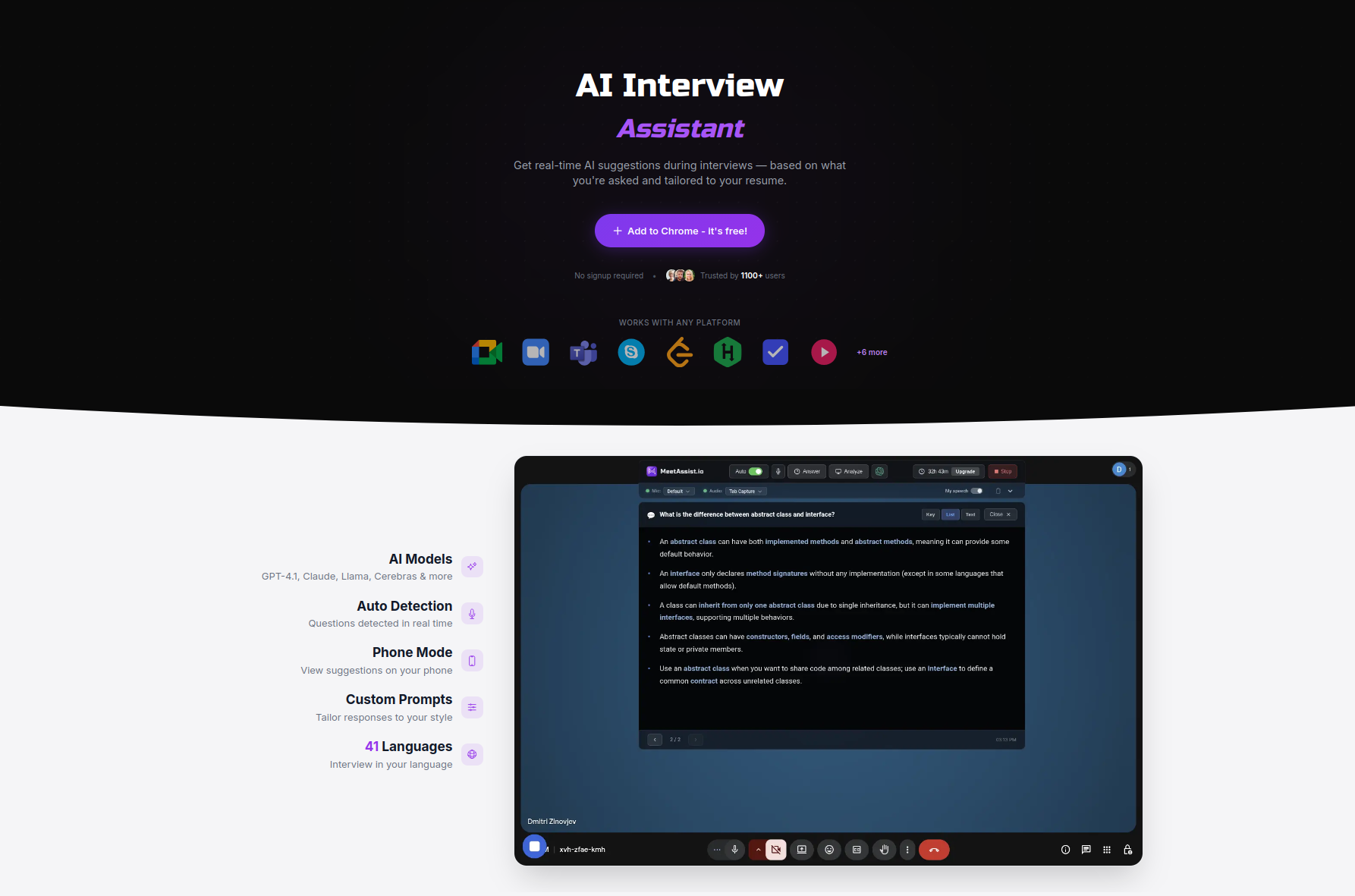
The platform supports customizable answer styles including STAR method, bullet points, and detailed narratives. Upload your resume once and receive tailored suggestions for technical questions, behavioral scenarios, and coding challenges. Phone Mode delivers all assistance invisibly to your mobile device, maintaining complete privacy during video interviews.
Practice realistic interview scenarios using AI that adapts to your experience level and target role. Build confidence with coding interview preparation preparation resources designed for software engineers, data scientists, and technical professionals. Access your preparation anytime, refine your answers, and enter interviews knowing you have intelligent support.
FAQ
How do I select which resume achievements to include in my answers?
Focus on achievements directly relevant to the question asked and the job requirements. Prioritize recent experiences with measurable results (percentages, dollar amounts, time saved). Choose examples that showcase the specific competency the interviewer is assessing, whether technical skills, leadership, or problem-solving.
When should I use concise vs detailed resume-based answers?
Use concise 30-45 second answers during phone screenings and initial technical assessments where interviewers evaluate many candidates quickly. Reserve detailed 90-120 second STAR-structured answers for behavioral interviews and final rounds where interviewers assess cultural fit and depth of experience. Watch for engagement cues to adjust your approach.
Can AI tools really help personalize my interview answers?
AI tools analyze your resume to suggest tailored, relevant answers that align with your documented experience and the question context. They save preparation time by generating answer frameworks you can customize to your speaking style. Real-time AI assistance during interviews helps you recall specific metrics and achievements under pressure, significantly reducing anxiety.
What are common mistakes to avoid in resume-based interview answers?
Avoid vague, generic answers without specific metrics or outcomes. Don’t overload early interview stages with excessive detail when concise responses suffice. Ensure your examples actually demonstrate the requested competency rather than tangentially related experiences. Always connect your answer explicitly to the role requirements so interviewers understand the relevance.
Recommended
- Interview Tips Articles – MeetAssist Blog | MeetAssist
- Step by Step Interview Preparation for Coding Success – MeetAssist | MeetAssist
- How to Answer Behavioral Questions for Interview Success – MeetAssist | MeetAssist
- 6 Essential Behavioral Interview Tips for Developers – MeetAssist | MeetAssist
- ApplyGenius – AI Resume Builder for Developers