

TL;DR:
- Mobile AI interview tools provide flexible, real-time practice anytime, anywhere, boosting consistency.
- They offer personalized feedback on answers, helping candidates improve structured responses effectively.
- Overreliance and scripted answers pose risks; authentic practice and reflection are essential for success.
The best interview practice does not have to happen at a desk, on a schedule, or with a coach watching over your shoulder. Busy candidates are increasingly turning to AI-driven mobile tools to squeeze real, structured practice into commutes, lunch breaks, and spare moments. These apps do more than quiz you on common questions — they analyze your answers, coach your structure, and simulate realistic interview scenarios in real time. This guide breaks down how mobile AI interview tools work, what they genuinely offer technical and behavioral candidates, where they can backfire, and how to build them into a prep routine that actually moves the needle.
Table of Contents
- How mobile AI interview tools work
- Top benefits for job seekers and technical candidates
- Potential pitfalls and ethical considerations
- Making mobile AI interview tools part of your winning routine
- The truth most job seekers miss about mobile AI interview tools
- Explore the best mobile interview tools to upgrade your journey
- Frequently asked questions
Key Takeaways
| Point | Details |
|---|---|
| Anytime, anywhere practice | Mobile AI tools let you prep for interviews flexibly during commutes or short breaks. |
| Personalized real-time feedback | Instant analysis and suggestions help you improve both technical and behavioral answers. |
| Avoid overreliance | Use mobile tools for mock practice, but rely on honest skills and keep live interview use ethical. |
| Effective integration | Build a balanced routine by combining mobile tools with human feedback for the strongest results. |
How mobile AI interview tools work
Traditional interview prep usually means booking time with a coach, scheduling a mock session with a friend, or sitting at a laptop running through question banks. Mobile AI tools flip that model entirely. They put a responsive, always-available practice partner in your pocket.
The most widely used apps in this space include Interview Hammer, Interview Man, and Huru. Each takes a slightly different approach, but they share a core set of capabilities that make them genuinely useful for job seekers. Mobile AI interview tools enable anytime, anywhere practice, which is especially valuable for technical candidates juggling full-time jobs while searching for new roles.
Here is a quick look at the key features these tools typically offer:
| Feature | What it does |
|---|---|
| Real-time listening | Captures your spoken answers and transcribes them live |
| AI answer suggestions | Offers structured response options based on your role and field |
| Instant feedback | Scores your answer for clarity, structure, and relevance |
| STAR method coaching | Guides you to frame answers using Situation, Task, Action, Result |
| Field-specific scenarios | Generates questions tailored to tech, finance, healthcare, and more |
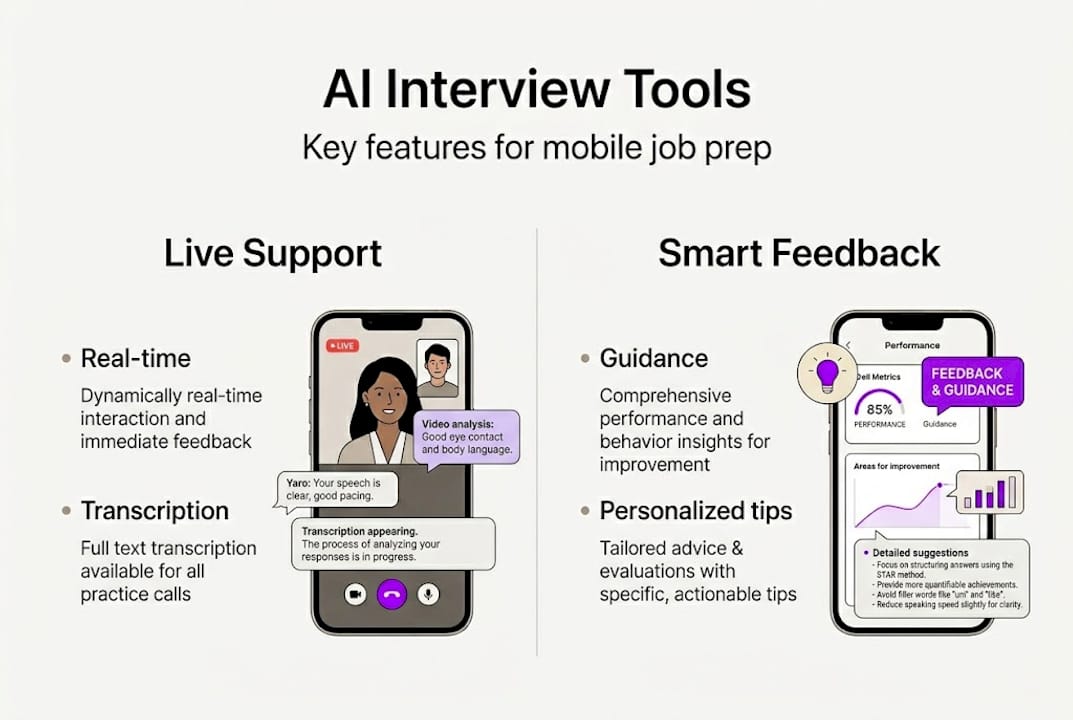
These tools use AI methodologies like speech analysis, STAR method feedback, field-specific responses, and live transcription to give candidates feedback that a static question bank simply cannot. That combination of real-time analysis and structured coaching is what separates them from older prep methods.
Common use cases include:
- Solo practice sessions for behavioral and situational questions
- coding interview preparation warm-ups using scenario-based prompts
- Peer review prep where you record answers and share for feedback
- On-the-go rehearsal between meetings or during a commute
- STAR method drilling for structured behavioral responses
For candidates exploring AI in interview prep more broadly, these mobile tools represent the most accessible entry point. They lower the barrier to consistent practice, which is the single biggest predictor of interview performance. The shift toward automation in technical interviews also means candidates who practice with AI tools are better calibrated to what modern hiring processes actually look like.
Top benefits for job seekers and technical candidates
Knowing what these tools do is one thing. Understanding why they matter for your specific situation is another.
The most immediate benefit is flexibility. A 15-minute session on your phone during a commute builds more cumulative practice than a single two-hour desktop session once a week. Consistency beats intensity in interview prep, and mobile tools make consistency easy.

| Factor | Mobile AI tools | Desktop tools |
|---|---|---|
| Flexibility | High — use anywhere, anytime | Low — requires a dedicated setup |
| Feedback type | Real-time, voice-based, personalized | Text-based, often delayed |
| Cost | Free to low-cost tiers available | Often subscription-based or expensive |
| Setup time | Under 60 seconds | Can require configuration |
| Portability | Fully portable | Desk-bound |
Here is how a typical candidate might realistically work these tools into a busy week:
- Monday morning commute — Run through five behavioral questions using STAR coaching
- Tuesday lunch break — Practice two technical scenario prompts for your target role
- Wednesday evening — Review AI feedback from earlier sessions and identify weak spots
- Thursday between meetings — Drill the specific question types you struggled with
- Friday — Do a full simulated mock interview to test your progress
Huru alone offers 20,000+ mock interviews, giving candidates an enormous range of scenarios to work through. That volume means you are unlikely to exhaust the question pool before your interview date.
On-the-go prep also reduces the anxiety that comes from cramming. Short, regular sessions normalize the interview experience so it feels less like a high-stakes event and more like a familiar routine.
For anyone pursuing AI interview assistance to build confidence, the personalized feedback loop is particularly powerful. The app does not just tell you whether your answer was good — it tells you why and how to improve it. That specificity accelerates growth in ways that generic prep guides cannot match.
Pro Tip: Schedule three 10-minute mobile sessions per week instead of one long session. Short, spaced repetition builds the kind of muscle memory that holds up under real interview pressure. Pair this with coding interview prep steps for technical roles to cover both sides of the equation.
Potential pitfalls and ethical considerations
The benefits are real, but mobile AI tools come with genuine risks that are worth taking seriously before you build them into your routine.
The biggest danger is overreliance. When candidates use AI to script every answer, they stop thinking and start reciting. Interviewers are trained to detect scripted, overly polished responses — and they find them off-putting. The goal is to sound like a prepared, thoughtful human, not a well-trained chatbot.
Watch for these warning signs:
- Your answers sound identical across different question types
- You freeze when a question deviates slightly from what you practiced
- You struggle to answer follow-up questions that go off-script
- You feel anxious without the app running during practice
- Your answers feel rehearsed even to you
There is also the question of live use. Real-time copilot use risks detection and ethical issues in live interviews, and overreliance leads to vague or scripted responses that undermine your credibility. Some hiring platforms now use behavioral analysis to flag unusual patterns, and the risk of disqualification is real.
“Authenticity remains the most important factor in interview success. Candidates who use AI to build their skills outperform those who use it as a crutch every time.” — HR professionals consistently emphasize that structured preparation beats scripted perfection.
The ethics of AI in job interviews are still evolving, but the core principle is straightforward: use these tools to get better, not to cheat. Understanding what AI answer suggestions actually do helps you use them as a learning tool rather than a shortcut.
Pro Tip: Use AI for mock practice exclusively. Never run a live AI assistant during an actual interview — the risk to your reputation and your candidacy is not worth it.
Making mobile AI interview tools part of your winning routine
Understanding the risks makes it easier to use these tools in ways that actually pay off. The key is treating them as a training environment, not a performance aid.
Here is a practical weekly workflow:
- Set a goal — Identify one area to improve each week (e.g., STAR structure, technical explanations, concise answers)
- Run daily micro-sessions — 10 to 15 minutes per day using your chosen app
- Review AI feedback actively — Do not just read it; rerecord the answer with the feedback applied
- Log your progress — Note which question types improved and which still need work
- Add a human element — Once a week, practice with a peer or mentor to get unscripted feedback
- Simulate real conditions — Do one timed, uninterrupted mock session per week without pausing for hints
For different interview types, the approach shifts slightly:
- Coding interviews — Use apps to practice explaining your thought process out loud, not just solving the problem silently
- Behavioral interviews — Focus on STAR structure and vary your examples so you do not repeat the same stories
- Case study interviews — Use AI to practice structuring your initial response before diving into analysis
AI tools make the process more meritocratic by providing context and coaching that goes beyond what a resume can show. Candidates without expensive coaches or elite networks can access the same quality of structured feedback. That is a genuine leveling of the playing field.
Pairing app-based practice with resources on soft skills for tech interviews rounds out your prep. Technical chops get you in the room; communication skills close the deal. Exploring top AI models for interview prep can also help you choose the right tool for your specific role and industry.
The truth most job seekers miss about mobile AI interview tools
Most candidates approach these tools looking for shortcuts. They want the app to tell them what to say so they can stop worrying about interviews. That mindset produces the worst outcomes.
The candidates who gain the most from mobile AI tools are the ones who use them for honest self-assessment. They run a session, listen back to the AI feedback with real curiosity, and ask themselves: “Do I actually believe what I just said?” That reflection is where the growth happens.
Empirical patterns consistently show that candidates who use AI to build structure — not to script responses — perform better in real interviews. They internalize frameworks like STAR and then speak naturally within them. The app becomes a mirror, not a script.
Current trends do favor these tools for equity and access. But the technology only works if you bring genuine effort to it. A candidate who practices authentically with a free app will outperform one who leans on an expensive tool without real reflection. Explore interview strategies that work to build a prep approach that holds up when the pressure is real.
Explore the best mobile interview tools to upgrade your journey
If you are ready to move beyond generic prep and build a smarter, more flexible routine, MeetAssist is worth exploring. The platform goes further than standard mobile apps by letting you sync AI assistance directly to your phone through Phone Mode, so you can analyze coding challenges, quizzes, and technical assessments from any active Chrome tab — all from your phone screen.
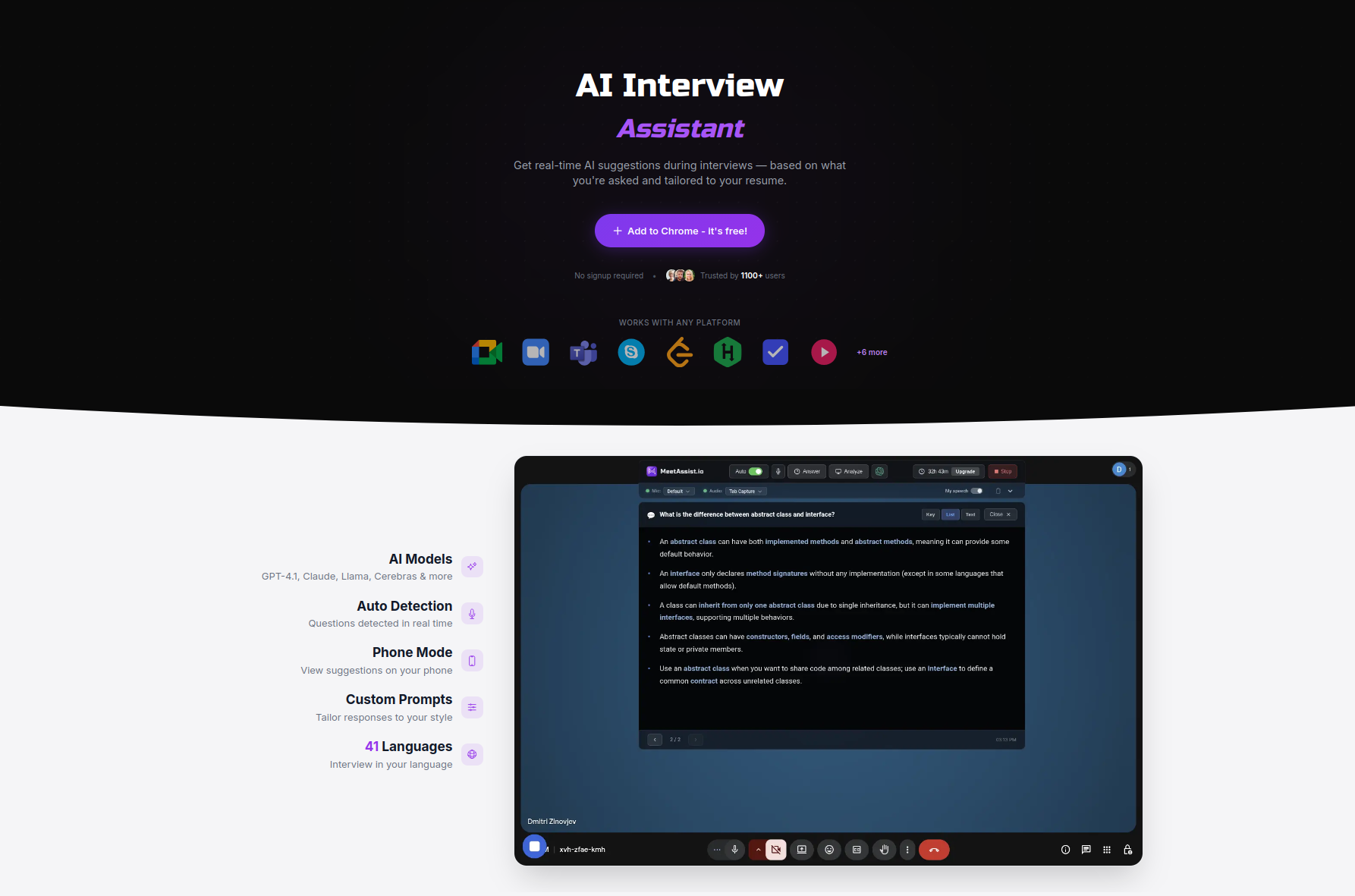
For candidates comparing options, the AI interview tool alternatives page gives you a clear side-by-side view of what different platforms offer. Whether you are preparing for a behavioral round or a live coding assessment, the MeetAssist platform gives you the tools to practice smarter and show up ready.
Frequently asked questions
Are mobile AI interview tools legit for real job interviews?
They are best used for practice and preparation before the interview. Real-time copilot use during live interviews risks detection and ethical consequences that can disqualify your application.
How do mobile tools compare to desktop interview solutions?
Mobile AI tools offer the flexibility to practice anywhere, while desktop solutions typically provide richer analytics and are better suited for keyboard-heavy technical prep.
What makes AI-driven feedback valuable?
AI tools deliver real-time, personalized feedback based on your specific field and answer structure, which helps you identify gaps and build confidence much faster than self-review alone.
Do employers know if I use mobile AI tools for prep?
No — practicing with mobile AI tools before an interview is completely undetectable. Only using AI assistance live during an actual interview creates any risk of detection or ethical concern.
Can mobile AI tools help with both technical and behavioral questions?
Yes. These tools use speech analysis and STAR feedback to simulate realistic scenarios across technical, behavioral, and case-based question formats, making them versatile for most interview types.