

TL;DR:
- AI now influences online assessments through proctoring, adaptive questioning, and response analysis.
- Understanding and strategically managing AI features can improve candidate performance and fairness.
- Awareness of biases and system limitations helps candidates better navigate AI-powered evaluations.
AI is quietly deciding whether you pass or fail your next technical interview, and most candidates have no idea it’s happening. From proctoring software that reads your eye movements to adaptive quizzes that follow up on your answers in real time, AI now shapes the outcome of online assessments at every stage. Platforms like HackerRank and Khan Academy have embedded machine learning deeply into their evaluation engines, making the human grader a secondary step rather than the first. Understanding how these systems work, where they can go wrong, and how to use them to your advantage is no longer optional for serious job seekers.
Table of Contents
- Understanding AI’s place in modern online quizzes
- AI proctoring: fairness, accuracy, and what it means for you
- How AI personalizes quiz feedback and reveals deeper understanding
- Bias, challenges, and future trends: What candidates should watch for
- Our take: Why understanding AI in assessments puts you ahead
- Ready to make AI work for you?
- Frequently asked questions
Key Takeaways
| Point | Details |
|---|---|
| AI shapes assessments | Online quizzes now use AI tools for proctoring, question analysis, and personalized feedback, often changing how candidates are evaluated. |
| Fairness and bias concerns | AI reduces cheating but can flag innocent behavior and may amplify biases if not carefully managed. |
| Adaptation strategy | Understanding AI’s role and best practices for test-taking helps candidates avoid pitfalls and stand out. |
| Changing interview norms | Some employers now design interviews around AI, emphasizing problem solving over memorization. |
Understanding AI’s place in modern online quizzes
When people hear “AI in online quizzes,” they usually picture a chatbot generating questions. The reality is far more layered. Today’s assessment platforms deploy AI across at least three distinct functions: integrity monitoring, question adaptation, and response analysis. Each one uses different technology and carries different implications for how you should prepare.
The core technologies powering these systems include computer vision (analyzing your webcam feed for suspicious movement), natural language processing or NLP (parsing written or spoken responses for meaning and intent), and machine learning algorithms (scoring patterns over time and flagging anomalies). Together, they create an evaluation environment that is always on and never tired.
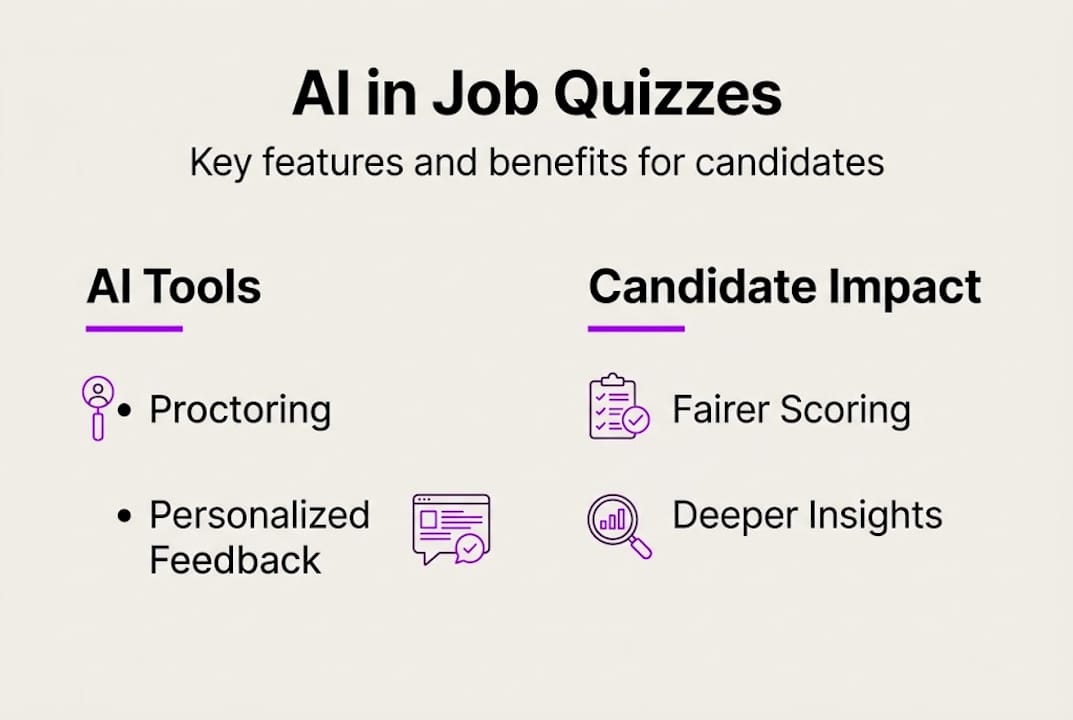
Here is a quick breakdown of how these features appear in practice:
| AI feature | Primary technology | What it does for the assessment |
|---|---|---|
| Proctoring and monitoring | Computer vision, NLP | Detects cheating via gaze, audio, behavior |
| Adaptive questioning | Machine learning | Adjusts difficulty based on your responses |
| Response analysis | NLP, deep learning | Grades open-ended answers and detects reasoning depth |
| Integrity scoring | Behavioral analysis | Flags copy-paste, tab switching, unusual timing |
The scale of AI adoption here is significant. HackerRank processes millions of technical assessments each year across thousands of companies. AI proctoring uses computer vision, NLP, and behavioral analysis to detect cheating with high accuracy, with some systems reporting 90%+ detection rates in controlled scripted cheating tests. That number is striking, but it comes with important caveats around real-world conditions that we will explore in the next section.
Meanwhile, How generative AI is transforming student assessment at Khan Academy shows that conversational AI assessments can reveal deeper understanding in 20 to 36% of cases beyond what a standard quiz would catch. That means AI is not just a gatekeeper. It is also a tool that can surface knowledge you have but might not show in a traditional multiple-choice format.
For job seekers, understanding AI in job interviews is no longer a curiosity. It is a core part of interview literacy. Getting familiar with AI-powered interview guidance before your next assessment can shift you from reactive to prepared.
AI proctoring: fairness, accuracy, and what it means for you
AI proctoring is the most anxiety-inducing part of modern online assessments, and for good reason. The system is watching you constantly, making automated judgments about whether your behavior looks suspicious. But knowing exactly how it works takes away much of its power to rattle you.
Here is what AI proctoring actually monitors during a typical online assessment:
- Webcam gaze tracking: Detects when your eyes move off-screen repeatedly, which may suggest you are reading from another source.
- Head pose analysis: Flags significant or repeated head turns, which can indicate looking at another monitor or person.
- Voice activity detection: Listens for background speech that might suggest someone is coaching you.
- Keystroke and mouse behavior: Unusual pauses, copy-paste actions, or tab-switching trigger integrity alerts.
- Screen recording review: Captures your screen for post-session human review if automated flags are triggered.
The good news is that proctoring reduces cheating significantly, with observed cheating rates as low as 4% in proctored environments. However, the same research shows that human-AI hybrid review rejects 50 to 71% of false positives in copy-typing detection scenarios. That is a high rate of incorrect flags, which means the system is genuinely imperfect.
“AI proctoring tools can flag innocent behavior as suspicious, particularly in cases involving environmental noise, poor lighting, or natural movement patterns. Human oversight remains essential for fair outcomes.” — Research on reducing false positive rates in AI proctoring
False positives happen most often when candidates have noisy environments, habitually look to one side while thinking, or use adaptive hardware. Understanding AI interview privacy helps you know what data is being collected and how to protect yourself.
Pro Tip: Before your test, record yourself answering a few practice questions on video. Watch it back and notice any habitual movements (like looking up or to the side when thinking) that an AI system might misread as suspicious. Adjust your camera angle so your face is fully lit and centered in frame.
For a broader set of strategies, AI interview prep tips offers practical guidance on how to present yourself well in AI-monitored settings.
How AI personalizes quiz feedback and reveals deeper understanding
Here is the part most candidates miss: AI is not just watching you for dishonesty. It is also trying to understand how you think. Adaptive AI quiz systems do not stop at marking your answer right or wrong. They follow up, probe, and analyze the reasoning behind your response.

This is a fundamental shift from traditional assessment. A human grader might give partial credit based on a gut sense of your understanding. An AI system can identify the specific conceptual gap in your answer and ask a targeted follow-up question to confirm whether it was a knowledge gap or just poor phrasing. Khan Academy’s AI detects deeper understanding in 20 to 36% of cases beyond initial answers, surfacing knowledge that static quizzes would have missed entirely.
In practice, adaptive AI-driven assessments may provide feedback that includes:
- Concept-specific corrections: Pinpointing the exact misunderstanding rather than just marking wrong
- Follow-up prompts: Asking you to explain your reasoning if your answer seems like a guess
- Partial credit signals: Identifying correct elements within an overall wrong answer
- Difficulty scaling: Moving you to harder or easier questions based on your response pattern
- Reasoning traces: Some systems record your step-by-step logic for human reviewers to assess
This matters enormously for AI in technical interviews, where demonstrating process is often as valuable as getting the right answer. A candidate who explains their reasoning clearly, even when arriving at a slightly wrong conclusion, will often score better than one who guesses correctly but offers no insight.
Pro Tip: When answering AI-driven quiz questions, narrate your reasoning out loud or in writing even when the format does not require it. Many platforms score explanation quality separately from answer accuracy. This approach also helps if the AI follows up with a clarifying question since you have already laid out your thinking. For deeper strategies, the AI answer generation guide is worth reading before your next technical assessment.
Bias, challenges, and future trends: What candidates should watch for
AI in assessments is not neutral by design. Every system reflects the data it was trained on, and training data carries the assumptions and limitations of whoever collected it. This has real consequences for candidates.
The challenges show up in predictable ways:
- Language and accent bias: NLP systems trained primarily on standard American English may score non-native speakers lower on spoken or written assessments, even when their answers are technically correct.
- Movement and cultural norms: Gaze tracking assumes Western eye-contact norms. Candidates from cultures where looking away during thought is respectful may trigger more false flags.
- AI fluency gaps: Some candidates have never interacted with AI-driven interfaces and are slower to adapt to adaptive questioning formats, which affects their pacing and performance.
- Inconsistent scoring at the edges: Systems tend to perform well in the middle of the ability distribution and less well at the extremes, where unusual but valid answers may get misclassified.
According to analysis of how companies are
Candidates who can’t outrun AI in tech interviews need to understand these edge cases. AI fluency gaps or linguistic concerns are real disadvantages that organizations are only beginning to address.
Some forward-looking employers are now allowing AI assistance during interviews intentionally, treating it as a real-world skills test rather than a gatekeeping mechanism. That trend is worth watching. The relevant AI ethics in interviews discussion is evolving fast, and staying current on it gives you a strategic edge.
Look for these signs that an employer is using advanced AI assessments:
- Timed coding challenges with no human reviewer present
- Questions that change based on your previous answer
- Automated feedback delivered within seconds of submission
- Requests to keep your webcam and microphone active throughout
Our take: Why understanding AI in assessments puts you ahead
Most candidates treat AI proctoring and adaptive quizzes as obstacles. We think that is the wrong frame entirely. Every system has logic you can learn, and every bias you understand is a variable you can control.
The candidates who perform best in AI-mediated assessments are not necessarily the smartest or the most technically skilled. They are the ones who understand the environment they are operating in. They know that gaze tracking has blind spots. They know that narrating reasoning scores higher than silent guessing. They know that follow-up questions are opportunities, not traps.
Conventional interview advice tells you to practice your answers. That is still true. But it misses the layer of how AI reads those answers, which is just as important as content in 2026. AI interview assistance that helps you understand and work within these systems is not cheating. It is the modern version of knowing your audience.
The uncomfortable truth is that AI fluency is now a job skill. The sooner you treat it that way, the faster you move ahead.
Ready to make AI work for you?
Understanding AI in assessments is the first step. Applying that understanding in a live test is where it counts. MeetAssist is built exactly for that moment, giving you real-time AI-powered suggestions during technical interviews and online assessments without leaving anything visible on your screen.
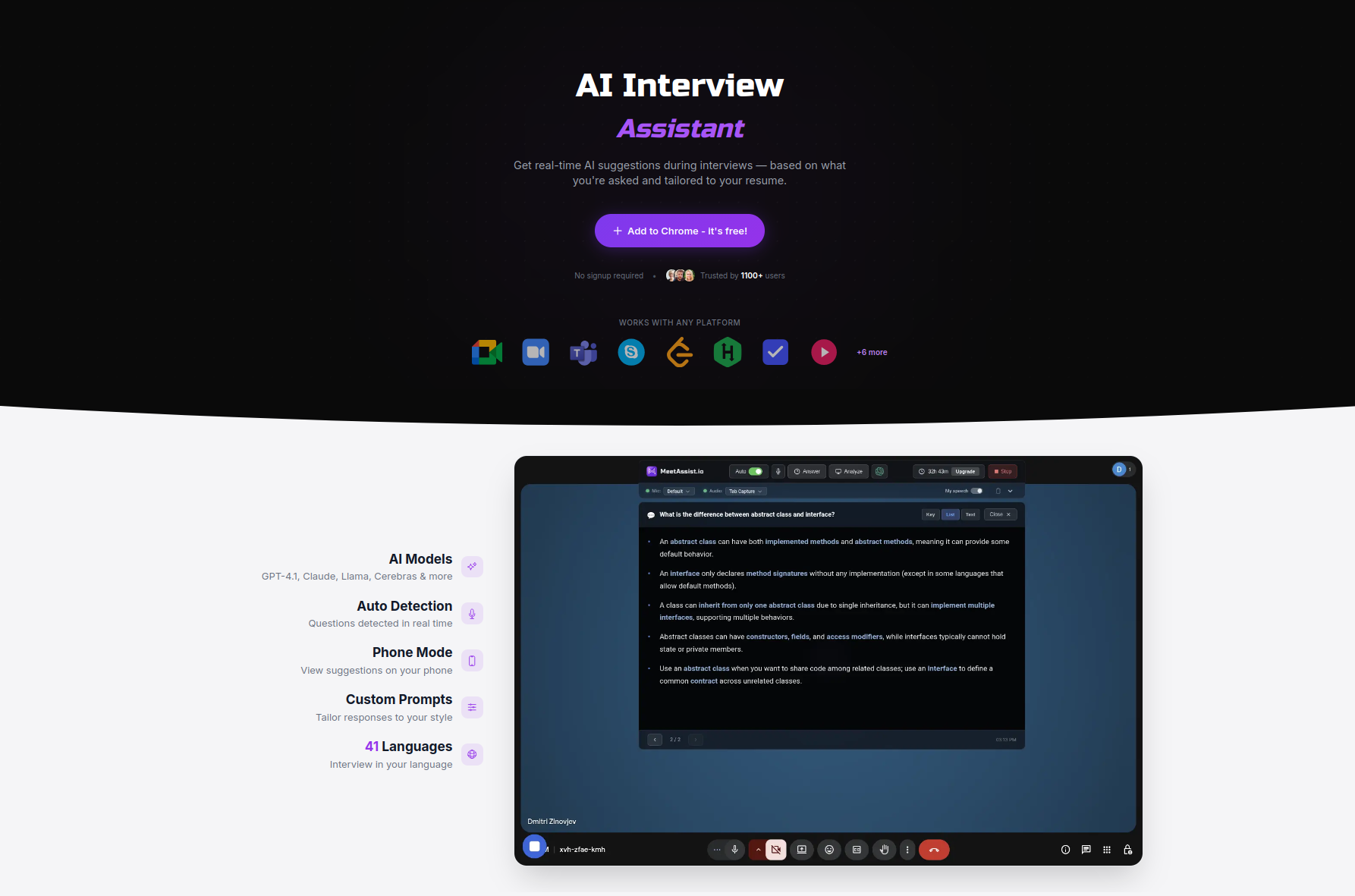
If you want to see how this fits your preparation strategy, take a look at how others are using MeetAssist to stay sharp during live assessments. You can also compare AI interview tools to find the right setup for your next opportunity. No subscriptions, no recording, just practical AI support when you need it most.
Frequently asked questions
How does AI detect cheating during online assessments?
AI proctoring uses computer vision, NLP, and behavioral analysis to flag suspicious activity like gaze deviation, background audio, and tab switching in real time. These signals are often reviewed by a human moderator before any action is taken.
What should I do if I’m falsely flagged by AI during a test?
Stay calm, minimize movement, and speak clearly throughout the session. Human-AI hybrid review rejects 50 to 71% of false positives, so contacting the platform’s support team with your session ID usually resolves the issue quickly.
Can AI make online quizzes less biased than human grading?
AI removes some human biases like name recognition or appearance, but it may amplify bias from its training data in other areas, such as accent or cultural movement norms. The outcome depends on how carefully the system was designed and tested.
Are some candidates at a disadvantage with AI-powered quizzes?
Yes. Non-native speakers and candidates disadvantaged due to AI fluency or unfamiliarity with adaptive interfaces often perform below their actual skill level in AI-driven assessments.
Recommended
- Coding challenge AI: smart tools for job interviews | MeetAssist
- What are AI answer suggestions? A guide for job seekers | MeetAssist
- What Is AI-Driven Answer Generation? A Guide for Job Seekers | MeetAssist
- AI in job interviews: tools, ethics, and success tips | MeetAssist
Looking for help with your next interview? MeetAssist provides real-time AI assistance during your video interviews on Google Meet, Zoom, and Teams. Browse our interview preparation guides to get started.