

AI powered tools are transforming how candidates approach technical interviews and coding challenges. Over 76% of engineers now use AI assistants daily in their work, but confusion persists about what counts as legitimate help versus cheating during assessments. This guide cuts through the noise to explain what real-time coding challenge help actually means, how these tools function, and the ethical boundaries you need to understand before your next interview.
Table of Contents
- Key takeaways
- What is real-time coding challenge help?
- Benefits and limitations of AI powered coding help
- Legitimate AI assistance versus cheating tools
- How to effectively use real-time coding challenge help
- Explore AI powered coding challenge assistants
- FAQ
Key Takeaways
| Point | Details |
|---|---|
| Real time coding help | Real time coding help refers to AI tools that offer live suggestions and debugging during interviews and assessments. |
| Legitimate AI assistance boosts hiring | Approved AI assistance on platforms like CodeSignal and CoderPad speeds hiring cycles and improves task completion rates. |
| Cheating tools violate policies | Stealth cheating tools secretly run on devices to bypass detection, but using them violates interview rules and risks candidacy. |
| Human AI collaboration | Human AI collaboration helps candidates achieve higher pass rates by letting them focus on design and problem solving while AI handles routine tasks. |
| AI limitations in coding | AI limitations show up on novel problems where deep reasoning and domain knowledge are required, with accuracy dropping on unfamiliar challenges. |
What is real-time coding challenge help?
Real-time coding challenge help refers to AI powered tools providing live assistance during coding interviews or technical assessments. These systems analyze your code as you write it, offering suggestions, debugging help, and solution hints in the moment. The technology ranges from officially sanctioned platforms built into interview systems to controversial stealth tools that candidates use without disclosure.
Legitimate platforms like CodeSignal and CoderPad have integrated AI assistance directly into their assessment environments. When you take a coding challenge on these platforms, the AI can explain problem statements, suggest algorithmic approaches, and help debug syntax errors. This mirrors how engineers actually work, since most developers use AI coding assistants like GitHub Copilot in their daily jobs.
The other category includes stealth cheating tools designed to bypass detection. These applications run hidden on your computer or phone, analyzing screen content and generating solutions without the interviewer’s knowledge. While marketed as undetectable, using these tools violates interview policies and puts your candidacy at serious risk.
Real-time coding help typically provides several types of assistance:
- Code completion suggestions based on context and common patterns
- Explanations of error messages and debugging recommendations
- Alternative solution approaches when you’re stuck on a problem
- Syntax corrections and best practice recommendations
Understanding the difference between approved assistance and prohibited cheating tools matters for your interview preparation success. Companies increasingly expect candidates to work alongside AI, but they also track usage patterns to ensure fairness. The key is knowing which tools align with interview guidelines and which cross ethical lines.
Benefits and limitations of AI powered coding help
Legitimate AI assistance delivers measurable improvements in hiring efficiency and candidate performance. Companies using approved AI coding help report 60% faster hiring cycles and see candidate task completion rates jump by 35%. These gains come from reducing time spent on syntax debugging and letting candidates focus on problem solving logic rather than memorizing API documentation.
Benchmark testing reveals important limitations in current AI coding capabilities. Large language models score below 40% accuracy on novel, real world coding problems that require deep reasoning or domain expertise. AI excels at recognizing common patterns and generating boilerplate code but struggles with unique algorithmic challenges or debugging complex edge cases.
| AI capability | Performance level | Best use case |
|---|---|---|
| Simple CRUD operations | 85-90% accuracy | Greenfield projects, standard implementations |
| Algorithm optimization | 45-60% accuracy | Initial approaches, not final solutions |
| Complex debugging | 30-40% accuracy | Identifying potential issues, not root causes |
| Novel problem solving | Below 40% accuracy | Brainstorming only, requires human verification |
The sweet spot for AI coding help involves simpler tasks and greenfield development where established patterns apply. When you’re building something new without legacy constraints, AI suggestions tend to be more accurate and useful. Conversely, debugging production code or solving novel algorithmic puzzles often exposes AI limitations.

Human-AI collaboration produces better outcomes than either approach alone. Research on editing benchmarks shows that candidates working with AI assistance achieve 31% higher pass rates compared to those coding solo. The synergy comes from using AI to handle routine tasks while you focus cognitive energy on architecture decisions and creative problem solving.
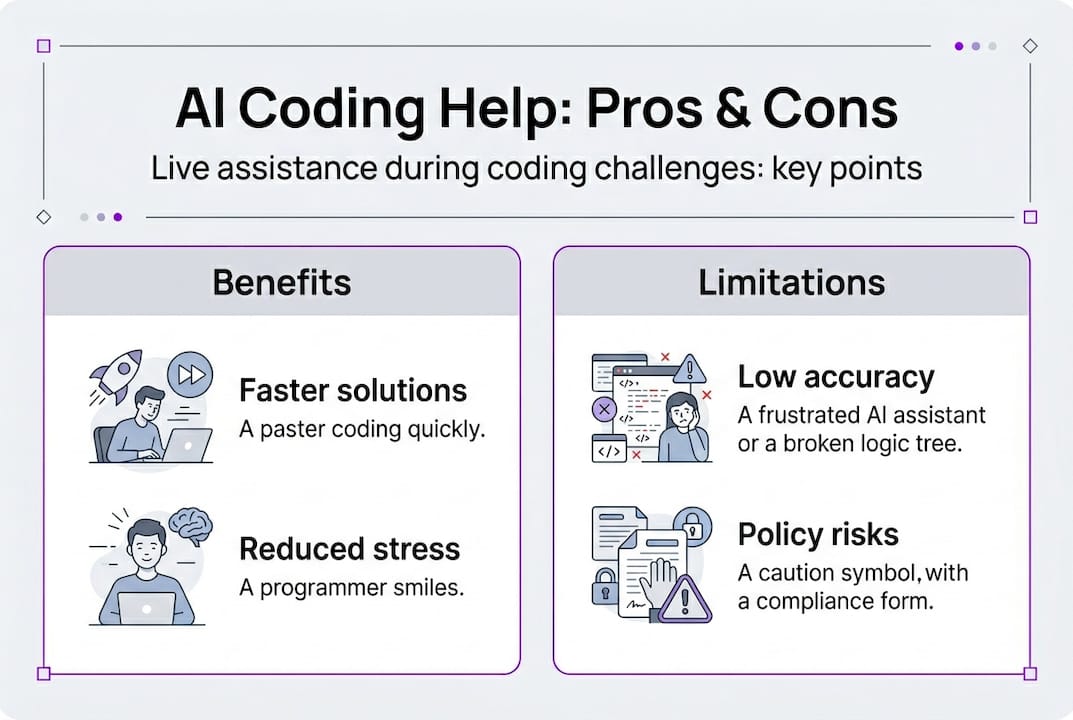
Pro Tip: Use AI help to quickly generate test cases and edge conditions for your solutions. This frees your mental bandwidth to focus on optimizing algorithms and handling complex logic, where human insight still outperforms AI.
The technical interview automation impact extends beyond individual performance to reshape how companies evaluate candidates. Forward thinking organizations now design assessments that assume AI availability, testing for skills like prompt engineering and AI output verification rather than pure memorization.
Legitimate AI assistance versus cheating tools
The line between ethical AI use and cheating hinges on transparency and policy compliance. 76% of engineers use AI daily for legitimate coding tasks, and many interview platforms now explicitly allow approved AI tools. The distinction comes down to whether the assistance is disclosed, permitted by interview rules, and reflects how you’d actually work on the job.
Interview platforms track AI usage patterns to maintain assessment integrity. They monitor factors like typing speed, solution similarity to AI generated code, and unusual performance spikes that suggest hidden assistance. CodeSignal and similar platforms flag suspicious activity for human review, and candidates caught using unauthorized tools face immediate disqualification.
Cheating tools market themselves as undetectable, but this claim rarely holds up under scrutiny. These applications promise to:
- Analyze your screen without visible windows or processes
- Generate solutions that mimic your coding style
- Operate completely hidden from interview monitoring software
- Provide answers faster than human problem solving allows
The risks of using cheating tools extend far beyond a single interview. Getting caught typically results in permanent bans from company applicant systems, damaged professional reputation, and potential legal consequences if you signed integrity agreements. Even if undetected initially, using prohibited tools means you’ll struggle in the actual job since you haven’t developed genuine problem solving skills.
Ethical AI use in coding interviews mirrors real world engineering practices. If you wouldn’t hide the tool from your team lead during code review, you shouldn’t hide it from interviewers either.
Legitimate AI assistance aligns with company policies and interview transparency. Before using any AI tool during an assessment, verify that it’s explicitly allowed in the interview guidelines. Many companies now permit AI coding assistants because they want to see how you collaborate with technology, not whether you can solve problems entirely from memory.
The shift toward using AI ethically in interviews reflects changing workplace realities. Companies recognize that banning AI from interviews creates an artificial environment that doesn’t match actual job conditions. The focus is moving toward evaluating how effectively you leverage AI tools rather than whether you use them at all.
How to effectively use real-time coding challenge help
Maximizing AI coding help requires strategic thinking about when and how to engage the technology. Start by using AI to clarify ambiguous problem statements and verify your understanding of requirements. Ask the AI to rephrase the challenge or provide example inputs and outputs, ensuring you’re solving the right problem before writing code.
Practice with AI tools on similar challenges before your actual interview. Familiarize yourself with how the AI responds to different types of problems and learn to recognize when its suggestions are helpful versus misleading. This preparation builds intuition about AI strengths and weaknesses, letting you make better real time decisions during high pressure interviews.
- Read the entire problem statement carefully before requesting AI help
- Write pseudocode or outline your approach independently first
- Use AI for specific tasks like generating test cases or debugging syntax
- Verify all AI suggestions by testing them against edge cases
- Explain your reasoning to interviewers, including how AI assisted your process
- Balance AI input with your own problem solving to demonstrate genuine skills
Disclose AI assistance when interview rules allow it and be transparent about your collaboration process. Many interviewers appreciate candidates who can articulate how they use AI effectively, viewing it as a valuable meta skill. Explain which parts you solved independently and where AI helped accelerate your work.
Understand platform specific rules about AI usage before starting any assessment. Some companies provide built in AI tools and expect you to use them, while others prohibit all external assistance. Review interview guidelines carefully and ask clarifying questions if policies seem unclear.
Pro Tip: Use AI to generate multiple solution approaches quickly, then evaluate trade-offs yourself. This demonstrates strategic thinking and shows you can leverage AI for brainstorming while maintaining critical judgment about which approach best fits the requirements.
Balance AI input with your own coding skills for optimal results. Research shows human-AI collaboration boosts pass rates by 31% compared to working alone, but only when candidates actively engage with and verify AI suggestions. Blindly accepting AI output often leads to subtle bugs or suboptimal solutions that reveal lack of genuine understanding.
Develop a systematic approach to using AI for Google interviews and other high stakes assessments. Create a mental framework for which tasks to delegate to AI versus which require your direct attention. Routine syntax checking and documentation lookup work well for AI, while architectural decisions and algorithm selection benefit from human judgment.
The most successful candidates treat AI as a collaborative partner rather than a replacement for their own skills. Use it to handle tedious tasks and accelerate initial exploration, but maintain ownership of the overall solution strategy. This approach aligns with interview preparation guides steps that emphasize building genuine competence rather than gaming assessments.
Explore AI powered coding challenge assistants
Ready to experience how AI assistance transforms your interview preparation? MeetAssist provides real-time AI powered help during coding challenges, technical assessments, and live interviews. The platform integrates with web based meeting tools and coding environments, offering instant suggestions without disrupting your workflow.
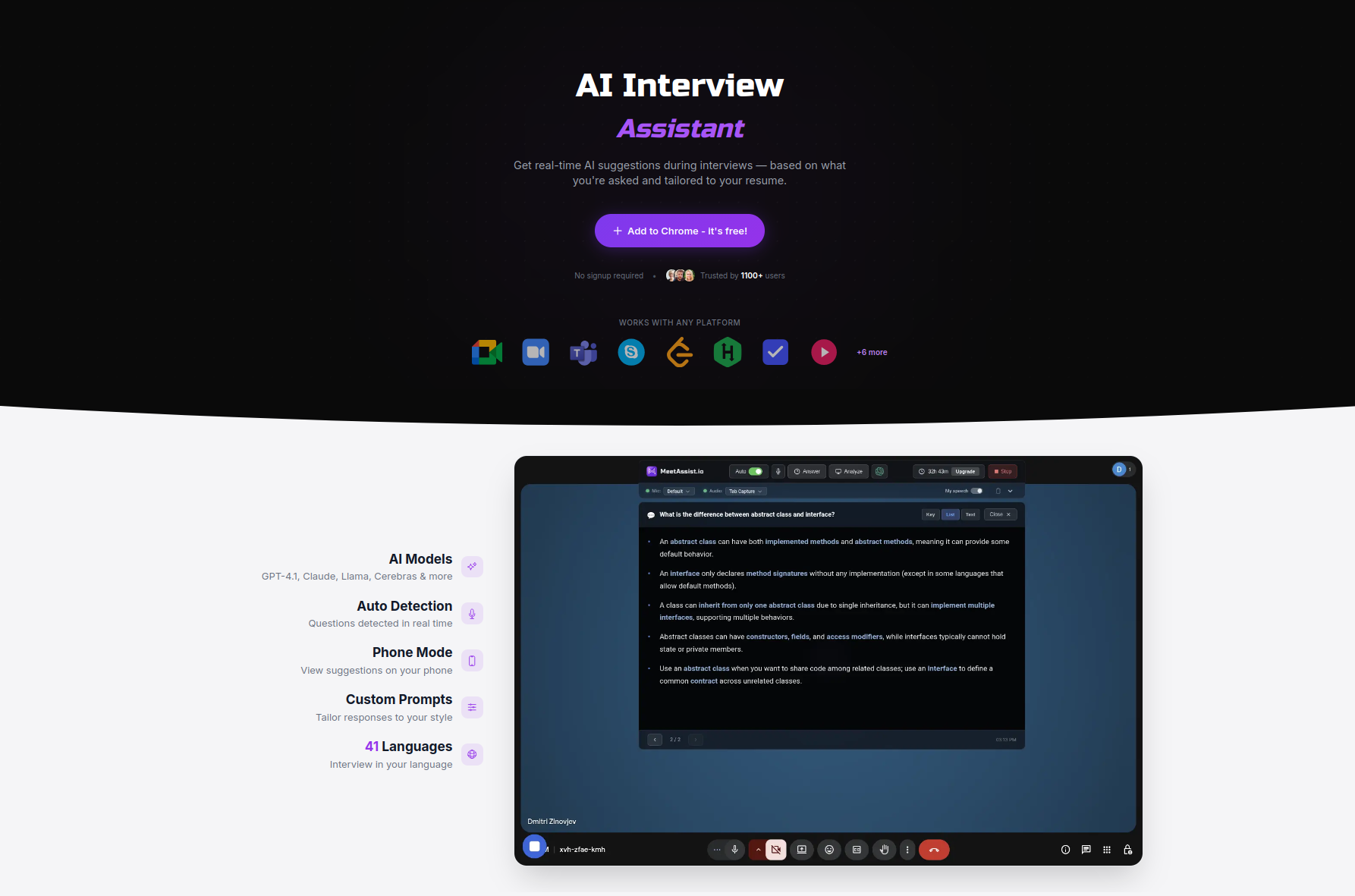
Explore comprehensive AI interview assistant alternatives to find the right tool for your specific needs. Compare features like multi-model AI support, phone mode for invisible assistance, and customizable answer styles. Access detailed MeetAssist usage guides to maximize effectiveness during your next technical interview. Visit the MeetAssist homepage to discover how AI assistance can level up your interview performance while maintaining ethical standards.
FAQ
Is using real-time AI coding help considered cheating?
Using AI coding help is only cheating if it violates specific interview policies or involves undisclosed assistance. Legitimate AI use is widespread among engineers, with 76% using AI tools daily in their actual work. Many companies now explicitly allow AI assistants during interviews because they reflect real world engineering practices. However, stealth cheating tools that operate without disclosure violate interview integrity agreements and risk permanent disqualification. Always verify what AI assistance is permitted before your interview and disclose any tools you use when asked.
How accurate are AI assistants in solving coding challenges?
AI assistants excel at simple coding tasks but show significant limitations on complex problems. Current large language models score below 40% accuracy on novel, real world coding challenges that require deep reasoning or domain expertise. AI performs best on standard implementations, boilerplate generation, and common algorithmic patterns where it can draw from extensive training data. For complex debugging, unique problem solving, or optimization tasks, AI suggestions often miss critical edge cases or produce subtly incorrect solutions. Use AI as a helpful assistant for routine tasks, but verify all suggestions through testing and apply your own judgment for complex logic.
Can I use AI assistants during live coding interviews safely?
You can safely use AI assistants during live coding interviews if you follow three key practices. First, check interview guidelines explicitly about AI tool permissions before the session starts. Second, disclose any AI assistance you’re using to interviewers when asked or when policies require transparency. Third, choose tools that align with company policies rather than stealth applications marketed as undetectable. Many forward thinking companies now expect candidates to demonstrate AI collaboration skills, viewing it as a valuable competency. Review our guide on using AI safely in interviews for detailed best practices and policy navigation strategies.
What types of coding problems benefit most from AI assistance?
AI assistance delivers the greatest value for greenfield coding problems, standard implementations, and tasks involving common design patterns. Generating test cases, writing boilerplate code, and debugging syntax errors represent ideal use cases where AI accuracy exceeds 85%. AI also helps quickly explore multiple solution approaches, letting you evaluate trade-offs faster than brainstorming alone. Conversely, AI struggles with novel algorithmic challenges, complex system design decisions, and debugging intricate edge cases in existing codebases. The optimal strategy combines AI for accelerating routine tasks while reserving your cognitive energy for creative problem solving and architectural decisions that require human insight.
How do interview platforms detect unauthorized AI usage?
Interview platforms employ multiple detection methods to identify unauthorized AI assistance during coding assessments. They analyze typing patterns and speed, looking for sudden performance changes that suggest external help. Platforms compare your solution against known AI generated code patterns and flag high similarity scores for review. They monitor for unusual screen activity, hidden processes, or network traffic that indicates stealth tool usage. Some systems track how quickly you produce solutions relative to problem complexity, flagging suspiciously fast completions. Advanced platforms also use behavioral analytics to identify candidates whose interview performance significantly exceeds their actual skill level based on resume and previous assessments.
Recommended
- Step by Step Interview Preparation for Coding Success – MeetAssist | MeetAssist
- Technical skill assessments explained: 2026 guide – MeetAssist | MeetAssist
- Technical Interview Automation: Real-Time AI Impact – MeetAssist | MeetAssist
- Best Interview Coder Alternatives in 2026 (Top 5 Compared) | MeetAssist