

Technical interviews remain the gatekeeper to your dream tech role, yet many candidates stumble because they prepare for the wrong interview type or fail to recognize the distinct skills each format demands. Understanding the types of technical interviews you’ll face and tailoring your preparation accordingly can transform your performance from average to exceptional. This guide walks you through the major interview formats, explains what each type tests, and shows you how to prepare strategically so you can walk into every round with confidence and clarity.
Table of Contents
- How To Evaluate And Choose Types Of Technical Interviews To Prepare For
- Coding Interviews: Core Skills And Preparation Strategies
- System Design Interviews: Demonstrating Strategic And Technical Depth
- Behavioral Interviews: Proving Your Teamwork And Problem-Solving Skills
- Comparing Technical Interview Types: Formats, Focus, And Tips
- How Meetassist Supports Your Technical Interview Success
Key takeaways
| Point | Details |
|---|---|
| Multiple interview types | Technical interviews include coding, system design, behavioral, and other specialized formats that test different skill sets. |
| System design impacts salary | Performance in system design interviews significantly influences your starting level and compensation package. |
| Behavioral rounds matter | Soft skills and communication are increasingly weighted in hiring decisions, especially for senior roles. |
| Tailored preparation wins | Effective preparation requires understanding which interview types your target companies use and practicing accordingly. |
| Consistent practice pays off | Experts recommend around 3 months of focused practice to build the depth needed across interview formats. |
How to evaluate and choose types of technical interviews to prepare for
Before diving into practice problems, you need a clear strategy for which interview types deserve your time and energy. Technical interviews vary based on role and company, ranging from one to multiple rounds depending on seniority. Start by researching your target companies and roles to identify which interview formats they commonly use. A startup might focus heavily on coding and culture fit, while a large tech company often includes system design and multiple behavioral rounds.
Consider the number of rounds and skill emphasis per interview type. Entry-level positions typically prioritize coding ability and problem-solving fundamentals, while senior roles demand architectural thinking and leadership evidence. Tailor your preparation effort based on this reality. If you’re applying for senior positions, allocate significant time to system design even if coding feels more comfortable.
Preparation for technical interviews should include practice, job requirement understanding, project showcasing, and staying updated. Maintain consistent practice focusing on problem-solving depth rather than memorizing solutions. Build a portfolio of relevant projects that demonstrate your technical skills in real-world contexts. Keep your industry knowledge current by following engineering blogs, attending meetups, and engaging with technical communities.
Pro Tip: Create a spreadsheet tracking which companies use which interview types, then allocate your weekly study hours proportionally. If 70% of your target roles include system design, dedicate 70% of your preparation time accordingly.
Key preparation priorities include:
- Identify common interview formats for your target roles through company research and candidate experiences
- Assess your current skill level in each interview type to find gaps
- Allocate study time proportionally based on interview frequency and your weaknesses
- Schedule mock interviews covering all relevant formats
- Review and refine your approach weekly based on practice performance
For comprehensive guidance across all interview stages, explore our interview prep resources and interview tips collection.
Coding interviews: core skills and preparation strategies
Coding interviews remain the foundation of technical hiring, testing your ability to solve algorithmic problems under pressure. Technical interviews assess problem-solving and technical skills relevant to the industry. These sessions typically focus on data structures, algorithms, coding correctness, and your ability to communicate your thought process clearly. You might encounter live coding on a shared editor, whiteboard sessions, or timed online assessments.
Typical formats include 45-60 minute sessions where you solve one to three problems of varying difficulty. Interviewers evaluate not just whether you reach the correct solution, but how you approach the problem, handle hints, optimize your code, and explain trade-offs. Clean, readable code matters as much as algorithmic correctness. Many candidates fail not because they can’t solve problems, but because they rush to code before fully understanding requirements or skip edge case testing.
Many experts recommend setting aside around 3 months for dedicated interview practice. Effective preparation involves consistent daily practice, mock interviews with peers or platforms, and systematic review of fundamental data structures and algorithms. Focus on understanding patterns rather than memorizing solutions. When you solve a problem, ask yourself what category it belongs to and what similar problems share the same approach.
Problem-solving skills and writing clean code are key to success. Start with easier problems to build confidence, then gradually increase difficulty. Track your progress and identify weak areas like dynamic programming or graph algorithms. Revisit challenging problems after a few days to reinforce learning.
Pro Tip: After solving each problem, write a brief summary explaining the pattern, time complexity, and when to apply this approach. This creates a personalized reference guide that’s far more valuable than generic study materials.
Essential coding interview preparation guides steps:
- Master fundamental data structures including arrays, hash tables, trees, graphs, and heaps
- Practice algorithmic patterns like two pointers, sliding window, backtracking, and dynamic programming
- Conduct timed mock interviews to build pressure management skills
- Review your code for readability, edge cases, and optimization opportunities
- Explain your thinking out loud during practice to improve communication
Our interview prep category and software engineer questions collection provide targeted practice resources.
System design interviews: demonstrating strategic and technical depth
System design interviews separate mid-level engineers from senior architects by testing your ability to build scalable, reliable systems from scratch. System design interview performance is a key factor in determining a candidate’s starting level and salary. These sessions assess strategic thinking, communication clarity, and deep understanding of distributed systems concepts like caching, load balancing, database sharding, and consistency models.
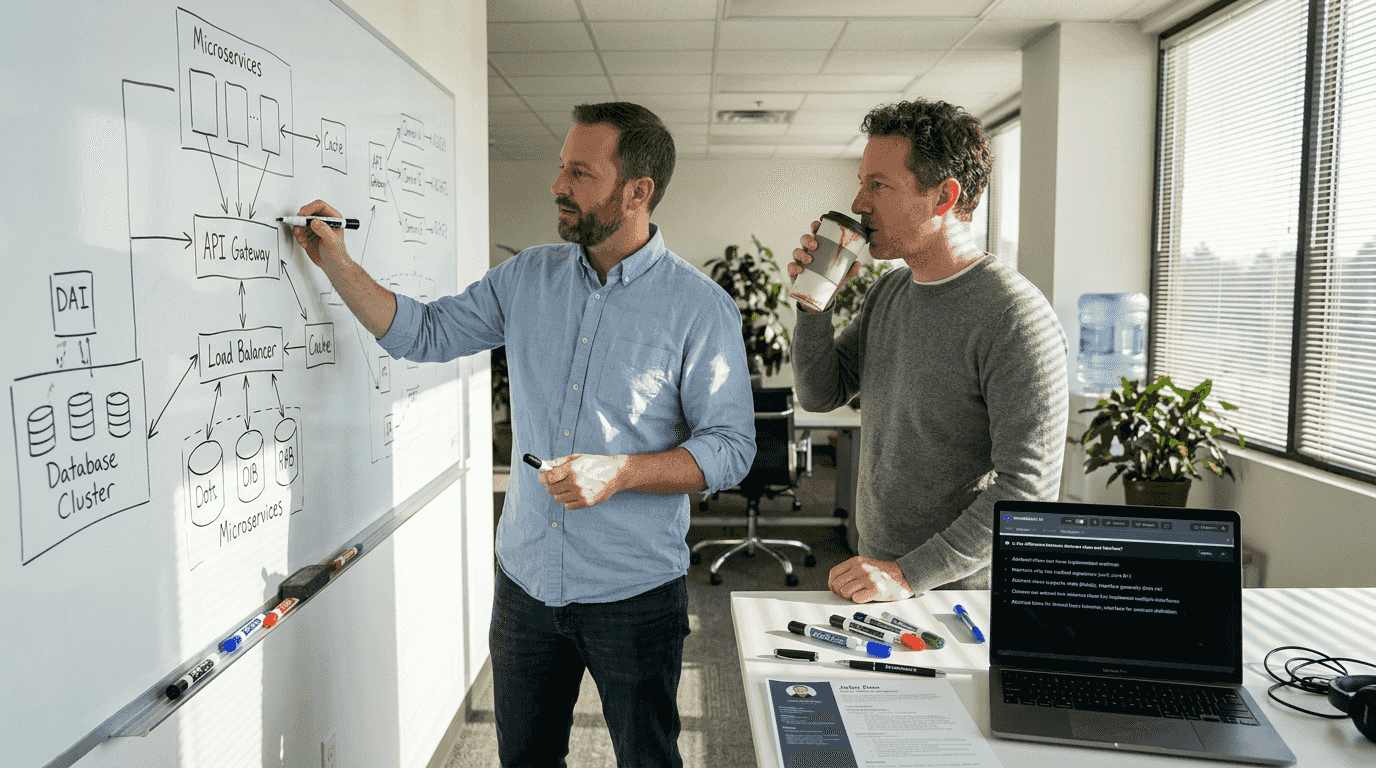
Unlike coding interviews with clear right answers, system design is open-ended and conversational. You’ll receive a vague prompt like “Design Instagram” or “Build a URL shortener,” then spend 45-60 minutes discussing architecture, trade-offs, and scaling strategies. Interviewers probe your decisions with follow-up questions, testing whether you truly understand the systems you’re proposing or simply regurgitating memorized designs.
Failure in system design interviews often stems from a shallow understanding of distributed systems rather than architecture memorization. Common pitfalls include jumping to solutions without clarifying requirements, proposing overly complex architectures for simple problems, or failing to explain why you chose one approach over alternatives. Success requires explaining trade-offs thoughtfully and adapting your design as requirements evolve during the conversation.
“The best system design candidates don’t just draw boxes and arrows. They explain why each component exists, what happens when it fails, and how the system evolves as scale increases.”
Pro Tip: Start every system design interview by spending 5-10 minutes clarifying functional requirements, scale estimates, and constraints. This foundation prevents costly assumptions and shows systematic thinking.
Key system design preparation tactics:
- Study real-world system architectures through engineering blogs from companies like Netflix, Uber, and Facebook
- Practice explaining trade-offs between SQL and NoSQL, synchronous and asynchronous processing, and consistency versus availability
- Draw diagrams by hand to build comfort with visual communication
- Conduct mock interviews where you defend your design choices under questioning
- Learn to estimate capacity, storage, and bandwidth requirements quickly
Explore our system design insights and interview prep resources for deeper preparation guidance.
Behavioral interviews: proving your teamwork and problem-solving skills
Behavioral interviews have evolved from a formality to a critical evaluation component, especially as companies prioritize cultural fit and collaboration skills. Behavioral interviews are growing in importance, focusing on soft skills, communication, and problem-solving. These sessions assess your past experiences, team collaboration style, conflict resolution approach, and leadership potential through structured storytelling.
They are crucial for roles requiring autonomy and leadership. At Meta, behavioral interview guide feedback was key in determining candidate level, especially for senior positions. Typical questions probe how you handled difficult teammates, managed competing priorities, dealt with failure, or influenced decisions without authority. Interviewers listen for specificity, self-awareness, and evidence of growth from past experiences.
Preparation includes reflecting on your career experiences and crafting clear, structured stories using frameworks like STAR (Situation, Task, Action, Result). Identify 6-8 significant experiences covering different themes like leadership, conflict, failure, and technical challenges. For each story, know the context, your specific role, actions you took, and measurable outcomes. Avoid vague generalities or taking credit for team achievements without acknowledging others.
Cultural fit assessment goes beyond answering questions correctly. Interviewers evaluate your communication style, how you handle feedback during the conversation, and whether your values align with company principles. Authenticity matters more than rehearsed perfection. Share genuine challenges and what you learned, even if the outcome wasn’t ideal.
Essential behavioral interview preparation:
- Prepare specific stories covering leadership, teamwork, conflict, failure, and technical decision-making
- Use the STAR framework to structure responses with clear context and outcomes
- Practice delivering stories concisely in 2-3 minutes without rambling
- Research company values and prepare examples demonstrating alignment
- Reflect on lessons learned from each experience to show growth mindset
Our technical program manager tips and interview tips provide frameworks for behavioral excellence.
Comparing technical interview types: formats, focus, and tips
Understanding how different interview types compare helps you allocate preparation time effectively and set appropriate expectations. Technical interviews assess problem-solving, technical skills, and soft skills, differing by format and seniority. The table below summarizes key characteristics, challenges, and preparation recommendations for the three primary interview types.
| Interview Type | Format | Primary Focus | Typical Duration | Common Challenges | Preparation Tactics |
|---|---|---|---|---|---|
| Coding | Live coding, online assessment | Algorithms, data structures, problem-solving | 45-60 minutes | Time pressure, communication while coding, edge cases | Daily practice, mock interviews, pattern recognition |
| System Design | Whiteboard discussion, architecture diagrams | Scalability, trade-offs, distributed systems | 45-60 minutes | Vague requirements, defending choices, depth of knowledge | Study real systems, practice explaining trade-offs, capacity estimation |
| Behavioral | Structured Q&A, storytelling | Past experiences, teamwork, cultural fit | 30-45 minutes | Vague answers, taking undue credit, lack of self-awareness | STAR framework, specific stories, honest reflection |
Balancing study time across different interview types requires honest self-assessment. If you’re strong in coding but weak in system design, allocate more hours to your weakness even though coding practice feels more comfortable. Most candidates should spend roughly 50% of time on coding fundamentals, 30% on system design for mid to senior roles, and 20% preparing behavioral stories and practicing delivery.
Strategies for balanced preparation:
- Create a weekly schedule alternating between interview types to maintain skills across all areas
- Track your performance in mock interviews to identify which format needs more attention
- Join study groups or find practice partners covering different interview types
- Use the first month for fundamentals, the second for integration, and the third for polish and mock interviews
- Adjust your focus based on feedback from practice sessions and actual interviews
Explore our comprehensive interview prep resources, interview tips collection, and interview questions database for targeted practice across all formats.
How MeetAssist supports your technical interview success
Mastering different interview types requires not just preparation but also real-time support when it matters most. MeetAssist offers AI-powered assistance during live technical interviews on Google Meet, Microsoft Teams, and other platforms, providing answer suggestions, coding help, and communication guidance as you navigate challenging questions. The platform supports multiple AI models including GPT-4.1, Claude, Llama, and Cerebras, with customizable answer styles from concise to detailed responses.
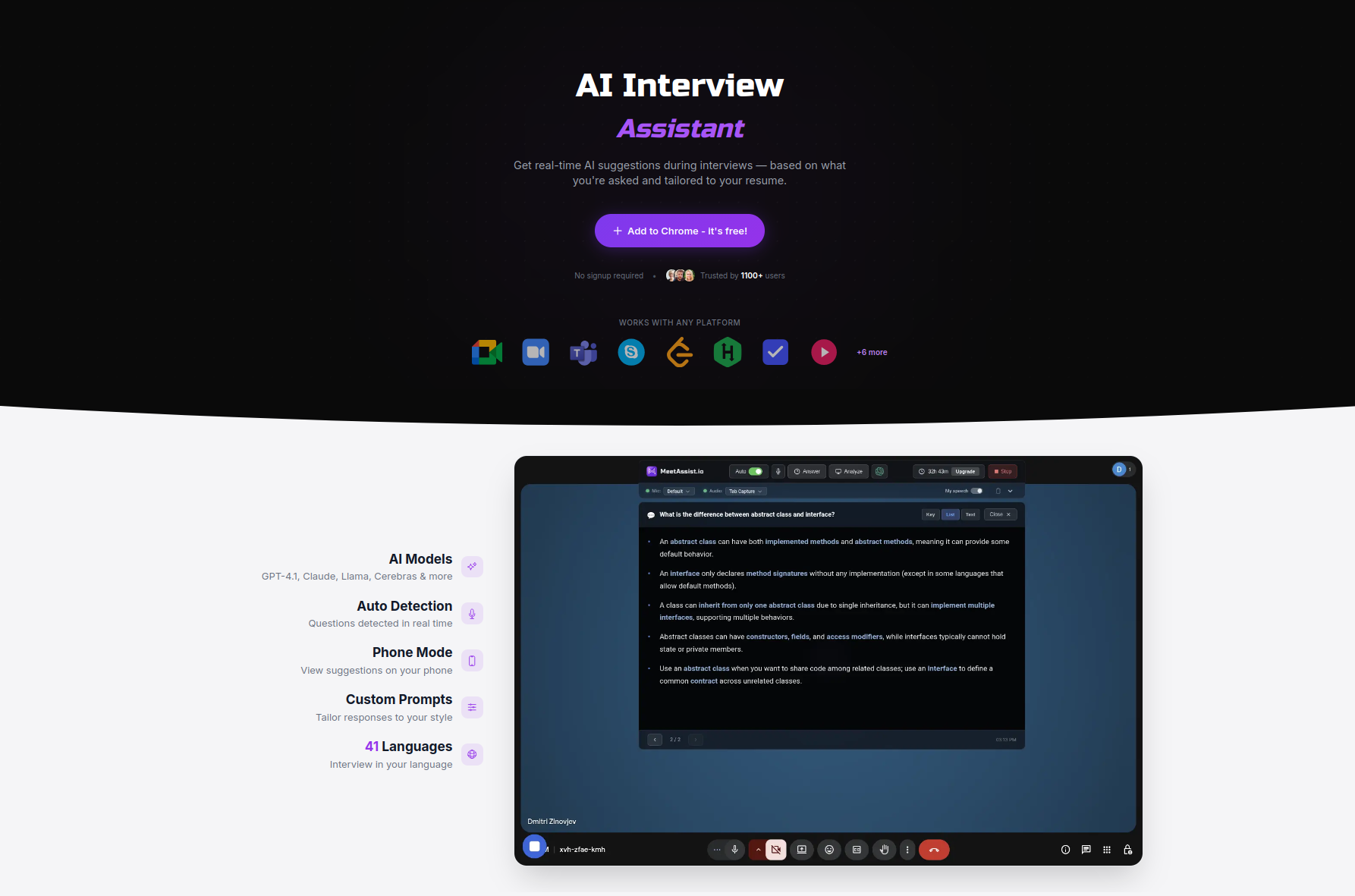
Phone Mode removes the extension from your computer screen entirely, syncing all transcripts and AI suggestions to your phone for invisible assistance. You can also remotely capture and analyze any active Chrome tab, whether it’s a coding challenge, technical assessment, or system design whiteboard. Explore our user guides and phone mode setup to see how MeetAssist complements your preparation and boosts confidence during actual interviews.
Frequently asked questions
What are the most common types of technical interviews?
The three primary types are coding interviews testing algorithms and data structures, system design interviews assessing architectural thinking, and behavioral interviews evaluating soft skills and cultural fit. Some companies also include pair programming sessions, take-home assignments, or live debugging exercises depending on the role and seniority level. Research your target companies through our interview prep resources to understand their specific formats.
How long should I prepare for technical interviews?
Experts recommend about 3 months of focused technical interview practice, roughly 11 hours weekly. Time investment varies by role complexity and your current skill level. Entry-level candidates might need more time building algorithmic foundations, while experienced engineers may focus primarily on system design and behavioral polish. Consistent daily practice beats cramming, so start early and maintain steady progress.
Why are behavioral interviews important in tech hiring?
Behavioral interviews are increasingly emphasized to evaluate communication, problem-solving, and team leadership skills. They assess cultural fit and depth of experience beyond technical ability. For senior and leadership roles, behavioral performance often determines your level and compensation as much as technical interviews. Companies want engineers who collaborate effectively, handle ambiguity, and grow from challenges.
How can I stand out in system design interviews?
Focus on explaining trade-offs clearly and answering follow-up questions thoughtfully rather than rushing to a final design. Success requires demonstrating deep understanding of distributed systems and adapting designs to evolving requirements. Avoid relying solely on memorized architectures. Instead, show how you think through constraints, estimate scale, and make deliberate choices based on specific requirements. Showcase adaptability when interviewers introduce new constraints or scale factors.