

TL;DR:
- Effective coding interview preparation guides requires pattern recognition, deliberate practice, and strategic use of platforms like LeetCode and NeetCode 150. Mastering core data structures and algorithms, practicing under simulated conditions, and maintaining clear communication are essential for success under pressure. Regular mock interviews and honest mistake review build confidence and refine problem-solving fluency, increasing your chances of passing technical assessments.
Walking into a technical interview without a plan feels like taking a road trip with no map. You know the destination, but every wrong turn costs you time and confidence. The good news is that coding interviews are far more predictable than they seem. Key platforms like LeetCode, HackerRank, NeetCode 150, and Tech Interview Handbook have proven that structured preparation works. This guide gives you an actionable checklist built around those patterns, covering the mindset, tools, topics, and techniques that actually move the needle for job seekers preparing for technical assessments.
Table of Contents
- Start with the right mindset and strategy
- Essential platforms and tools for effective practice
- Core topics to master: Data structures and algorithms
- Techniques for real interviews: Process, communication, and timing
- Simulation and review: Practice under real conditions
- A smarter path: What most candidates get wrong in coding challenge prep
- Take your coding interview prep further with MeetAssist
- Frequently asked questions
Key Takeaways
| Point | Details |
|---|---|
| Pattern mastery beats volume | Learning common problem types is more effective than brute-force practice. |
| Top platforms boost results | Sites like LeetCode and HackerRank offer proven practice environments. |
| Communication is key | Thinking aloud and explaining solutions ups your chances of success. |
| Simulate the real thing | Timed practice and mock interviews improve your readiness for the test. |
Start with the right mindset and strategy
Most candidates approach coding interviews the wrong way. They open LeetCode, solve random problems for a few weeks, and hope familiarity kicks in when it counts. That approach leads to plateaus, not progress.
The better foundation is pattern recognition. Interviews are not testing your ability to memorize solutions. They are testing whether you can recognize which tool to reach for when a new problem appears. The coding interview preparation cheatsheet confirms this approach: focusing on 20 patterns can cover roughly 80% of what you will encounter. That is a powerful insight. Instead of solving 500 random problems, you can solve 150 carefully chosen ones and come out ahead.
Deliberate practice means practicing for speed AND accuracy, not one or the other. Set a timer. Push yourself to code a correct solution within a defined window. If you always practice at a relaxed pace, you will freeze during the real thing when a recruiter is watching the clock.
Here is what a strong mindset looks like in practice:
- Treat every wrong answer as a data point, not a failure
- After each problem, write down why you got stuck and what pattern it belonged to
- Review your notes from the previous week before starting new problems
- Focus on communication during solo practice by narrating your thinking out loud
“Preparation is not about covering everything. It is about covering the right things deeply enough that you can apply them under pressure.”
For a structured walkthrough of how to handle coding problems during a live session, the guide on step-by-step challenge answers is worth bookmarking. If you are building your full interview roadmap, the article on preparation steps for success pairs well with this checklist.
Pro Tip: Keep a dedicated “mistakes log” in a spreadsheet. Record the problem name, the pattern it belongs to, your mistake, and the correct approach. Reviewing this log once a week is more effective than solving five new problems.
One more mindset shift worth making: stop measuring progress by problem count. Measure it by pattern fluency. Can you identify a sliding window problem in under 30 seconds? Can you immediately set up a BFS traversal without looking up the template? That fluency is what separates candidates who pass from those who get stuck.
Essential platforms and tools for effective practice
Once you know how to approach preparation, the right tools keep you working efficiently rather than just hard. The coding preparation platforms that top candidates rely on each serve a different purpose, and combining them strategically is smarter than sticking to just one.
| Platform | Best for | Difficulty range | Unique value |
|---|---|---|---|
| LeetCode | Real company questions | Easy to Hard | Largest problem library, company-tagged problems |
| HackerRank | Broad topic coverage | Beginner to Advanced | Certifications, diverse domains |
| NeetCode 150 | Pattern-based practice | Easy to Hard | Curated set with video explanations |
| Tech Interview Handbook | Frameworks and strategy | All levels | Free cheatsheets, behavioral prep |
Each platform has a distinct role in your prep workflow. LeetCode is your main training ground. Its filtering by company, topic, and frequency lets you target exactly what your target employer tends to ask. If you are interviewing at a FAANG company, sort by frequency and work through the top 75 problems tagged to that company first.

HackerRank works well for candidates earlier in their journey or switching domains. Its structured skill tracks cover everything from SQL and Python to data structures and system design basics, making it a useful diagnostic tool.
NeetCode 150 is arguably the most efficient starting point if you have limited time. The curated 150 problems are grouped by pattern and come with video walkthroughs that explain the reasoning, not just the code. This is exactly the deliberate practice model we discussed in the previous section.
Beyond problem platforms, your toolkit should include:
- A local code editor like VS Code for writing and testing solutions offline
- A spreadsheet (Google Sheets works fine) for tracking progress and mistakes
- A timer app to enforce realistic time limits per problem
- An AI-powered coding interview tool when you want real-time analysis of your problem-solving approach
Pro Tip: Spend the first two weeks on NeetCode 150 to build pattern fluency, then shift to company-tagged LeetCode problems in the final two weeks before your interview. This sequence moves you from concept to application efficiently.
Core topics to master: Data structures and algorithms
The platforms offer hundreds of topics, but a focused list gets you 80% of the way there. The 20 LeetCode patterns that cover the vast majority of interview questions center on a core set of data structures and algorithms. Master these, and you will recognize most problems on sight.
| Topic | Why it matters | Example problem type |
|---|---|---|
| Arrays and strings | Foundation of almost everything | Two Sum, Anagram detection |
| Hash maps | Fast lookups, deduplication | Grouping, counting, caching |
| Trees and graphs | Common in FAANG, system modeling | Binary search tree traversal |
| Two pointers | Efficient linear scanning | Palindrome check, sorted array ops |
| Sliding window | Substring and subarray problems | Longest substring without repeat |
| BFS and DFS | Graph and tree traversal | Shortest path, connected components |
| Dynamic programming | Optimization under constraints | Coin change, longest subsequence |
| Binary search | Sorted data, optimization | Search in rotated array |
Each of these categories contains a handful of recognizable templates. When you internalize those templates, you stop staring at a blank screen and start asking “which pattern does this belong to?”
Here is how to prioritize based on interview frequency:
- Arrays, strings, and hash maps appear in nearly every interview at every level
- Trees and graphs dominate mid-to-senior level technical rounds
- Dynamic programming shows up less often but carries high signal when it does
- BFS and DFS problems are almost guaranteed in any interview involving grids or networks
For guidance on approaching these problems during the actual interview, the article on answering code challenges covers the execution mechanics in detail.
One surprising insight many candidates miss: the same underlying pattern can appear in very different problem descriptions. A sliding window problem about substrings looks nothing like a sliding window problem about stock prices on the surface. But the template is identical. That is exactly why pattern recognition beats problem memorization every time.
Techniques for real interviews: Process, communication, and timing
Knowing the patterns is necessary. Using them effectively under pressure, while someone watches, is a different skill. This section is about translating your preparation into real interview performance.
The interview mechanics that consistently work follow a predictable sequence:
- Clarify the problem. Restate the question in your own words. Ask about edge cases: empty inputs, negative numbers, very large datasets. This step signals confidence and prevents wasted time.
- Explore approaches out loud. Start with the brute force solution. Name it, explain its complexity, then explain why you would refine it. Interviewers value the thought process as much as the answer.
- Code clearly. Use meaningful variable names. Add brief comments for non-obvious logic. Write code that a reader can follow, not just code that runs.
- Test with examples. Walk through your code manually with the provided example, then with an edge case you identified in step one.
- Analyze complexity. State the time and space complexity of your final solution. This shows you understand the trade-offs, not just the mechanics.
Communicating throughout the process is equally important. Think aloud at every stage. When you receive a hint, say “that’s helpful, let me think about how that applies here” rather than going silent. When you make a mistake, catch it yourself before the interviewer does and walk through your correction.
A few communication habits worth building:
- Practice narrating your thought process during solo sessions at home
- Record yourself solving a problem and listen back for long silences or unclear explanations
- Use precise language: say “O(n log n) time complexity” rather than “pretty fast”
- When stuck, state what you know and what you are trying to figure out rather than going quiet
For a deeper look at what interviewers actually observe during different formats, the guides on technical interview types and technical assessments provide useful context. For broader real-time performance strategies, the collection of AI interview tips is worth exploring.
“The candidate who communicates well while solving a medium problem often outperforms the candidate who solves a hard problem in silence.”
Timing also matters in ways most candidates underestimate. During a 45-minute live interview, spending 20 minutes clarifying and planning before writing a single line of code is not excessive. Rushing to code without a clear plan almost always leads to backtracking, which burns more time and signals disorganization.
Simulation and review: Practice under real conditions
After mastering your plan and know-how, consistent execution under real conditions is what closes the gap between preparation and performance.
Follow this weekly simulation structure:
- Schedule timed problem sets. Block 45-minute windows per problem, matching the real interview pace recommended by preparation guides. No pausing, no looking things up mid-problem.
- Run mock interviews 2-3 times per week. Use platforms like Pramp or Interviewing.io, or practice with a peer. The social pressure of someone watching changes how you perform in ways solo practice cannot replicate.
- Conduct structured reviews after every session. Go back through every problem you attempted. For ones you solved, ask whether you took the most efficient path. For ones you did not solve, identify the specific point where you got stuck.
- Update your mistakes log. Add new entries after each session and review old ones at the start of your next session. This creates a feedback loop that accelerates improvement.
Pro Tip: Record one mock interview per week on video. Watch it back with the sound off first to observe your body language and screen behavior, then with sound to evaluate your communication. Most candidates are surprised by how many silent gaps they leave.
The goal of simulation is to make the real interview feel familiar. When the actual session starts, your nervous system should recognize the format, the pacing, and the type of thinking required. Surprises are what cause freezes. Repetition is what builds calm.
For additional structured interview prep resources that cover both technical and behavioral components, MeetAssist maintains a growing library of practical guides tailored to candidates at every stage.
A smarter path: What most candidates get wrong in coding challenge prep
Here is the uncomfortable reality: most candidates who fail technical interviews prepared for weeks. They solved hundreds of problems. They reviewed solutions and watched explanation videos. And they still did not pass.
The issue is almost never lack of effort. It is lack of direction.
Candidates who grind through 400 problems without categorizing them or reviewing their mistakes are building surface familiarity, not real fluency. They recognize problems they have seen before but freeze on anything slightly different. That is not preparation. That is memorization with extra steps.
The candidates who consistently perform well in technical interviews share three habits. First, they build muscle memory around patterns by practicing the same template across multiple problems until the setup is automatic. Second, they verbalize every solution, even during solo practice, because the act of explaining sharpens understanding and prepares them for the communication demands of a real interview. Third, they review honestly. They do not move on after a failed problem. They sit with it, understand it at the conceptual level, and categorize it correctly.
There is also a subtler issue: most candidates do not practice failing gracefully. In a real interview, you will hit walls. A question will feel unfamiliar, or you will take a wrong turn halfway through. How you recover from that moment matters enormously to the interviewer. Candidates who have practiced communicating under uncertainty handle those moments with composure. Those who have only practiced clean solutions fall apart.
The candidates who use smart tools for interviews strategically, not as shortcuts but as feedback mechanisms, tend to identify their weak patterns faster. That faster feedback loop compounds over time into a meaningful performance advantage.
Take your coding interview prep further with MeetAssist
If you have built your preparation checklist and are ready to put it into practice with sharper tools behind you, MeetAssist was designed for exactly this moment.
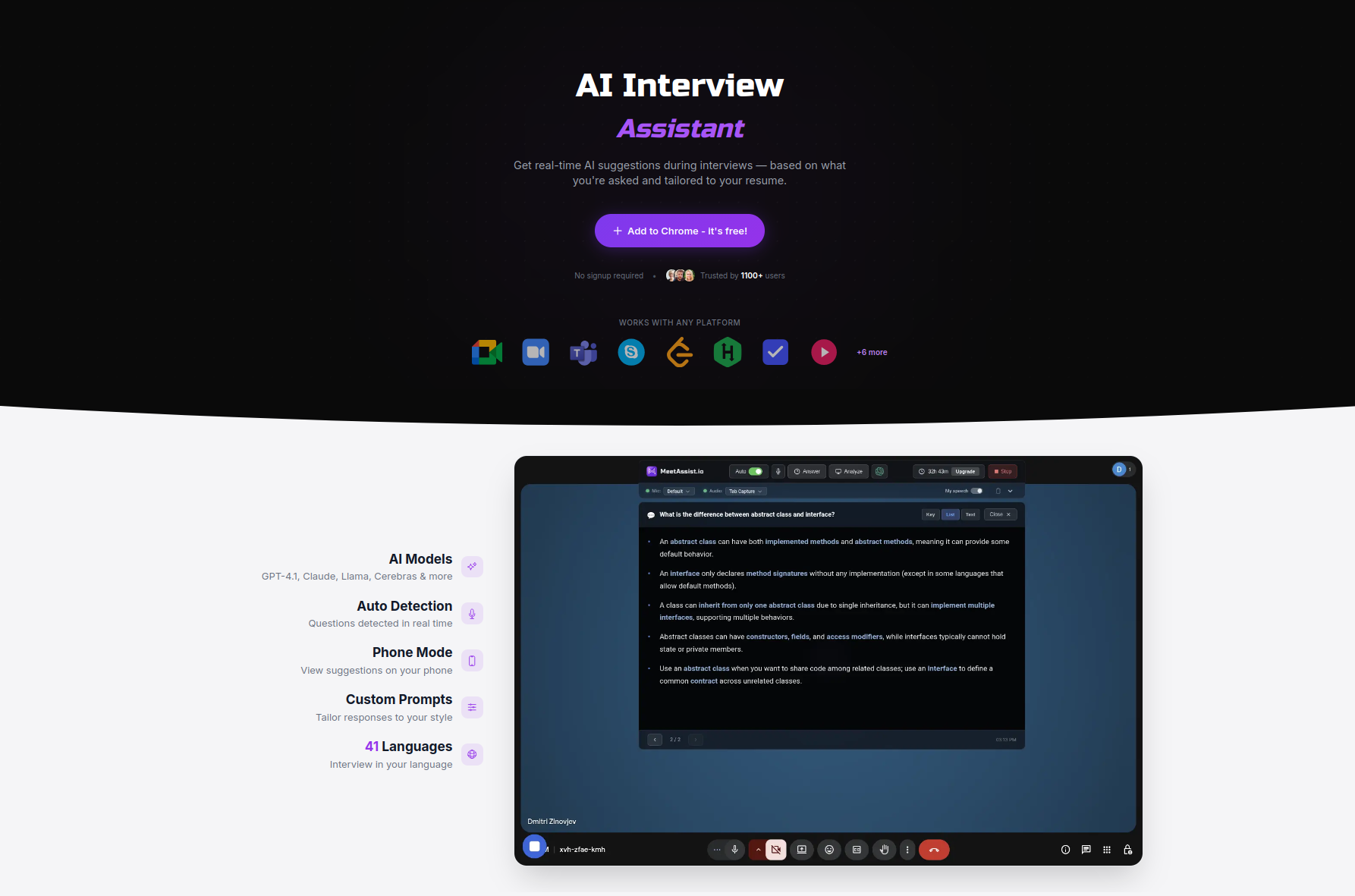
MeetAssist is a Chrome extension that listens in real time during technical interviews and generates AI-powered suggestions based on what is being asked. Its Phone Mode is particularly useful for technical assessments: after scanning a QR code, the extension moves entirely to your phone. You can remotely analyze any active Chrome tab, including live coding challenges, without anything visible on your computer screen. Explore the full range of AI interview tool alternatives or walk through setup and features in the MeetAssist guides to see how it fits your prep workflow.
Frequently asked questions
How many coding problems should I practice before interviews?
Quality matters more than quantity. Mastering around 20 common patterns can cover roughly 80% of problems you will face in real coding interviews.
What is the best programming language for coding interviews?
Python is the most popular choice because of its concise syntax and readability. According to interview preparation guides, consistency matters most, so pick one language and master it rather than switching between multiple.
How should I structure my answer during a technical interview?
Follow the standard mechanics: clarify the question, explore brute force and optimal approaches, code cleanly, test with edge cases, and analyze your complexity at the end.
How often should I do mock interviews?
Aim for 2-3 mock interviews per week leading up to your target interview date. This frequency builds both skill and comfort with the social dynamics of a live technical assessment.